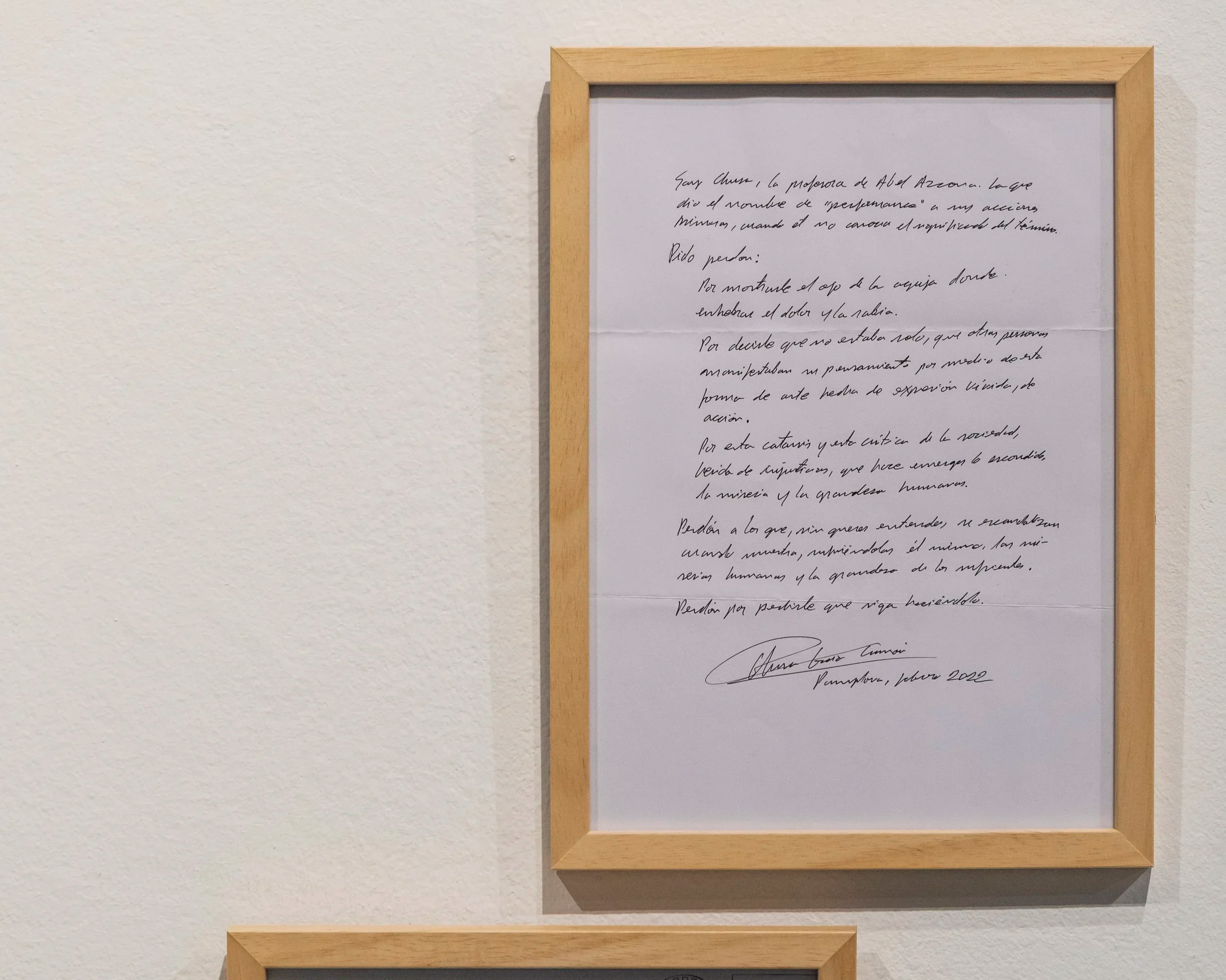
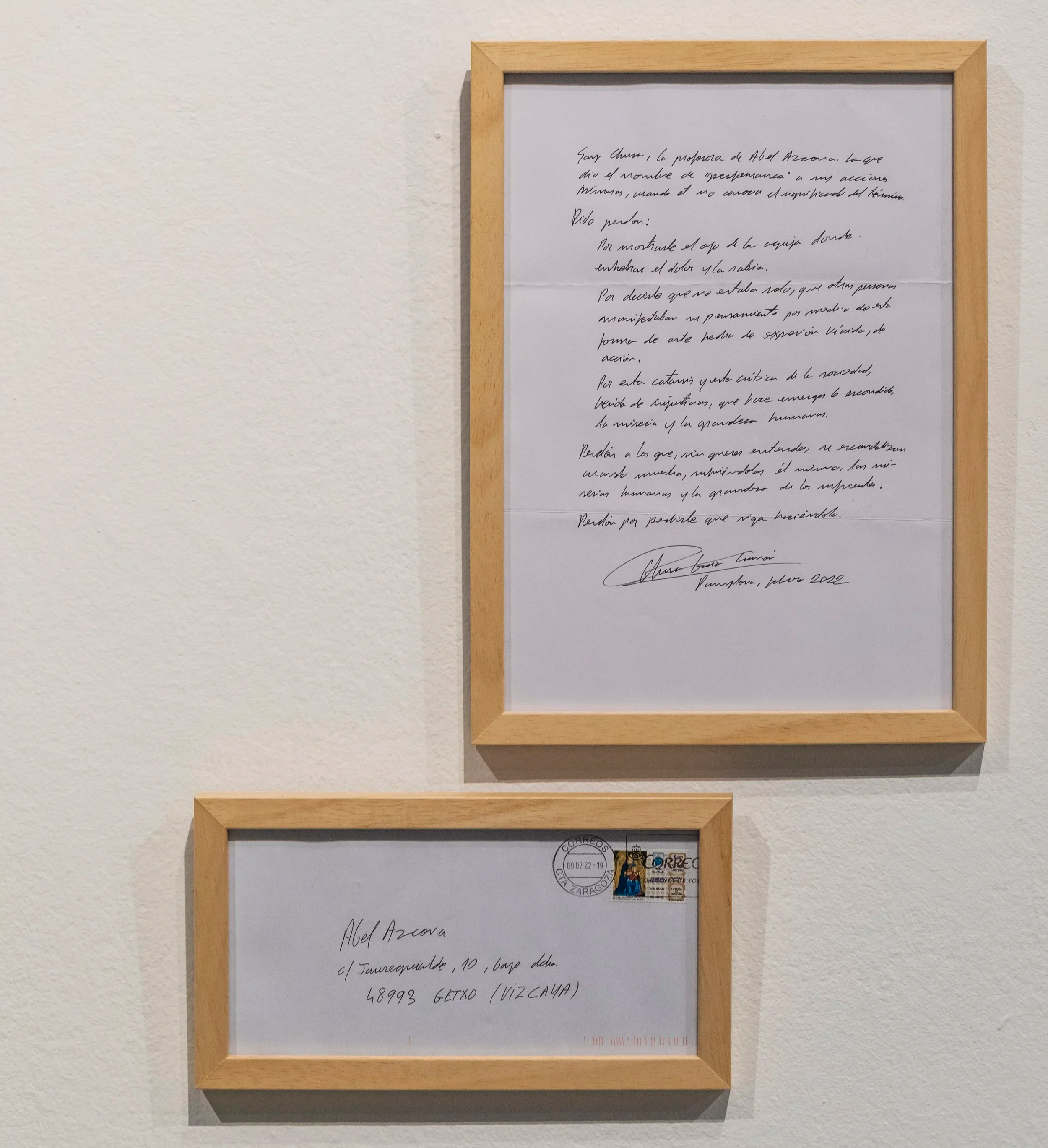
Forgiveness is a handwritten letter that Chus García, an Art History teacher, wrote to Abel Azcona in 2022. It describes what could be considered his first artistic action, carried out in 2005. In the letter, García asks forgiveness “for showing him the eye of the needle through which to thread pain and rage.” This image—the eye of the needle—refers to a narrow and demanding passage through which suffering can become artistic action. Forgiveness thus alludes to the revelation of a decisive tool: art, conceived as a means of confronting the world and oneself without mediation or refuge.
The action carried out in 2005, following a period of psychiatric hospitalization, interrupted the everyday order of the city of Pamplona through the exposure of the artist’s naked, vulnerable, and fully present body. This inaugural gesture did not pursue scandal as an objective, but accepted it as the consequence of making visible what had remained hidden. The body, traversed by the experience of psychic pain, ceased to be a representation and became an act: an embodied gesture unfolding in public space as a performative practice of presence and resistance. In this context, Azcona articulated one of the fundamental gestures of his practice: the possibility of channeling internal forces—pain, rage, fragility, and memory—and transforming them into a conscious, shared, and potentially reparative act. Here, art does not act as a suppression of pain, but as a structure that makes it possible to move through it.
By transforming the letter into a work of art, Azcona shifts an intimate act into the public sphere and activates it as an artistic device. The piece is not presented as a closed object, but as an element that will continue to resonate throughout his career. The letter speaks of the first time that action was named as “performance.” To name is to open a channel, to inaugurate a possibility. Here, naming means inscribing a bodily experience within a symbolic and theoretical framework, allowing it to be read as an artistic practice and as a form of knowledge.
Within the history of performance art, numerous artists have conceived of the body as an archive of the wound and as a space of resistance, among them Pepe Espaliú, Marina Abramović, and Regina José Galindo. From practices based on extreme passivity in order to reveal the violence inscribed in the gaze of the other, to those that resort to repetition, physical endurance, or prolonged exposure as strategies for addressing trauma, performance has constituted a territory in which suffering is not instrumentalized as an aesthetic resource, but translated into critical awareness. Azcona’s work is part of this tradition, but shifts it toward an intimate and relational dimension, in which pain is activated as a shared experience rather than as an object of exhibition. From his earliest actions, the artist has understood artistic practice as a strategy for survival.
Action art, as practiced by Azcona, does not seek to represent the wound, but to inhabit it. Its reparative potential lies in the production of meaning where fragmentation previously existed. It does not eliminate pain, but transforms it into language. For the artist, the creative act functions as a mechanism for organizing chaos and as a form of containment in the face of imminent collapse. For the viewer, the work acts simultaneously as a mirror and an indication: a sign that this passage has already been undertaken and that, therefore, it is possible.
Action art also raises a reflection on the responsibility of art within a social context marked by injustice, violence, and exclusion. Showing human misery does not constitute a cynical gesture, but an ethical position oriented toward truth. It implies pointing to the collective need to make visible what has been relegated. In a society that tends to conceal psychic suffering and stigmatize fragility, the exposure of pain acquires a political dimension. Violence does not lie in showing the wound, but in imposing its invisibility.
Likewise, Forgiveness emphasizes the importance of not moving through pain alone. When art emerges from lived experience and from the exposed body, it becomes a space of accompaniment and mutual recognition, where pain is shared without mediation or instrumentalization, fragility is articulated as strength, and acts of creation and observation operate as performative practices of resistance and care. In that narrow passage to which the letter refers, art does not offer a promise of salvation, but rather the fundamental possibility of passing through it accompanied.
Antonio Toca
Industrial engineer, art historian, and art collector (AT Collection)
El perdón es una carta manuscrita que Chus García, profesora de Historia del Arte, escribió a Abel Azcona en 2022. En ella se describe lo que podría considerarse su primera acción artística, realizada en 2005. En la carta, García pide perdón «por mostrarle el ojo de la aguja donde enhebrar el dolor y la rabia». Esta imagen —el ojo de la aguja— remite a un pasaje estrecho y exigente a través del cual el sufrimiento puede devenir en acción artística. El perdón alude, así, a la revelación de una herramienta decisiva: el arte, concebido como medio para confrontar el mundo y a uno mismo sin mediaciones ni refugios.
La acción realizada en 2005, tras un periodo de internamiento psiquiátrico, supuso una interrupción del orden cotidiano de la ciudad de Pamplona mediante la exposición del cuerpo desnudo, vulnerable y plenamente presente del artista. Este gesto inaugural no perseguía el escándalo como objetivo, sino que lo asumía como consecuencia de visibilizar aquello que permanecía oculto. El cuerpo, atravesado por la experiencia del dolor psíquico, dejó de ser representación para convertirse en acto: un gesto encarnado que se desplegaba en el espacio público como práctica performativa de presencia y resistencia. En este contexto, Azcona articuló uno de los gestos fundamentales de su práctica: la posibilidad de canalizar fuerzas internas —dolor, rabia, fragilidad y memoria— y transformarlas en un acto consciente, compartido y potencialmente reparador. El arte no actúa aquí como supresión del dolor, sino como una estructura que permite atravesarlo.
Al convertir la carta en obra, Azcona desplaza un acto íntimo hacia el ámbito público y lo activa como dispositivo artístico. La pieza no se presenta como un objeto cerrado, sino como un elemento que seguirá resonando a lo largo de toda su trayectoria. La carta habla de la primera vez que aquella acción fue nombrada como «performance». Nombrar es abrir un cauce, inaugurar una posibilidad. Aquí, nombrar implica inscribir una experiencia corporal en un marco simbólico y teórico, permitiendo leerla como práctica artística y como forma de conocimiento.
En el marco de la historia del arte de la performance, numerosos artistas han concebido el cuerpo como archivo de la herida y como espacio de resistencia, entre ellos Pepe Espaliú, Marina Abramović y Regina José Galindo. Desde prácticas basadas en la pasividad extrema para evidenciar la violencia inscrita en la mirada del otro hasta aquellas que recurren a la repetición, la resistencia física o la exposición prolongada como estrategias para abordar el trauma, la performance ha constituido un territorio en el que el sufrimiento no se instrumentaliza como recurso estético, sino que se traduce en conciencia crítica. La obra de Azcona se inscribe en esta tradición, pero la desplaza hacia una dimensión íntima y vincular, en la que el dolor se activa como experiencia compartida y no como objeto de exhibición. Desde sus primeras acciones, el artista ha entendido la práctica artística como una estrategia de supervivencia.
El arte de acción, tal como lo practica Azcona, no busca representar la herida, sino habitarla. Su potencial reparador reside en la producción de sentido allí donde previamente existía fragmentación. No elimina el dolor, pero lo transforma en lenguaje. Para el artista, el acto creativo funciona como un mecanismo organizador del caos y como una forma de contención ante la inminencia del derrumbe. Para el espectador, la obra actúa simultáneamente como espejo e indicio: señal de que este tránsito ya ha sido realizado y de que, por tanto, es posible.
El arte de acción plantea asimismo una reflexión sobre la responsabilidad del arte en un contexto social marcado por la injusticia, la violencia y la exclusión. Mostrar la miseria humana no constituye un gesto cínico, sino una toma de posición ética orientada hacia la verdad. Implica señalar la necesidad colectiva de visibilizar aquello que ha sido relegado. En una sociedad que tiende a ocultar el sufrimiento psíquico y a estigmatizar la fragilidad, la exposición del dolor adquiere una dimensión política. La violencia no reside en mostrar la herida, sino en imponer su invisibilidad.
Asimismo, El perdón subraya la importancia de no transitar el dolor en soledad. Cuando el arte emerge de la experiencia vital y del cuerpo expuesto, se constituye como un espacio de acompañamiento y reconocimiento mutuo, donde el dolor se comparte sin mediación ni instrumentalización, la fragilidad se articula como potencia y los actos de creación y de observación operan como prácticas performativas de resistencia y cuidado. En ese estrecho pasaje al que alude la carta, el arte no ofrece una promesa de salvación, pero sí la posibilidad —fundamental— de atravesarlo acompañado.
Antonio Toca
Ingeniero industrial, historiador del arte y coleccionista de arte (AT Colección)

“I have never been known for being a particularly cordial, empathetic, or sociable child. During the three years I studied at the School of Art, I found an oasis in a classroom on the first floor, where Art History classes were held. The teacher was always available to talk to me, listen to me, and offer advice. It was with her that I learned more about the disciplines that now define my life. Our trust grew to the point that we even shared tea during breaks. Until her retirement, whenever I visited Pamplona, I would return to the School of Art and we would repeat that ritual. Even today, whenever I open an exhibition in northern Spain, she is there waiting for me at the entrance.”
“I am Chusa, Abel Azcona’s teacher—the one who called his first actions “performance” when he still did not know what the term meant. I ask for forgiveness: For showing him the eye of the needle through which to thread pain and rage. For telling him that he was not alone, that other people also expressed their thoughts through this form of art, made of lived expression and action. For this catharsis and this critique of a society wounded by injustice, which brings the hidden into view, along with human misery and greatness. Forgiveness to those who, unwilling to understand, are scandalized when he reveals—while suffering them himself—human misery and the greatness of those who endure it. Forgiveness for asking him to continue doing so.”
“Nunca me he caracterizado por ser un niño cordial, empático o especialmente sociable. Durante los tres años que estudié en la Escuela de Arte encontré un oasis en un aula de la primera planta, donde se impartían las clases de Historia del Arte. La profesora siempre estaba disponible para hablar, escucharme y aconsejarme. Con ella aprendí más sobre las disciplinas que hoy protagonizan mi vida. Nuestra confianza llegó a ser tal que incluso tomábamos té juntos durante los recreos. Hasta su jubilación, cada vez que visitaba Pamplona regresaba a la Escuela de Arte y repetíamos aquel ritual. Y todavía hoy, cada vez que inauguro una exposición en el norte, ella está esperándome en la puerta.”
“Soy Chusa, la profesora de Abel Azcona, la que llamó «performance» a sus primeras acciones, cuando él todavía no conocía el significado del término. Pido perdón: Por mostrarle el ojo de la aguja donde enhebrar el dolor y la rabia. Por decirle que no estaba solo, que otras personas también manifestaban sus pensamientos a través de esta forma de arte hecha de expresión vivida y de acción. Por esta catarsis y esta crítica de una sociedad herida por las injusticias, que hace emerger lo oculto, la miseria y la grandeza humanas. Perdón a quienes, sin querer entender, se escandalizan cuando muestra —sufriéndolas él mismo— las miserias humanas y la grandeza de quienes las padecen. Perdón por pedirle que siga haciéndolo.”

Forgiveness (2005–2022) is an object-based work composed of a letter written by Chus García, Abel Azcona’s Art History teacher at the Pamplona School of Art. In 2005, following a period of hospitalization in two psychiatric clinics, the artist disrupted traffic on Avenida del Ejército in Pamplona by sitting naked on a chair. This action is considered his first performance. One of his teachers became interested in the event and described it as an artistic piece or performance, awakening Azcona’s interest in the discipline. In 2015, the city of Pamplona dedicated a retrospective exhibition to the artist, featuring a broad selection of his work. On the opening day, the teacher offered him a metaphorical and symbolic apology for having laid the first stone in his understanding of performance, a fundamental tool in his artistic practice. The apology also alluded to the radical and controversial dimension his work would later acquire. Years later, in 2022, that symbolic apology took material form in a letter sent to Azcona’s studio and signed by the teacher herself. The artist transformed the letter into a work of art: an object and, at the same time, the catalyst for a creative process. Work from the AT Collection (Santander).
In 2005, Azcona carried out what critics have considered his first artistic action. Following a period of hospitalization in two psychiatric clinics, he disrupted traffic on Avenida del Ejército in Pamplona by sitting naked on a chair. As a student at the Pamplona School of Art, one of his teachers became interested in the event and described it as an artistic piece or performance, thereby sparking his interest in the discipline. From that moment on, Azcona founded an action art collective made up of thirteen students from the school. Whenever he opened an exhibition in northern Spain, he received a surprise visit from that teacher. This continued until 2015, when the city of Pamplona dedicated a retrospective exhibition to him, featuring a broad selection of his work. On the opening day, the teacher offered him a metaphorical and symbolic apology for having laid the first stone in his understanding of performance, a fundamental tool in his approach to art. This apology can be understood in relation to the radical perspective and controversial dimension that characterize Azcona’s work. Years later, in 2022, the symbolic apology took material form in a letter sent to the artist’s studio and signed by the teacher herself. Azcona transformed the letter into a work of art: an object and, at the same time, the catalyst for his own creative process.
El perdón (2005–2022) es una obra-objeto compuesta por una carta de Chus García, profesora de Historia del Arte de Abel Azcona en la Escuela de Arte de Pamplona. En 2005, tras un periodo de ingreso en dos clínicas psiquiátricas, el artista interrumpió el tráfico en la avenida del Ejército de Pamplona sentado desnudo en una silla. Esta acción es considerada su primera performance. Una de sus profesoras se interesó por el hecho y lo describió como una pieza artística o performance, despertando en Azcona el interés por esta disciplina. En 2015, Pamplona dedicó al artista una exposición retrospectiva con una amplia selección de su obra. El día de la inauguración, la profesora le pidió disculpas, de manera metafórica y simbólica, por haber colocado la primera piedra de su conocimiento sobre la performance, una herramienta fundamental en su práctica artística. La disculpa aludía también a la dimensión radical y polémica que adquiriría su obra. Años después, en 2022, aquella disculpa simbólica tomó forma material en una carta enviada al estudio de Azcona y firmada por la propia profesora. El artista convirtió la carta en una obra: un objeto y, al mismo tiempo, el detonante de un proceso creativo. Obra perteneciente a AT Colección (Santander).
En 2005, Azcona realizó lo que la crítica ha considerado su primera acción artística. Tras un periodo de ingreso en dos clínicas psiquiátricas, interrumpió el tráfico en la avenida del Ejército de Pamplona sentado desnudo en una silla. Como alumno de la Escuela de Arte de Pamplona, una de sus profesoras se interesó por el acontecimiento y lo describió como una pieza artística o performance, despertando así su interés por esta disciplina. A partir de entonces, Azcona fundó un colectivo de artistas de acción formado por trece alumnos de la escuela. Desde aquel momento, cada vez que inauguraba una exposición en el norte de España, recibía la visita sorpresa de aquella profesora. Esta tradición se mantuvo hasta 2015, cuando la ciudad de Pamplona le dedicó una exposición retrospectiva con una amplia selección de su obra. El día de la inauguración, la profesora le pidió disculpas, de manera metafórica y simbólica, por haber colocado la primera piedra de su conocimiento sobre la performance, una herramienta fundamental en su forma de entender el arte. Aquella disculpa puede entenderse en relación con la mirada radical y la dimensión polémica que caracterizan la obra de Azcona. Años después, en 2022, la disculpa simbólica tomó forma material en una carta enviada al estudio del artista y firmada por la propia profesora. Azcona convirtió aquella carta en una obra de arte: un objeto y, al mismo tiempo, el detonante de su propio proceso creativo.