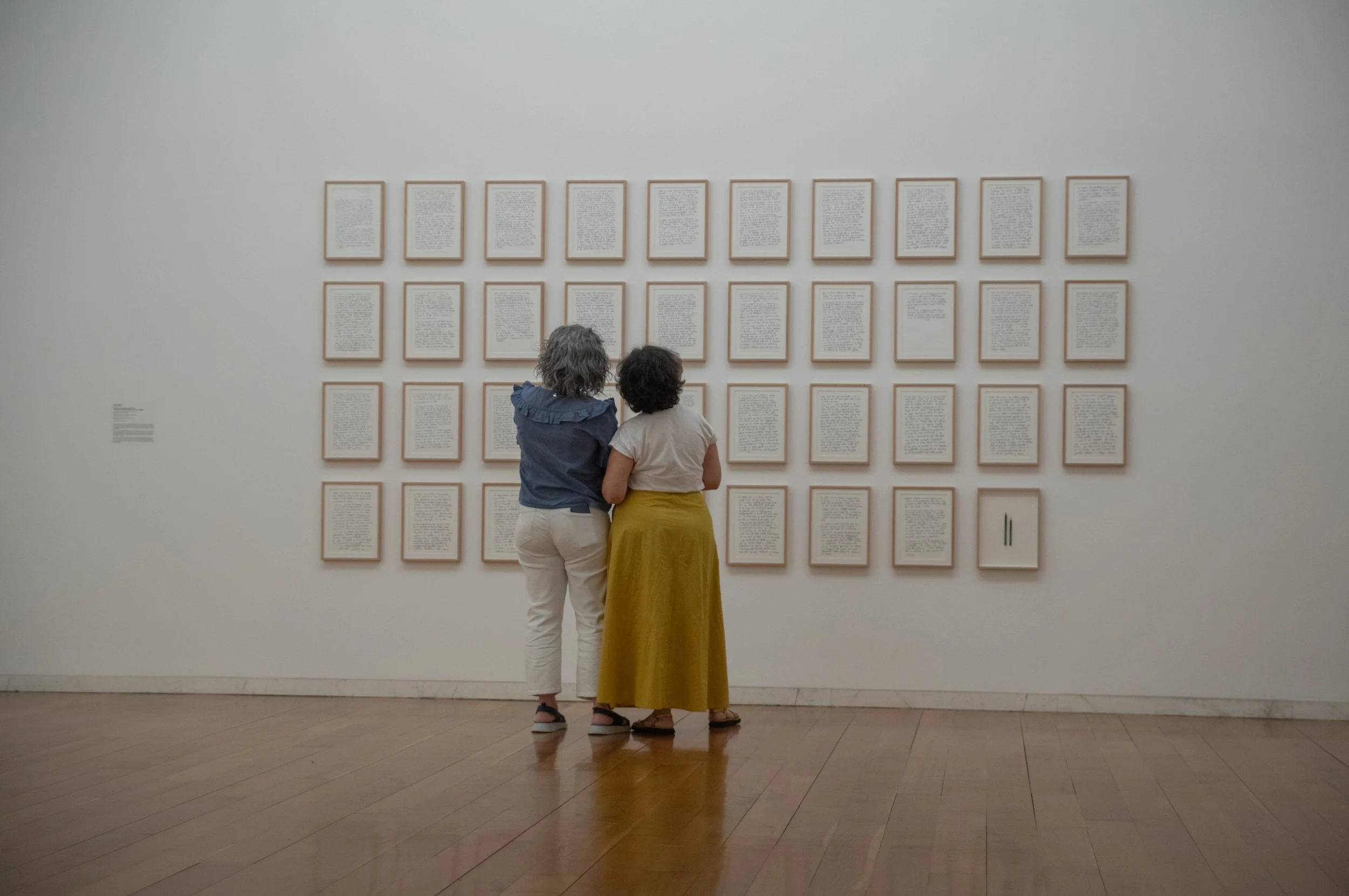
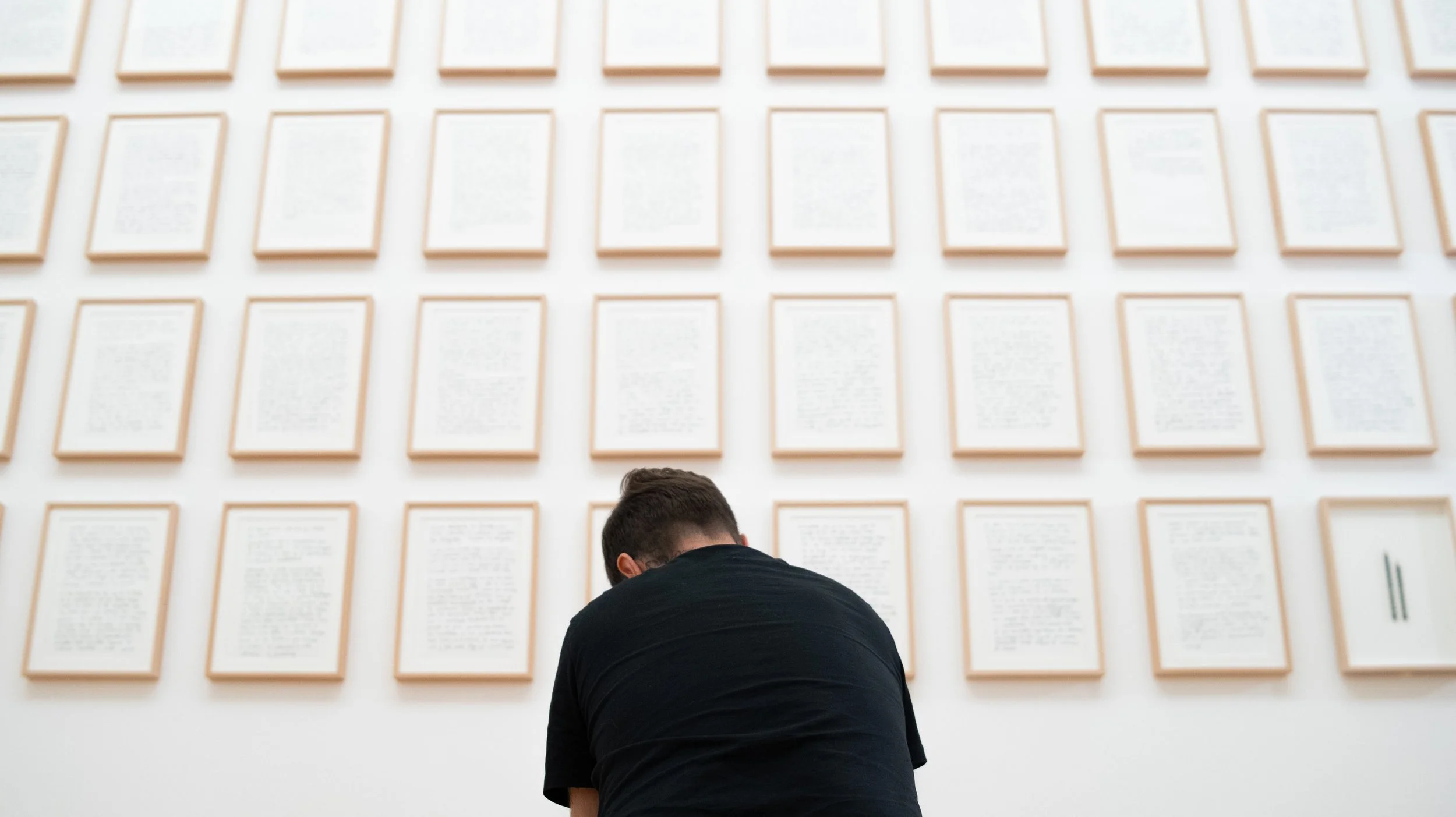
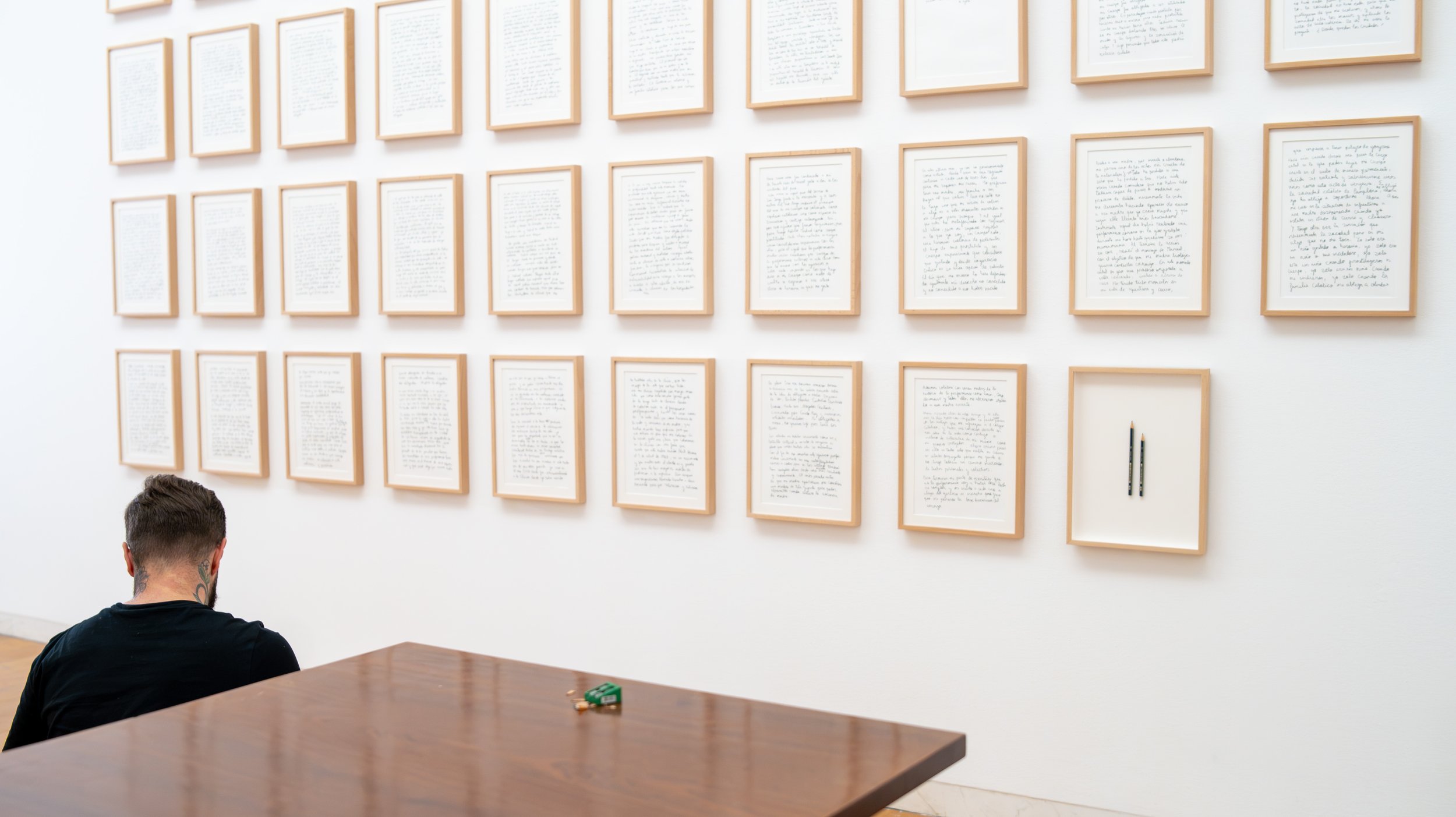
In Largo ensayo a cuerpo presente en torno al derecho a no haber nacido y otras derivas, Abel Azcona offers a deeply personal testimony and transforms writing into a kind of medium through which he transfers his story. The work unfolded in three stages in Santiago de Compostela. The first took place on 16 May 2024, through a twelve-hour performance at A Casa Branca. During the action, Azcona wrote and communicated to the audience, through words, the experience of abandonment, mistreatment, sexual abuse and prostitution to which he was subjected after his biological mother’s wish to have an abortion was not respected. However, this is not a performance about abortion, but about life and its consequences: an action that questions the possibility of non-existence and cries out against censorship, morality, punishment and violated rights. For many of those present, attending the action represented an experience of profound emotional turmoil and, at the same time, an exercise in autobiographical reflection. The second stage, understood by Azcona as part of the performative process, consisted of the agreement to incorporate the work into the permanent collection of the Centro Galego de Arte Contemporánea. This process culminated in its installation and inauguration in the institution’s galleries on 12 June 2026. The third stage took place on 19 September 2026 and consisted of a performative reactivation of the work. Over the course of nine hours, Azcona completely reviewed and rewrote the manuscript displayed in the CGAC collection, once again bringing his body, writing and voice into the institutional space.
En Largo ensayo a cuerpo presente en torno al derecho a no haber nacido y otras derivas, Abel Azcona ofrece, en primera persona, un duro testimonio vital y convierte la escritura en una suerte de médium a través del cual transfiere su relato. La obra se desarrolló en tres etapas en Santiago de Compostela. La primera tuvo lugar el 16 de mayo de 2024, mediante una performance de doce horas en A Casa Branca. Durante la acción, Azcona escribió y comunicó al público, a través de la palabra, la situación de abandono, maltrato, abusos sexuales y prostitución a la que se vio abocado después de que no se respetara la voluntad de abortar de su madre biológica. Sin embargo, no se trata de una performance sobre el aborto, sino sobre la vida y sus derivas: una acción que interroga la posibilidad de no existir y que grita contra la censura, la moral, el castigo y los derechos no respetados. Asistir a la acción supuso, para muchos de los presentes, una experiencia de profunda turbulencia emocional y, al mismo tiempo, un ejercicio de revisión autobiográfica. La segunda etapa, entendida por Azcona como parte del proceso performativo, consistió en el acuerdo para la incorporación de la obra a la colección permanente del Centro Galego de Arte Contemporánea. Este proceso culminó con su inauguración en las salas del centro el 12 de junio de 2026. La tercera etapa tuvo lugar el 19 de septiembre de 2026 y consistió en una reactivación performativa de la obra. Durante nueve horas, Azcona revisó y reescribió íntegramente el manuscrito expuesto en la colección del CGAC, incorporando nuevamente su cuerpo, su escritura y su voz al espacio institucional.

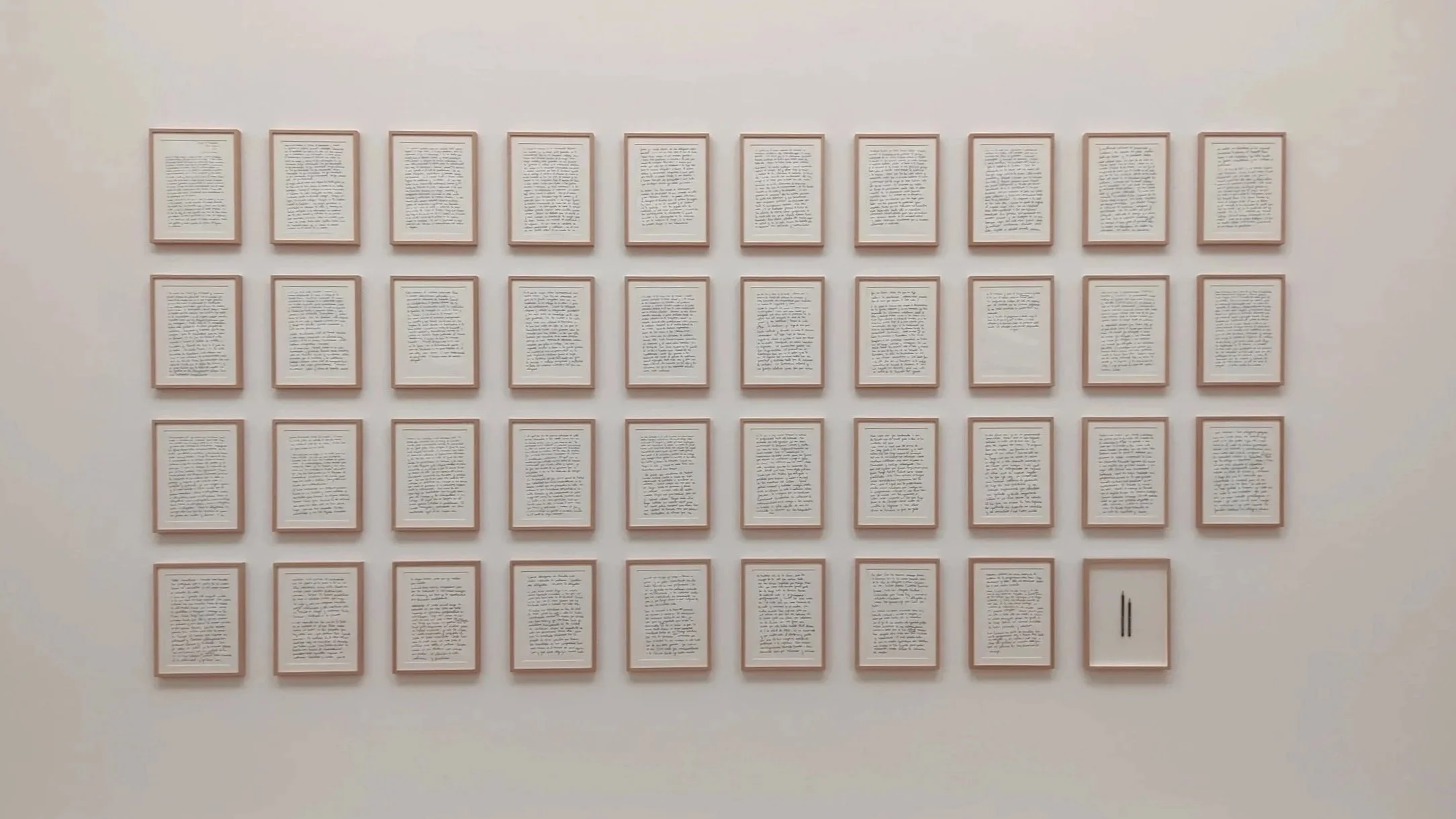
The final piece was acquired and incorporated into the collection of the CGAC Galician Centre for Contemporary Art in 2025, bringing the work’s processual development to a close. / La pieza final fue adquirida e incorporada por el CGAC Centro Galego de Arte Contemporánea en el año 2025 cerrando la obra de manera procesual.

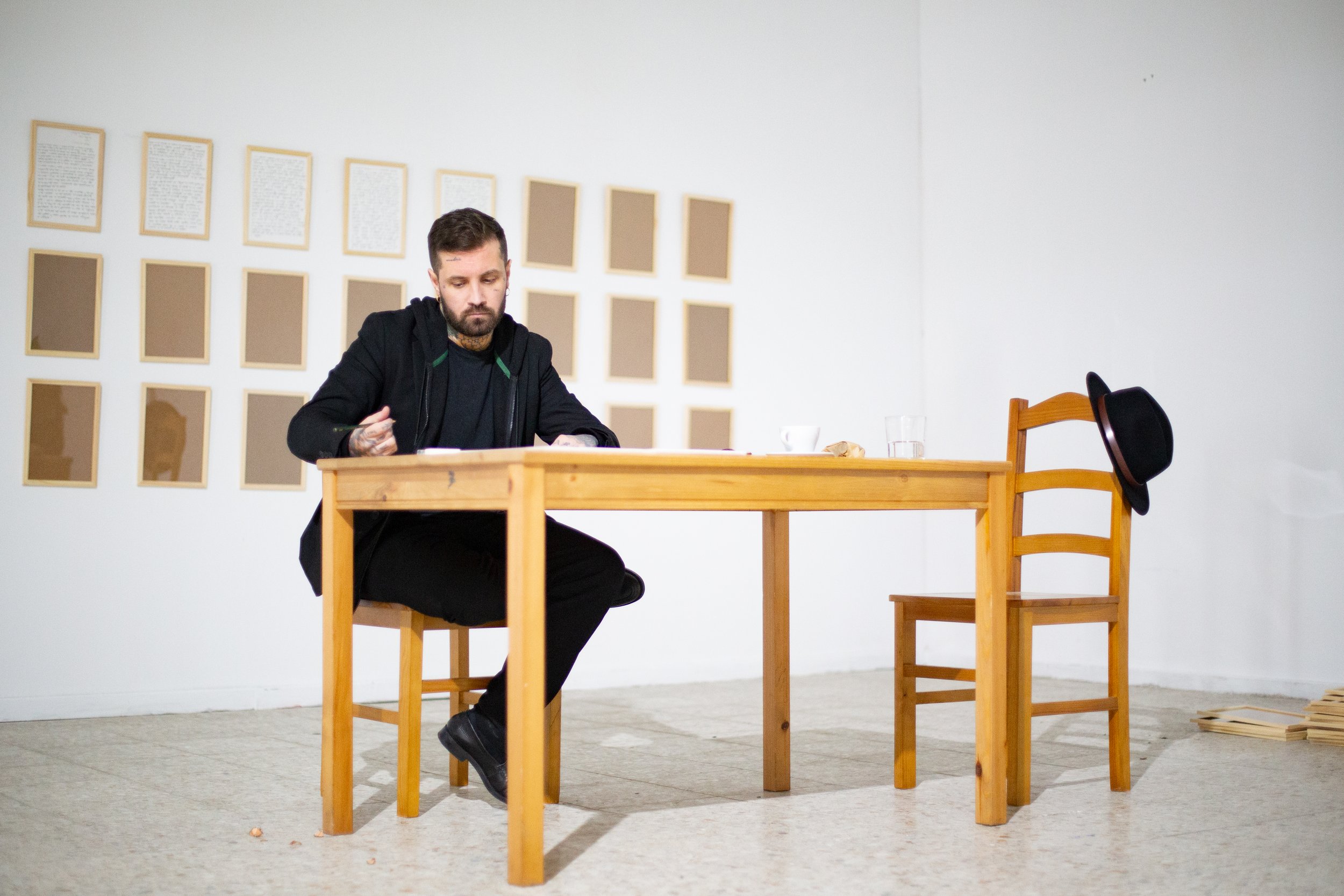


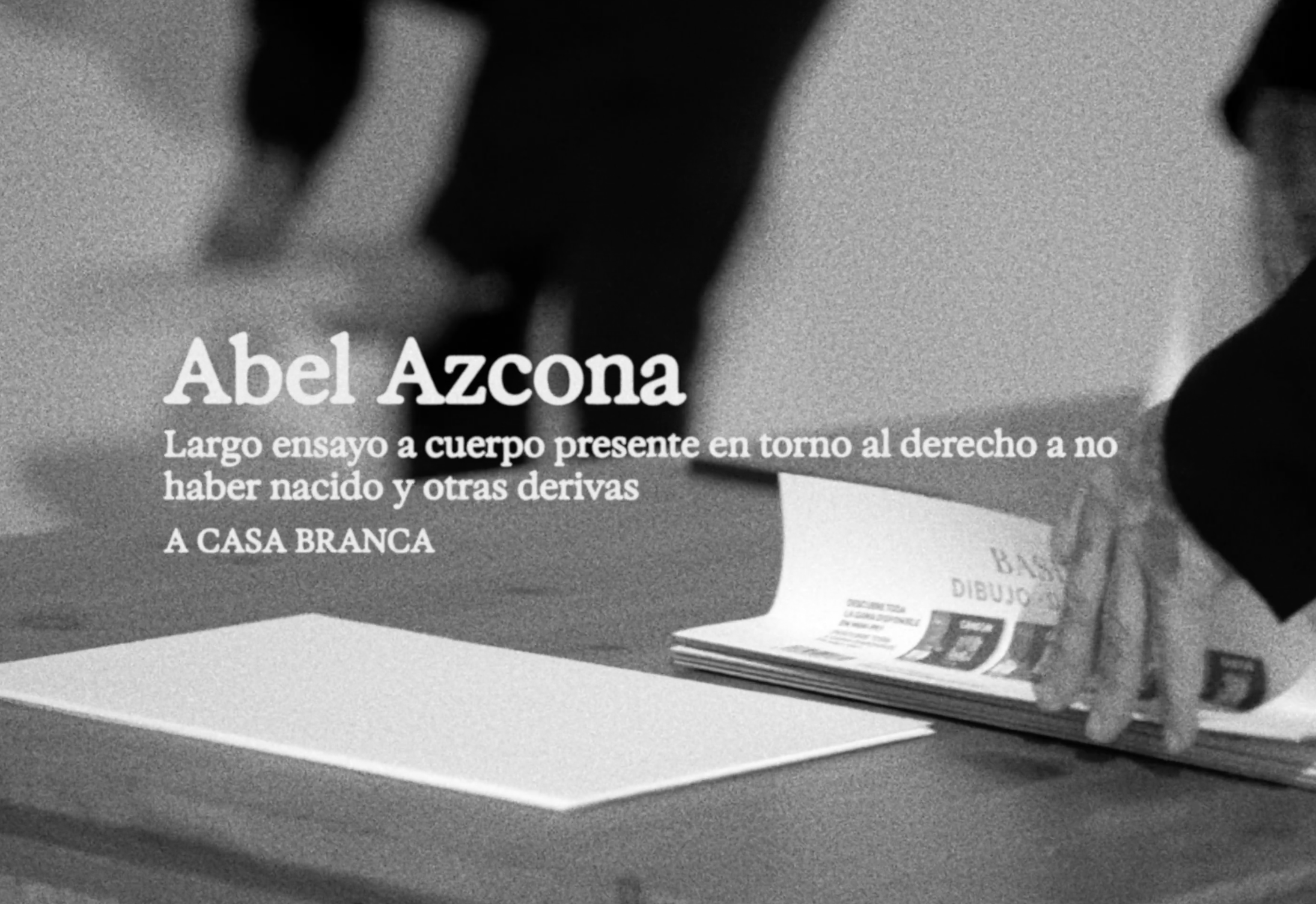
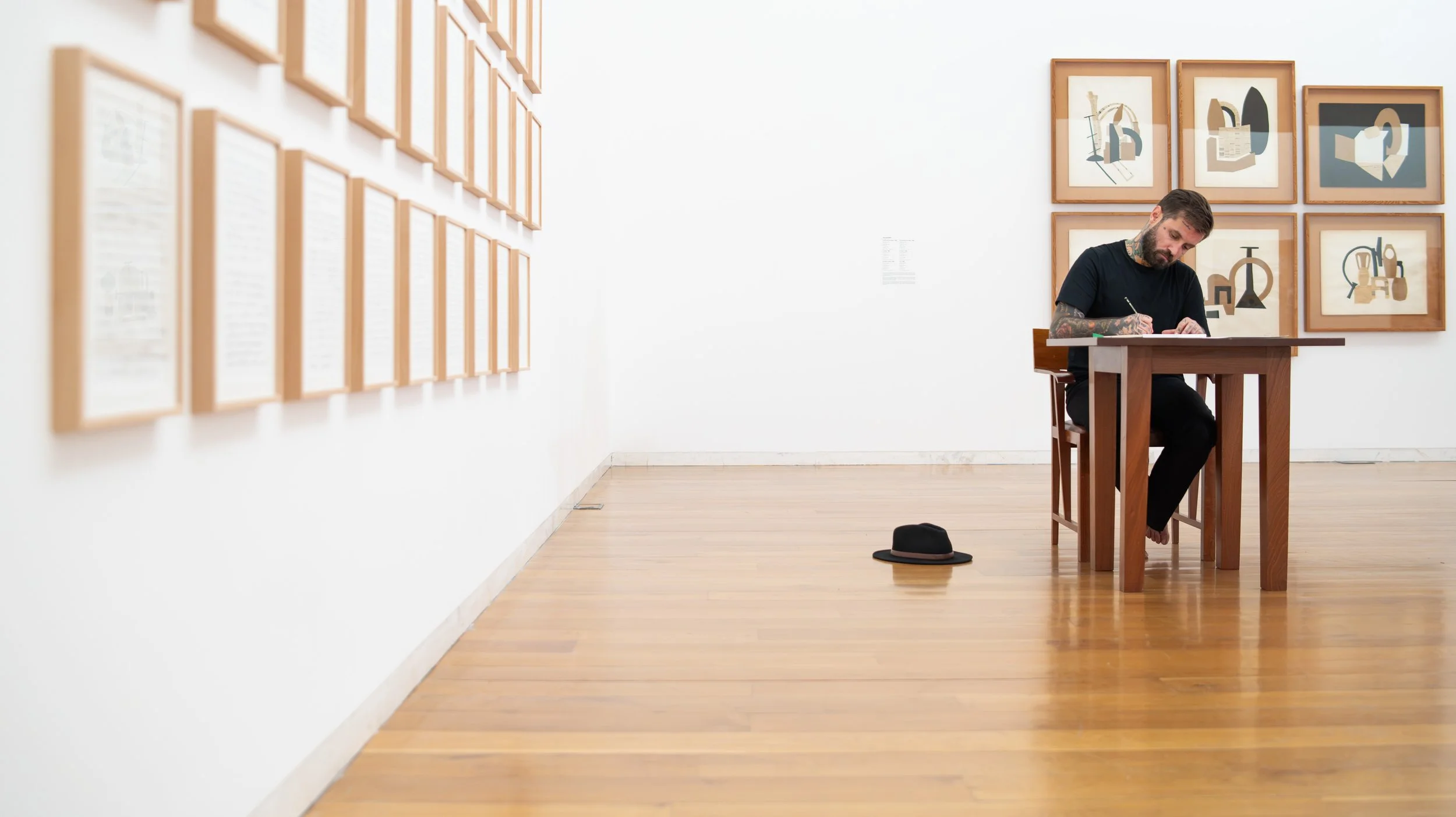
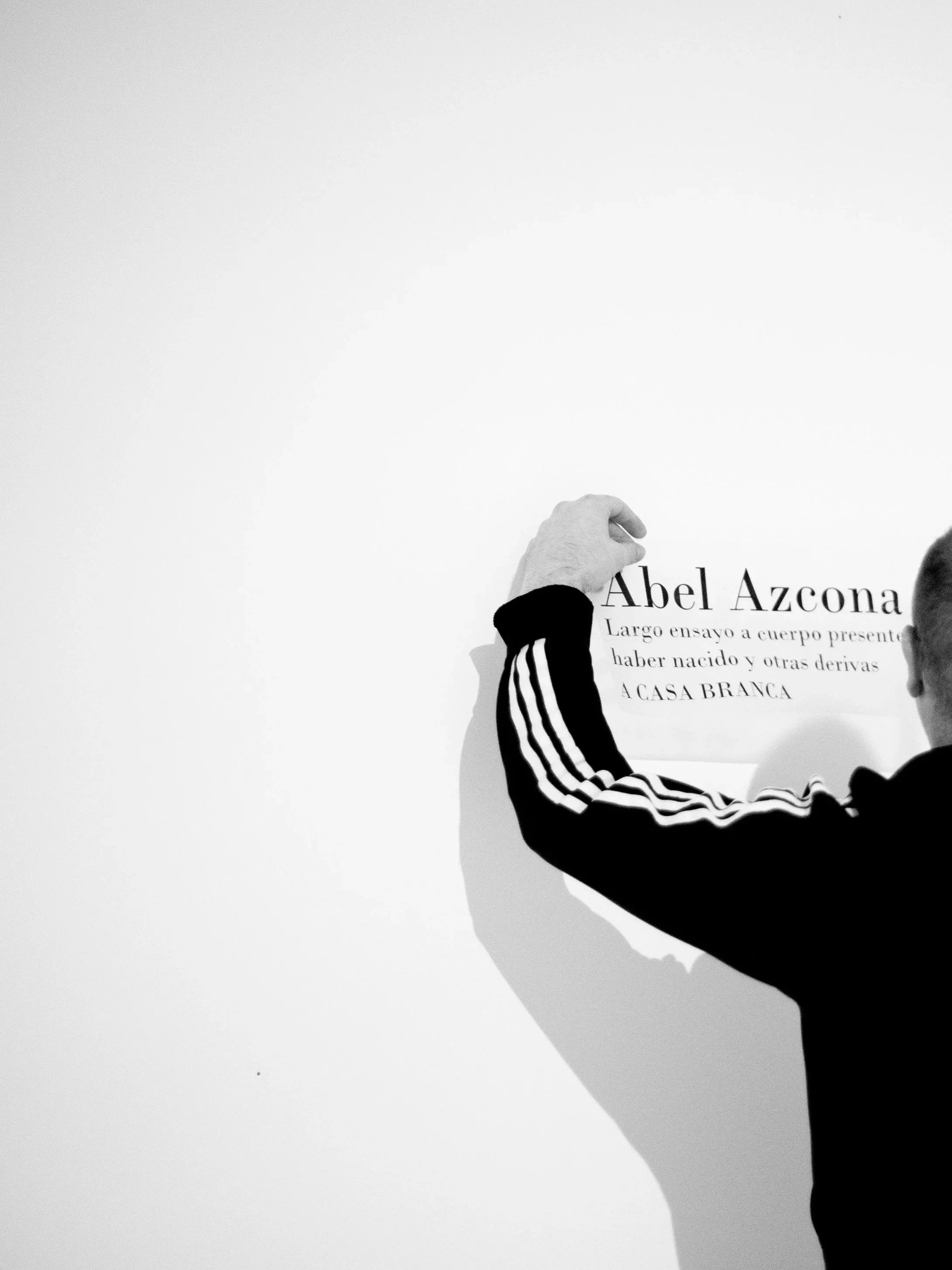
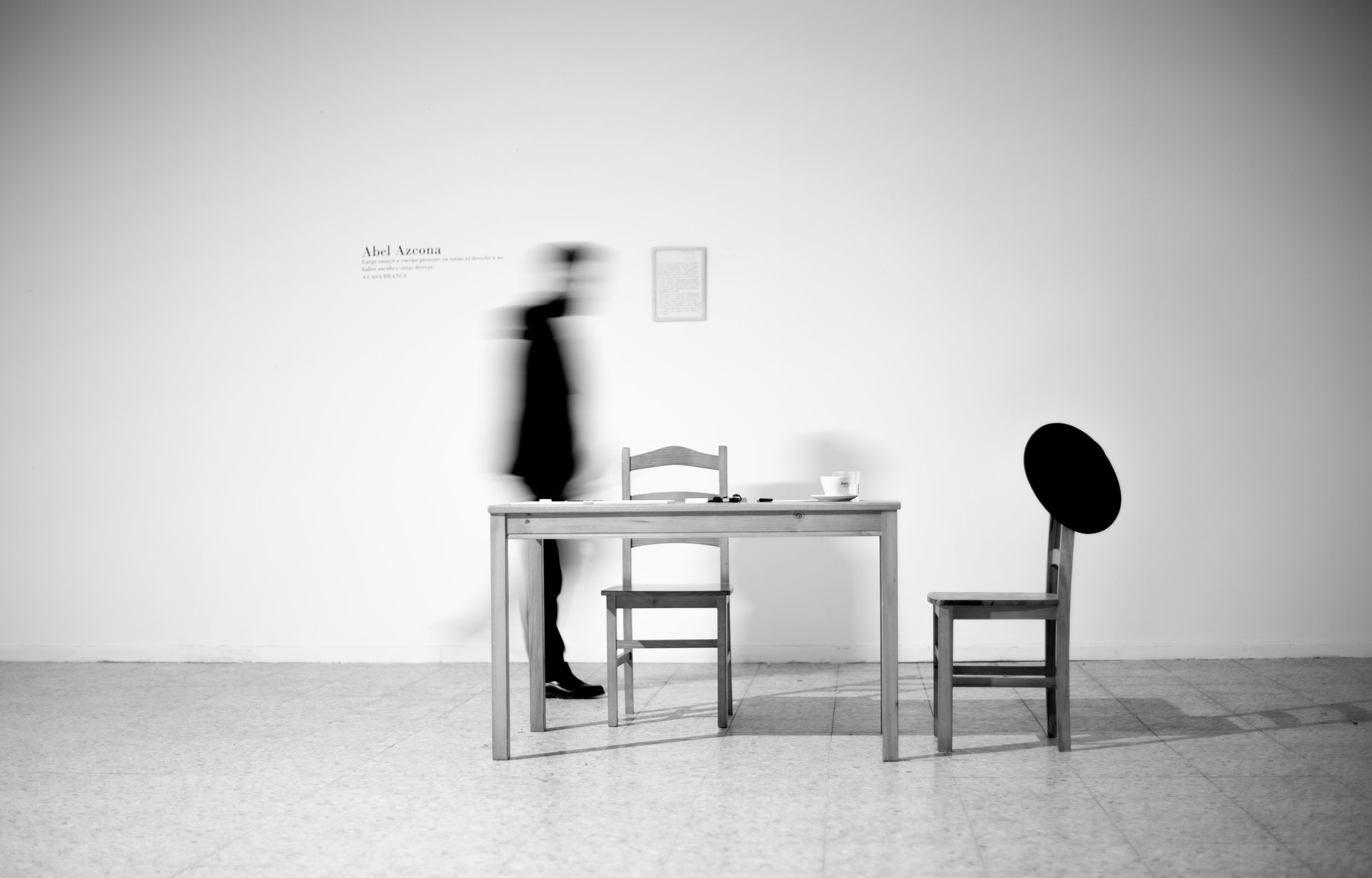
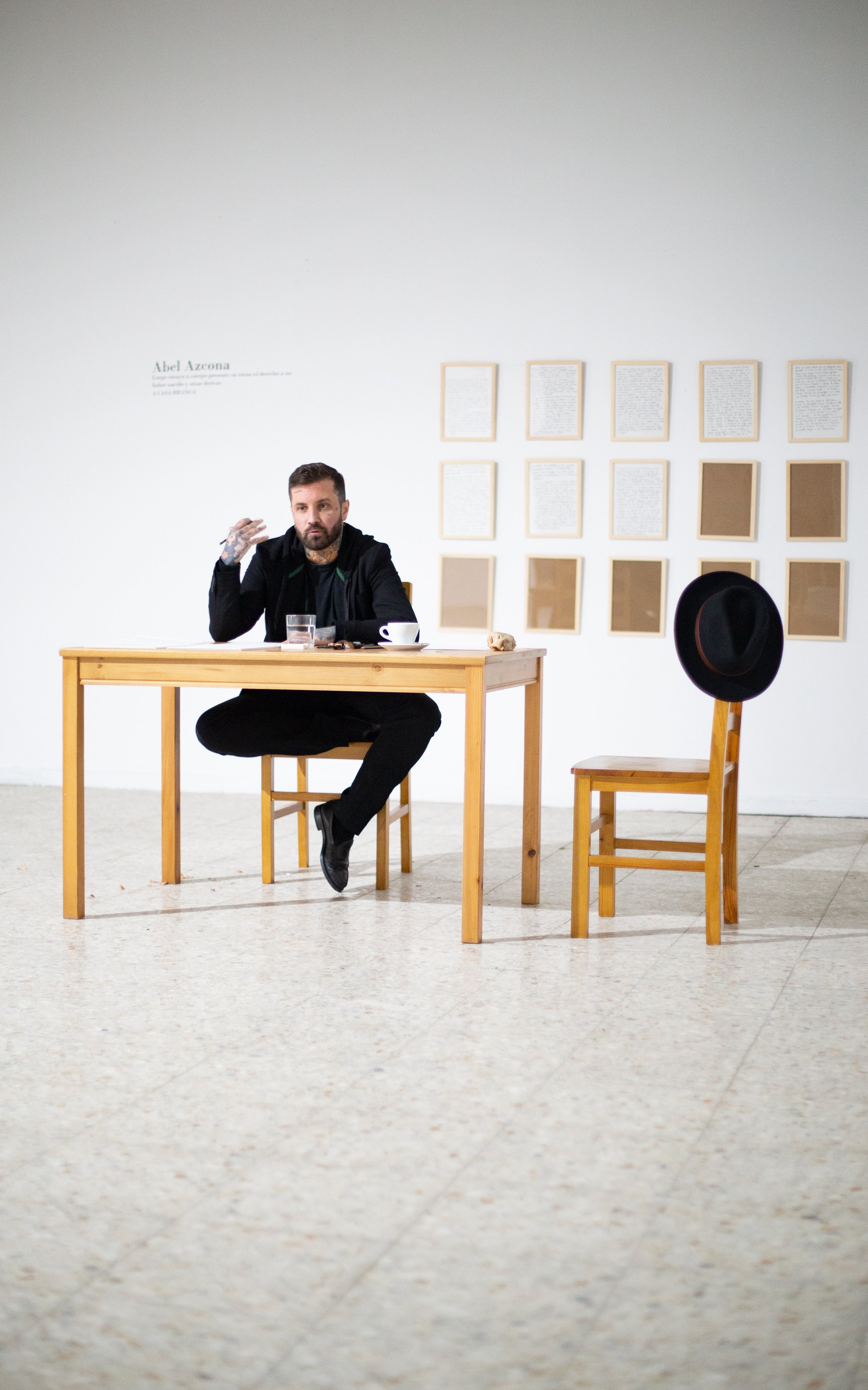
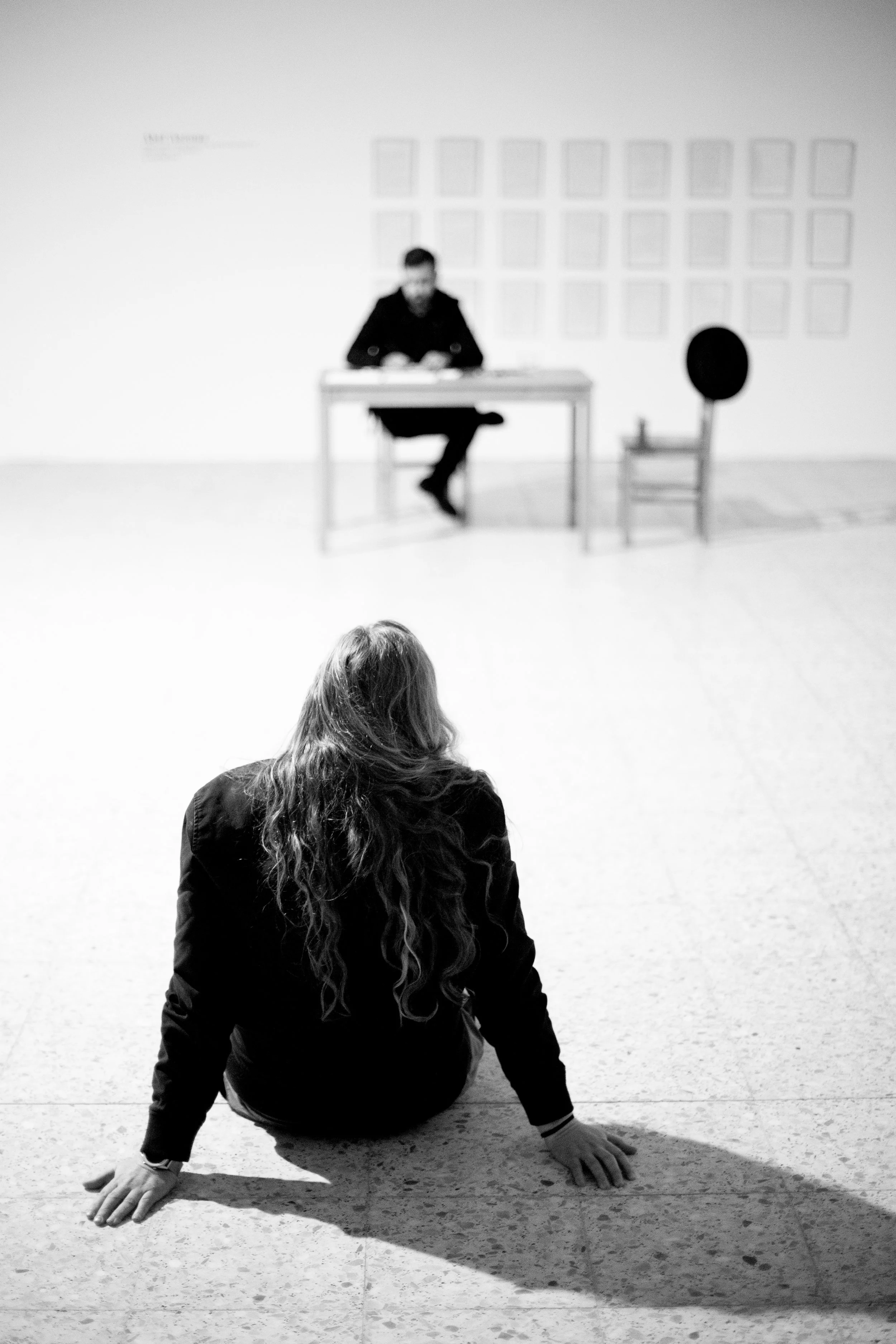
The first stage took place on May 16, 2024, through a twelve-hour performance at A Casa Branca in Santiago de Compostela. Azcona wrote the complete manuscript for the first time while reading it aloud.
La primera etapa tuvo lugar el 16 de mayo de 2024, mediante una performance de doce horas en A Casa Branca en Santiago de Compostela. Azcona escribió por primera vez el manuscrito completo mediante lo leía en voz alta.
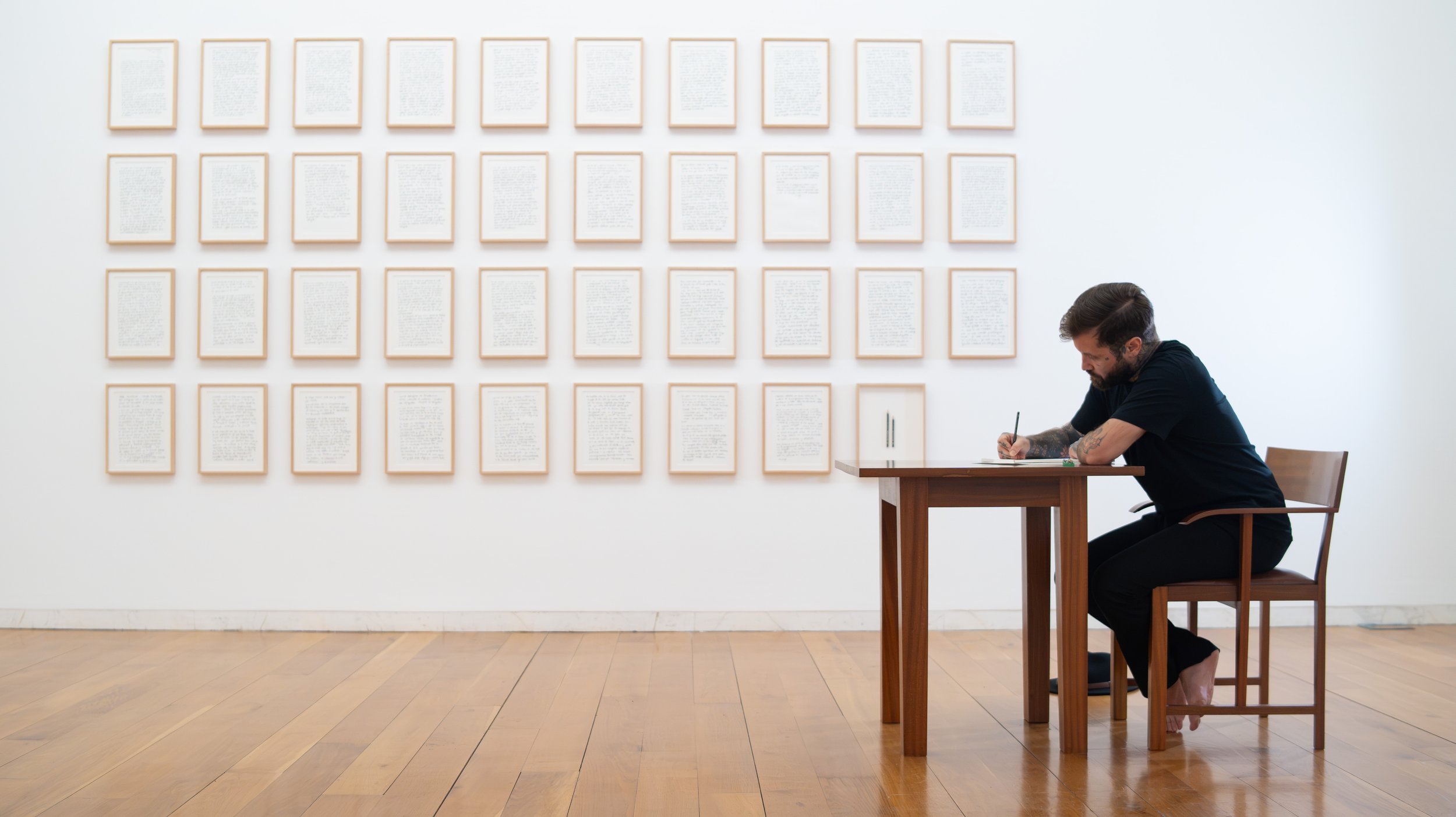

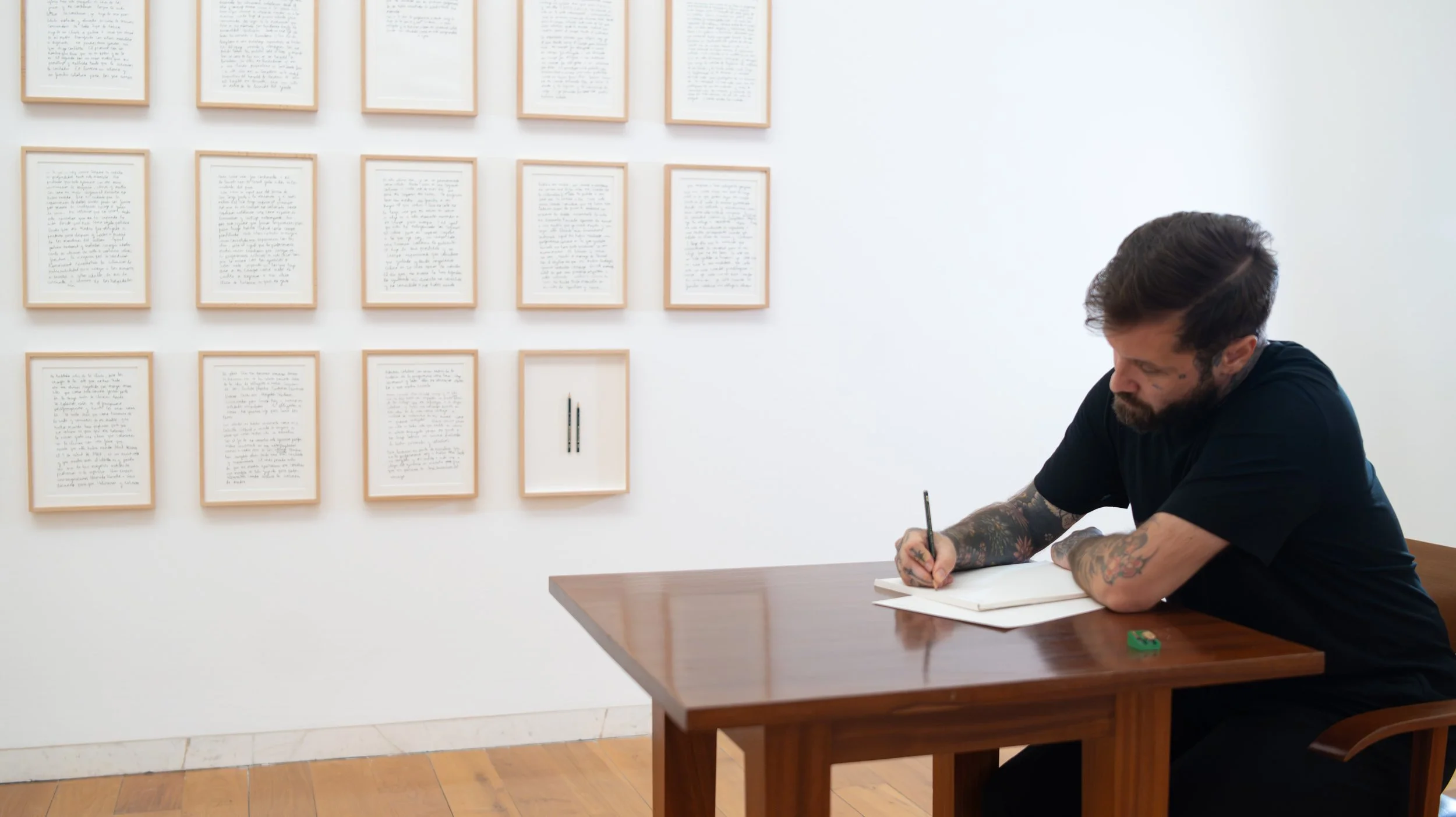


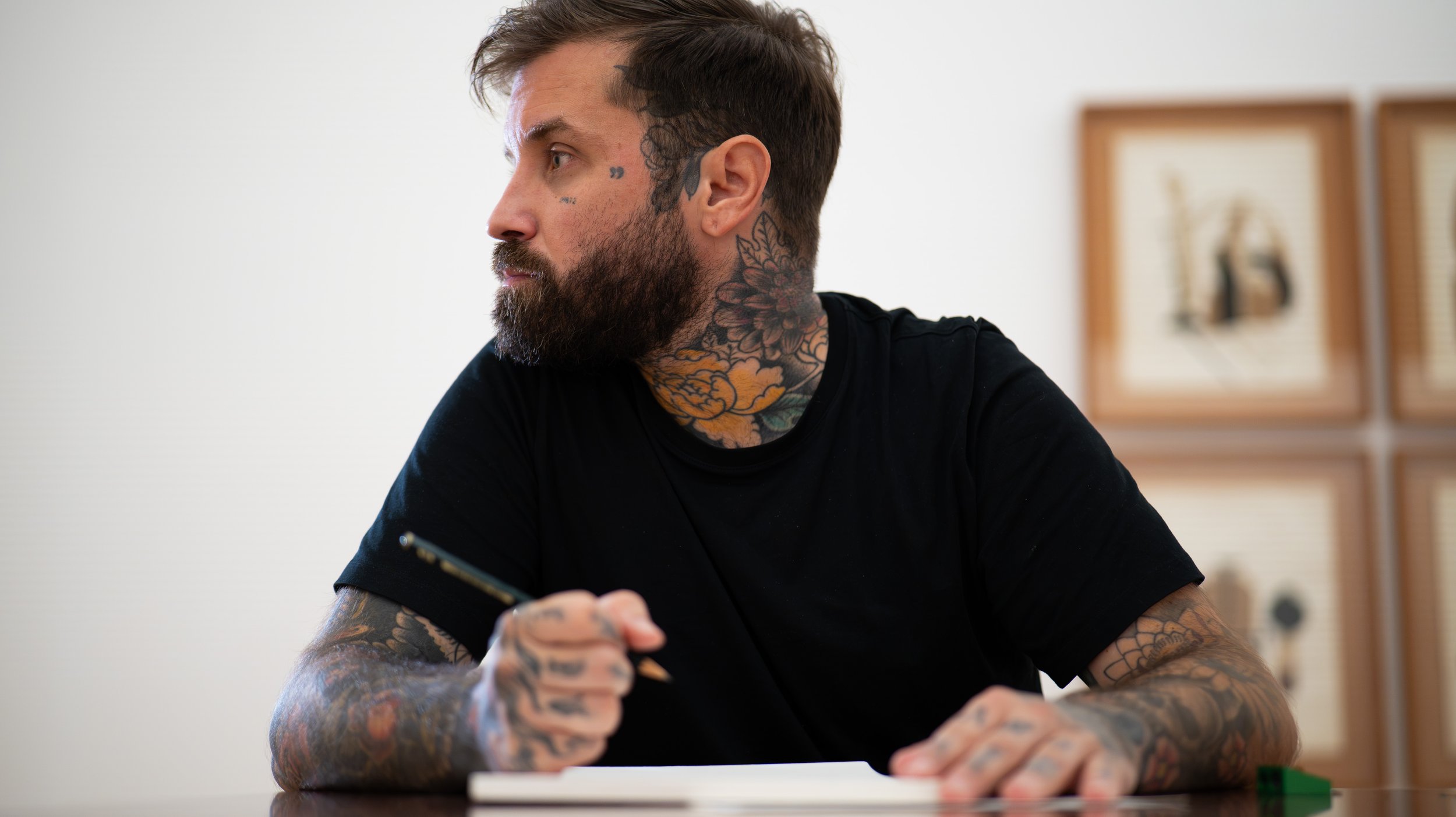
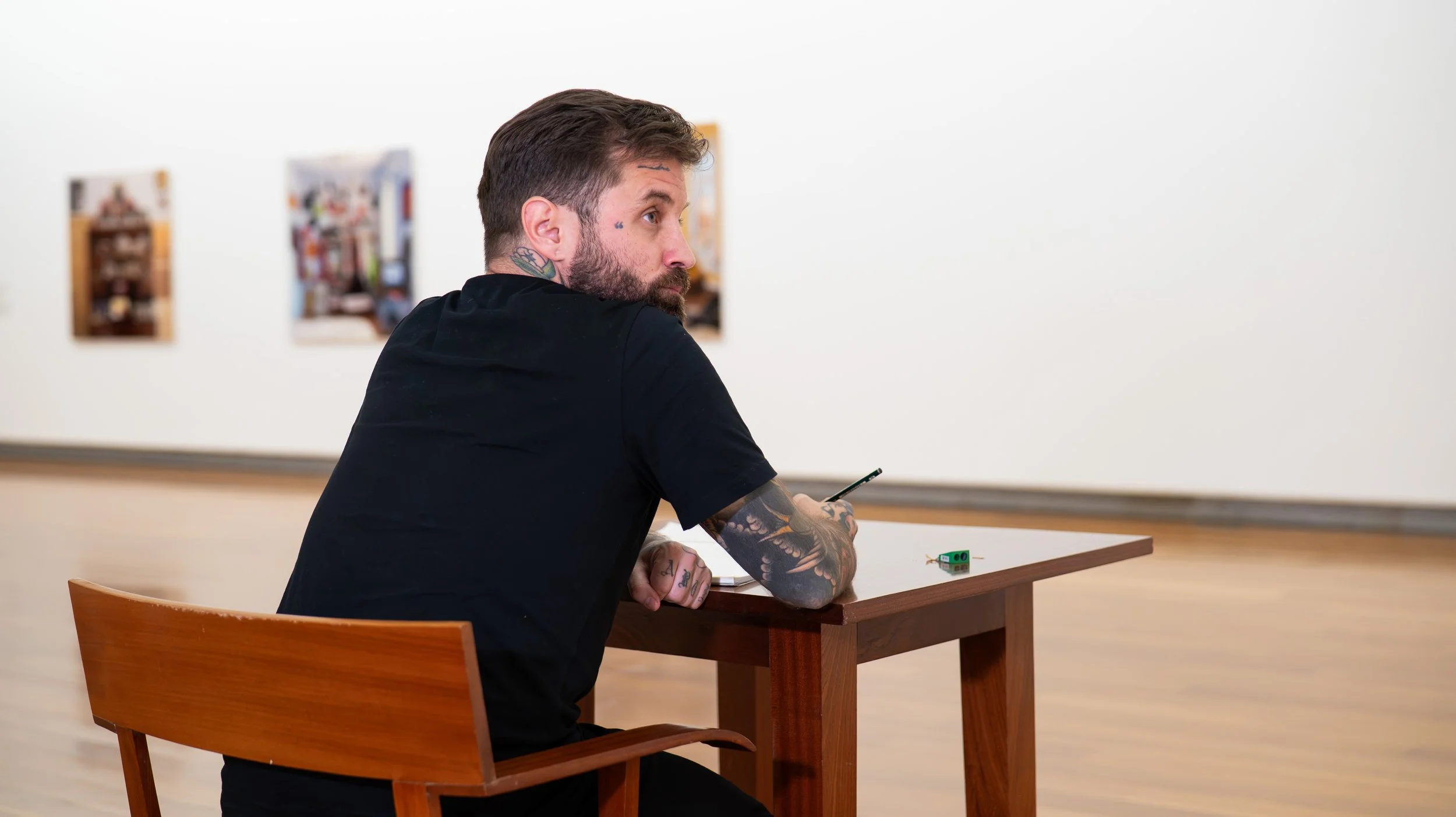
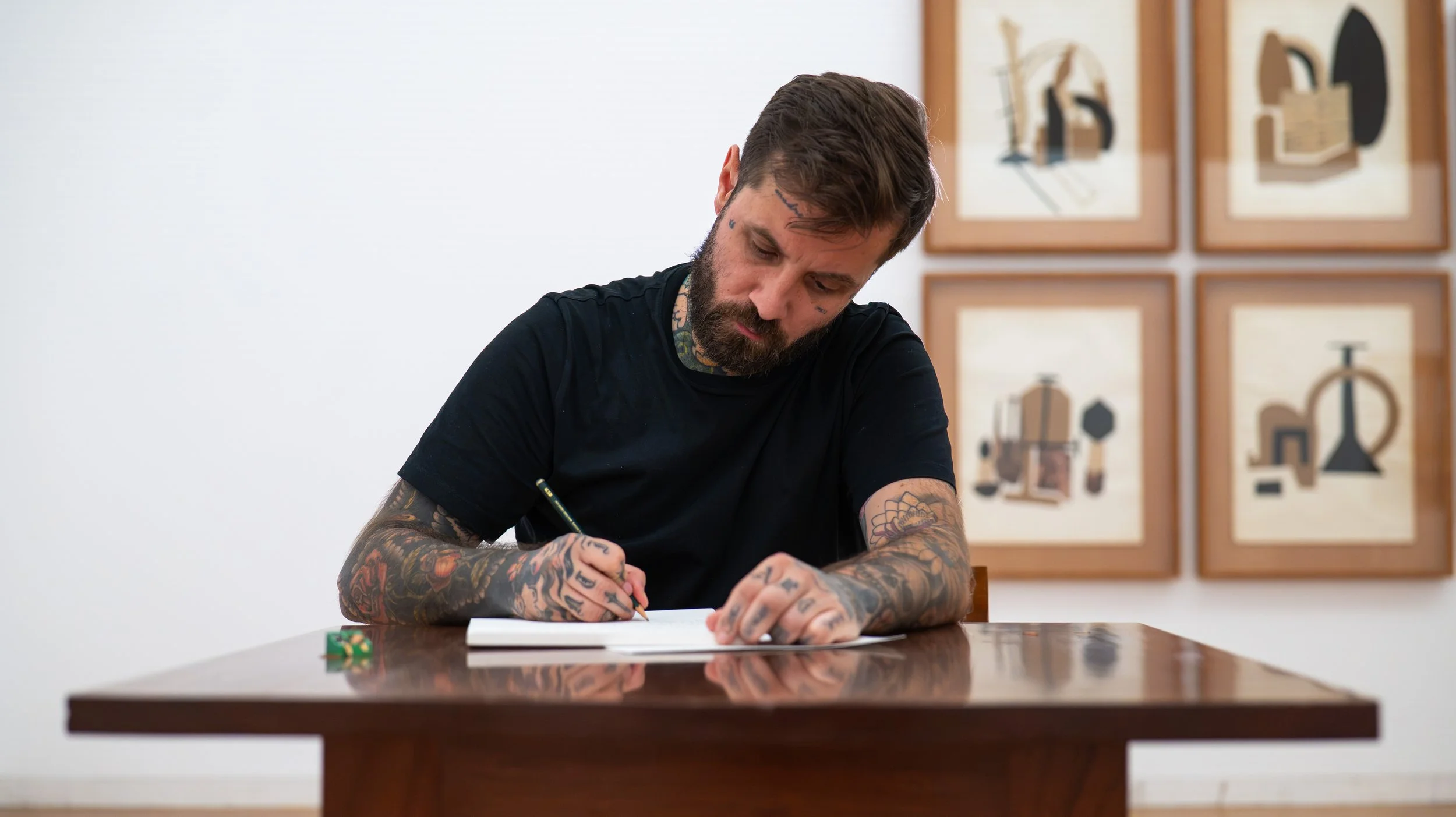
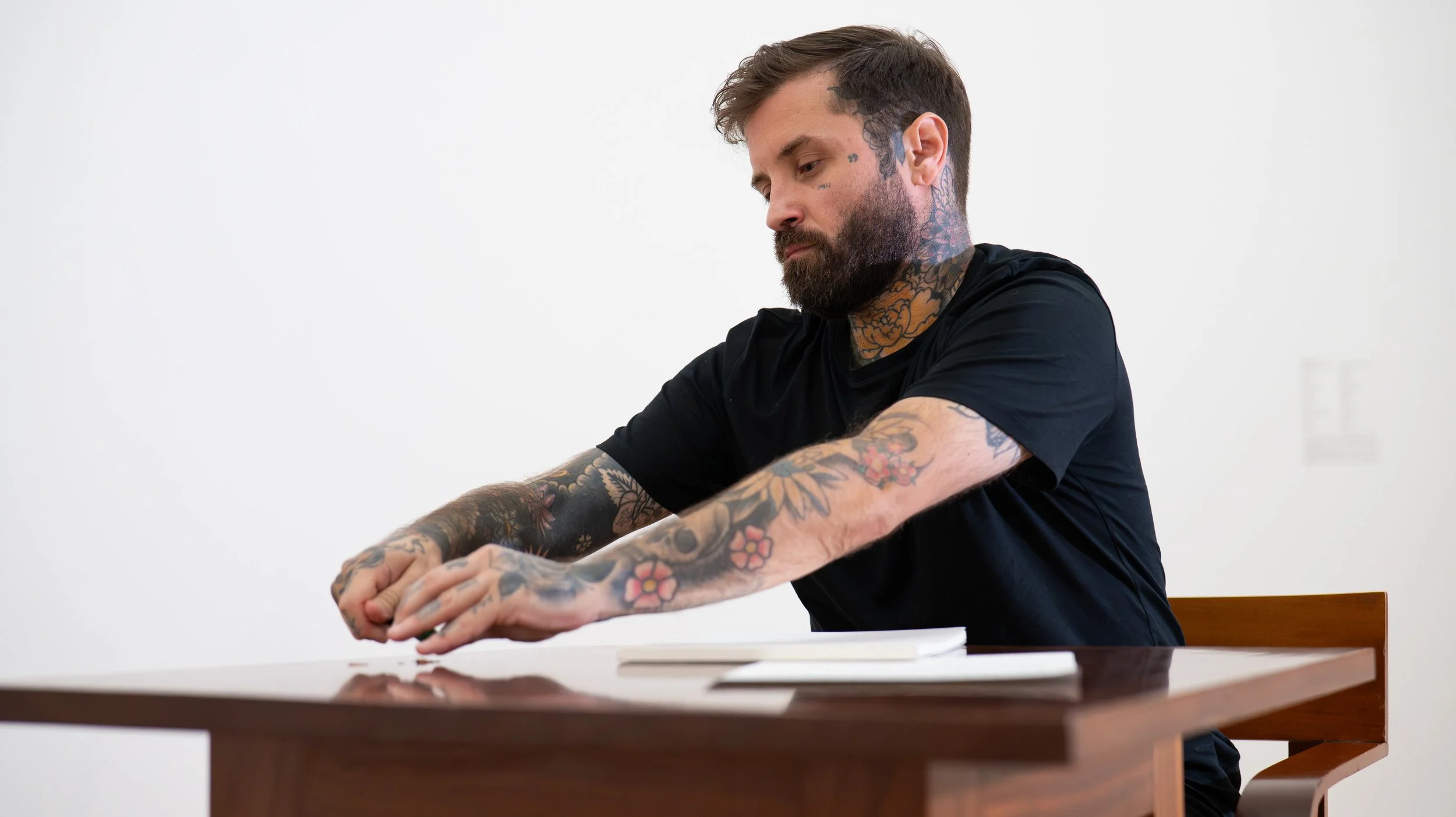
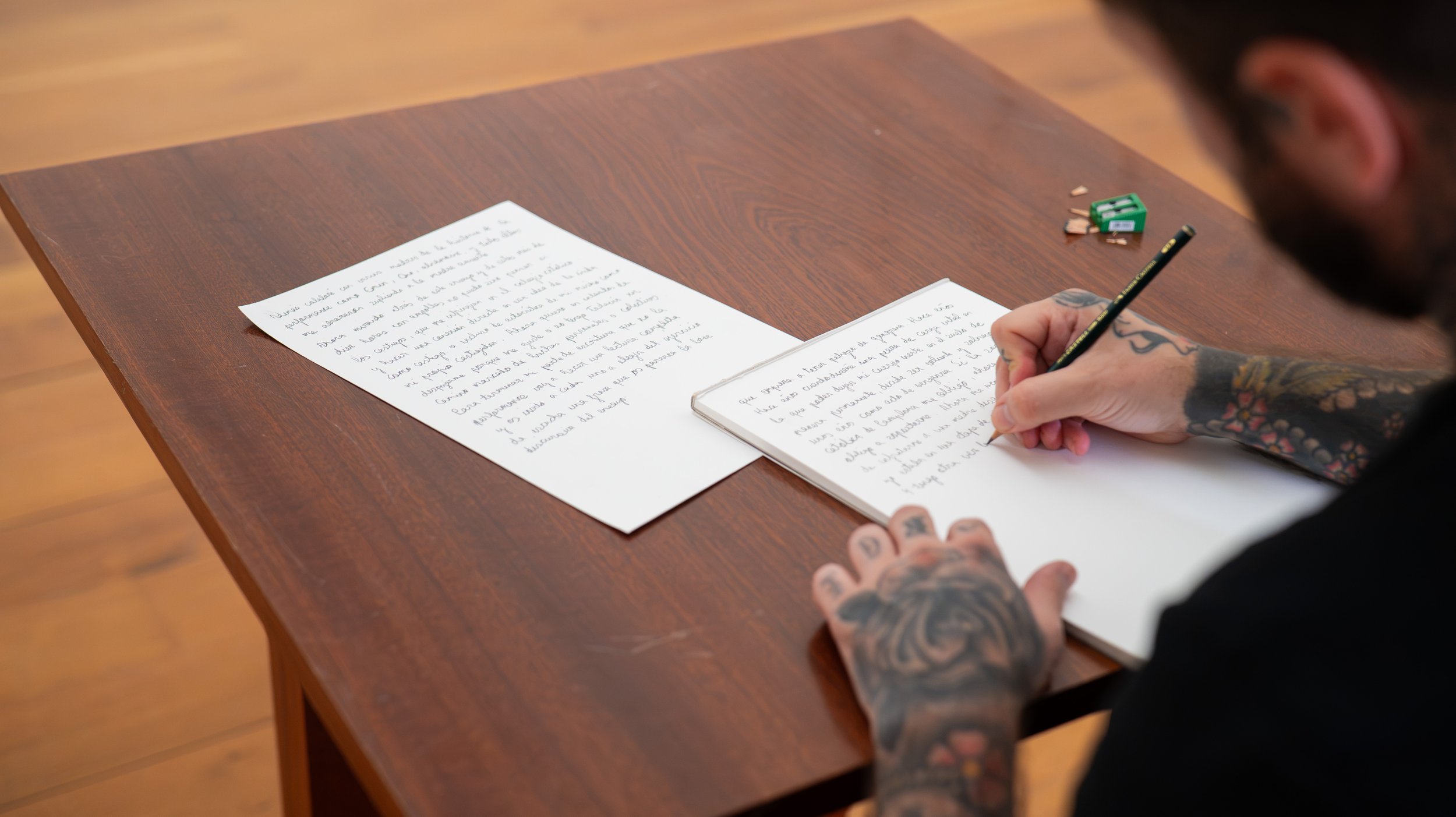
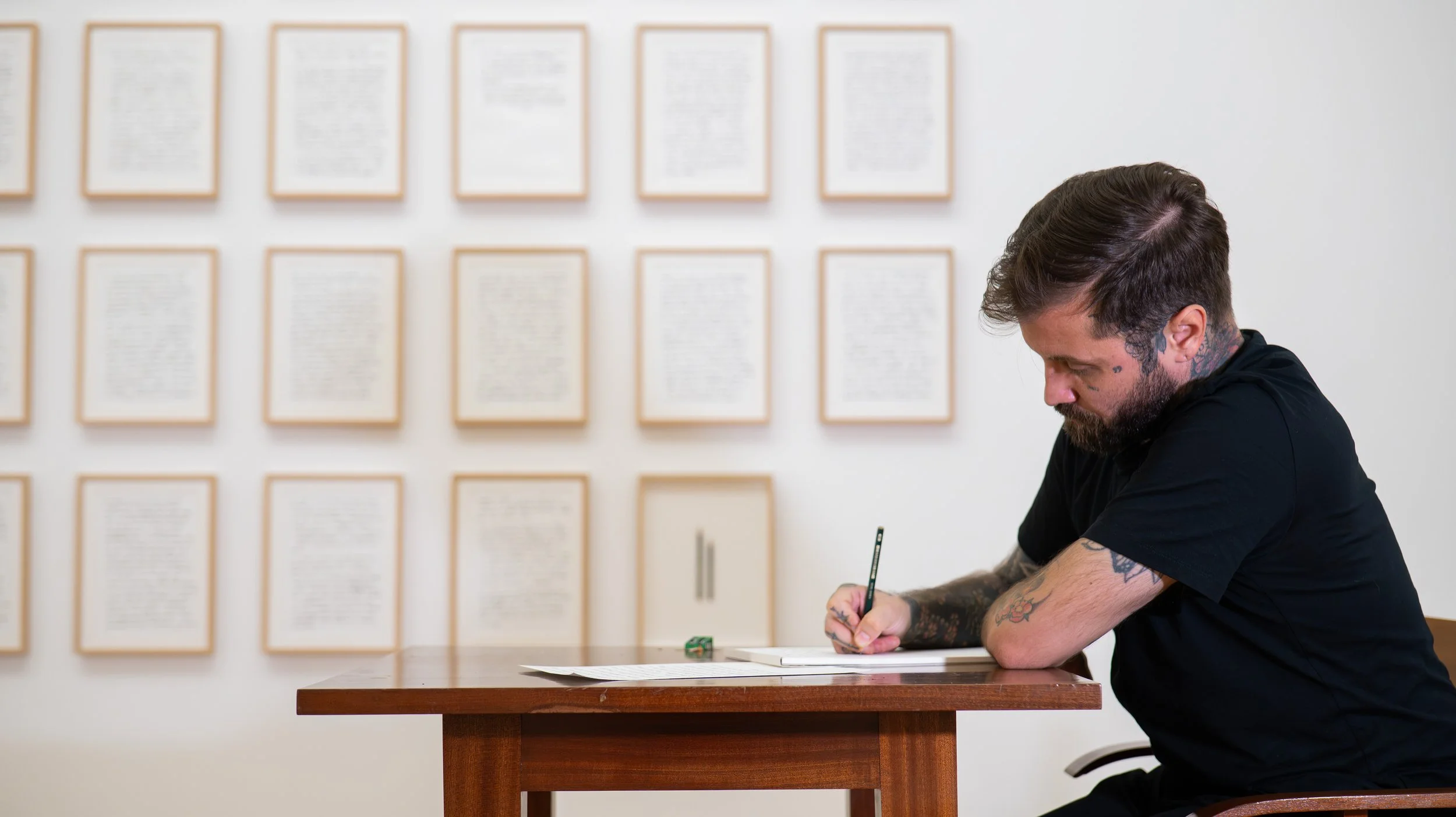
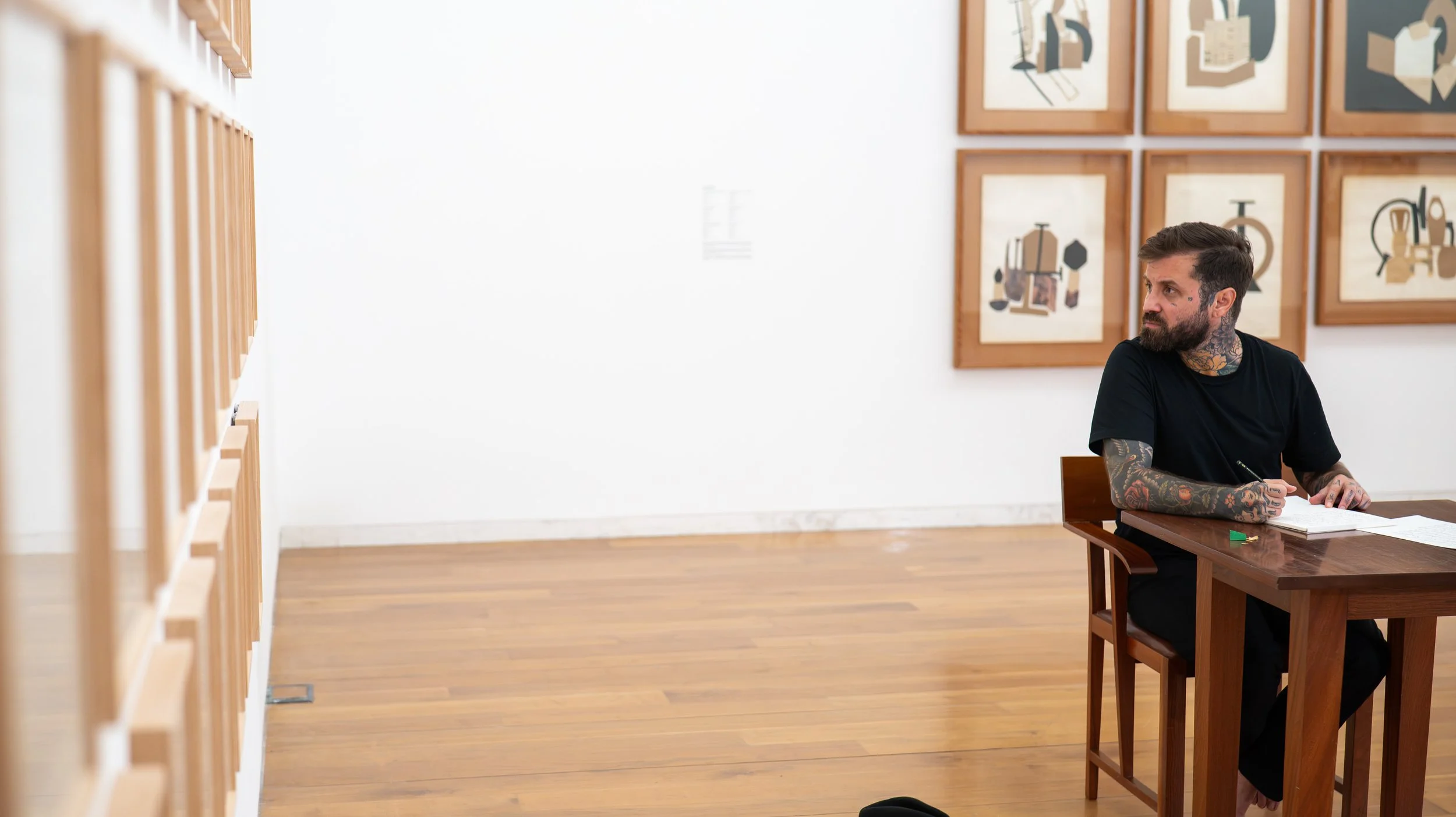
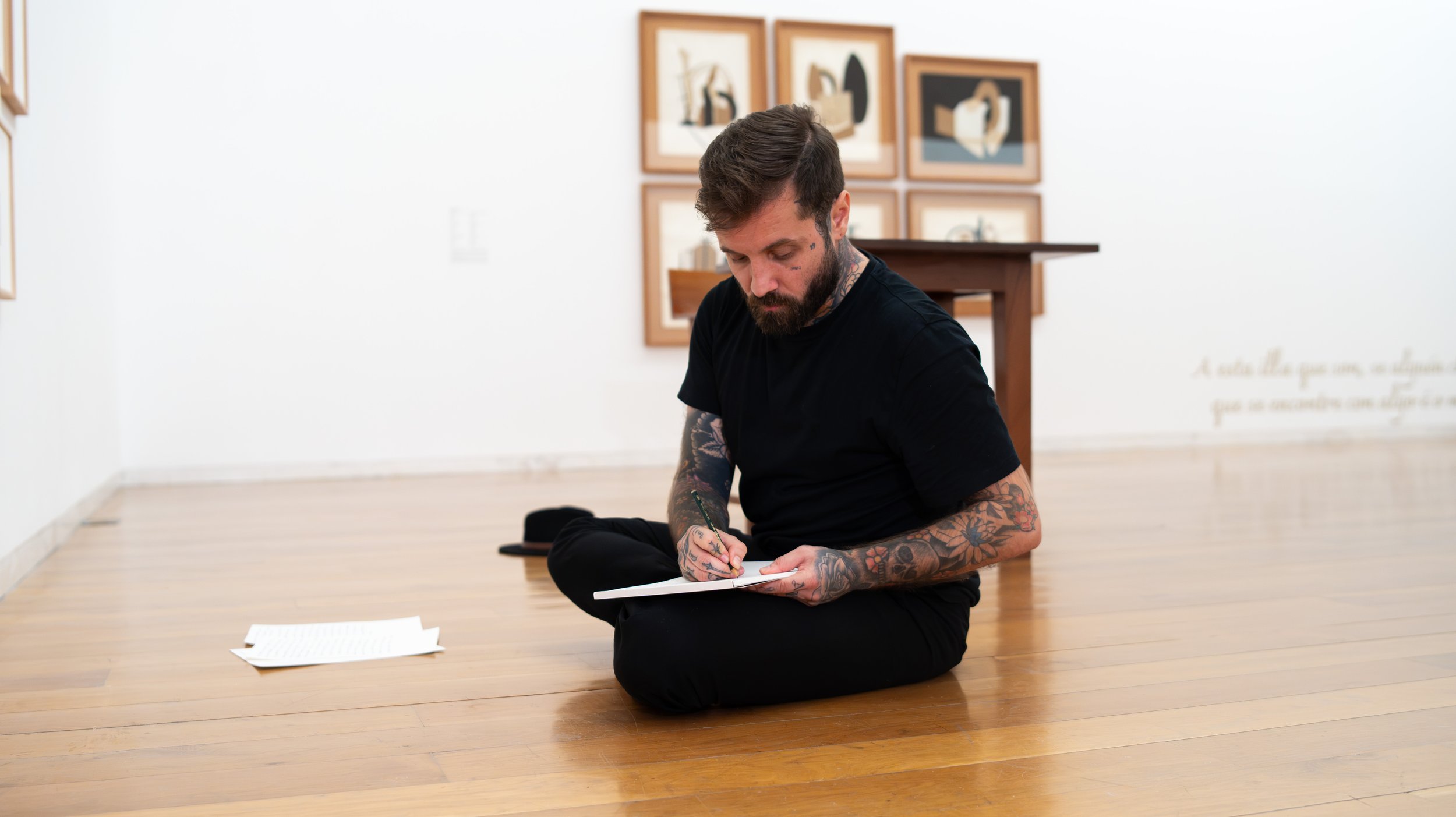
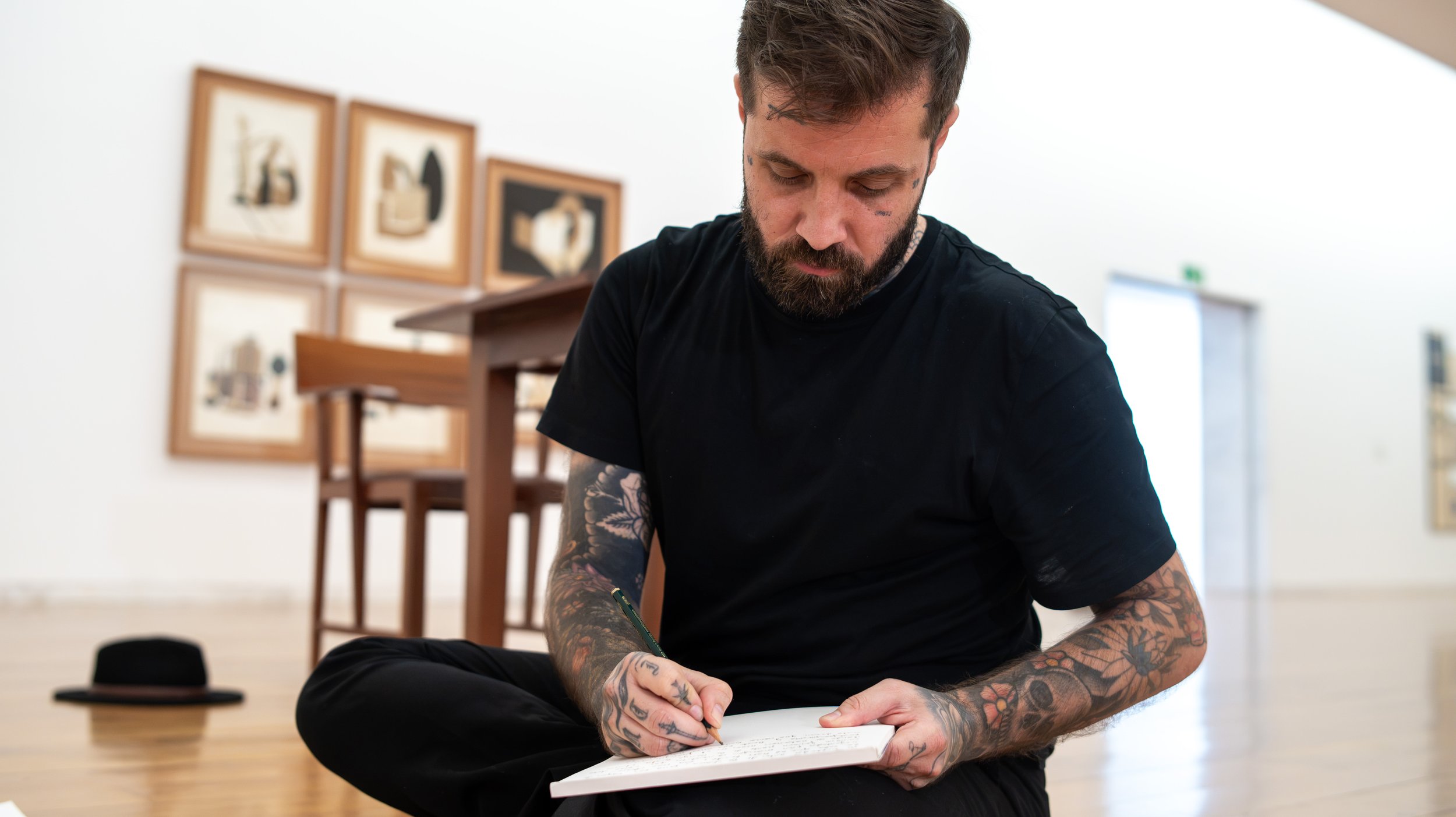
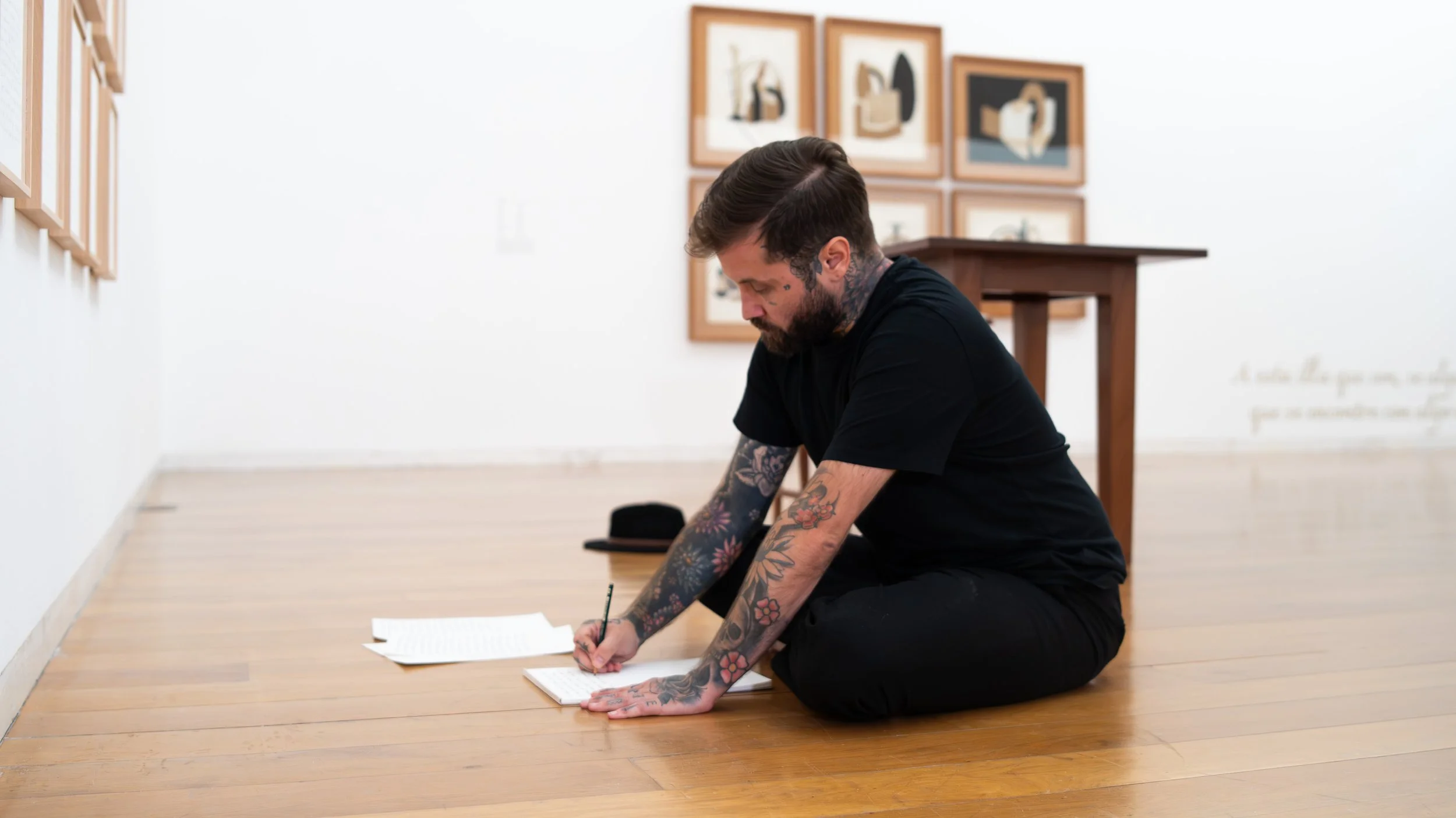
The third stage took place on 19 September 2026 and consisted of a performative reactivation of the work. Over the course of nine hours, Azcona completely reviewed and rewrote the manuscript displayed in the CGAC collection, once again bringing his body, writing and voice into the institutional space.
La tercera etapa tuvo lugar el 19 de septiembre de 2026 y consistió en una reactivación performativa de la obra. Durante nueve horas, Azcona revisó y reescribió íntegramente el manuscrito expuesto en la colección del CGAC, incorporando nuevamente su cuerpo, su escritura y su voz al espacio institucional.
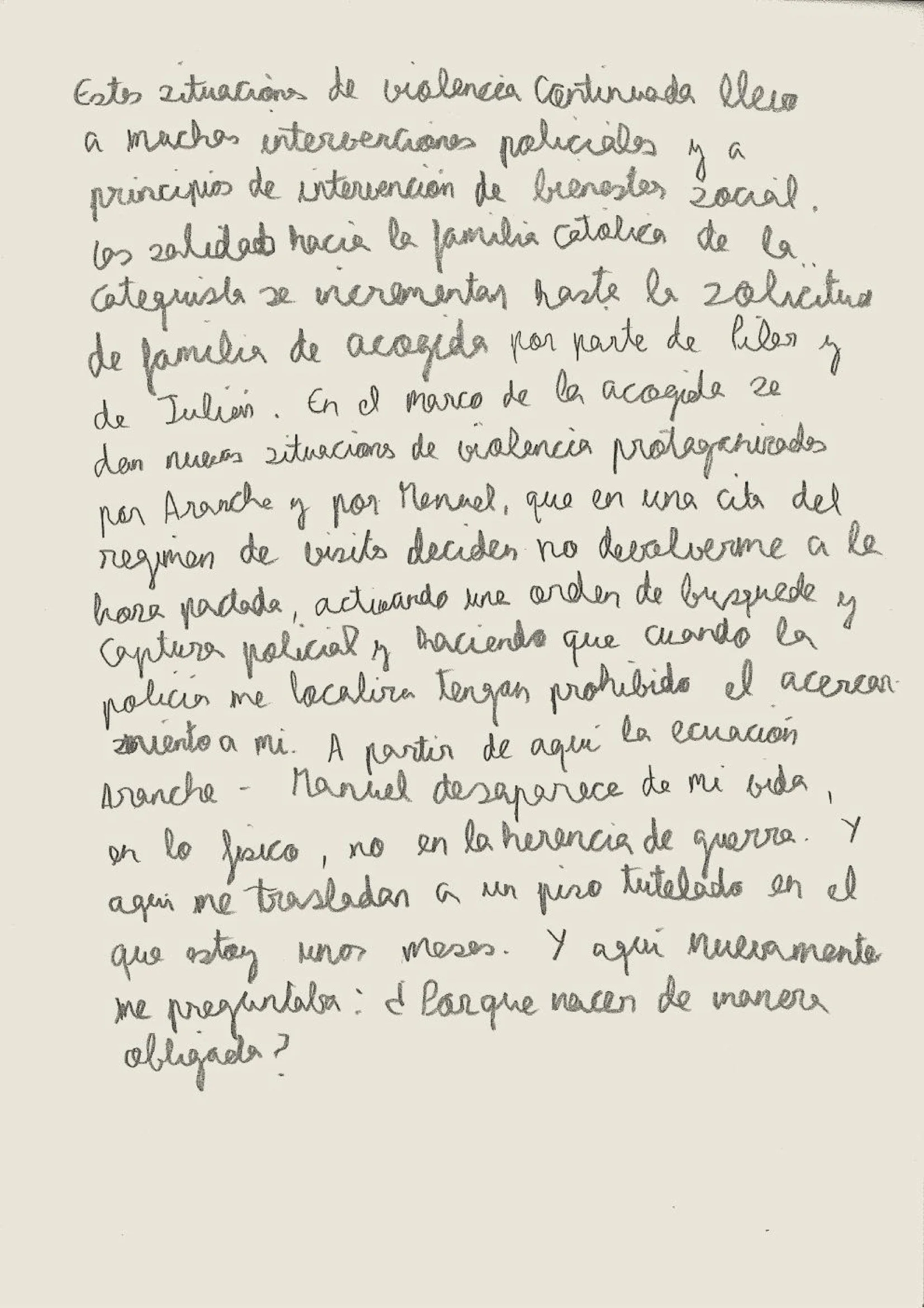
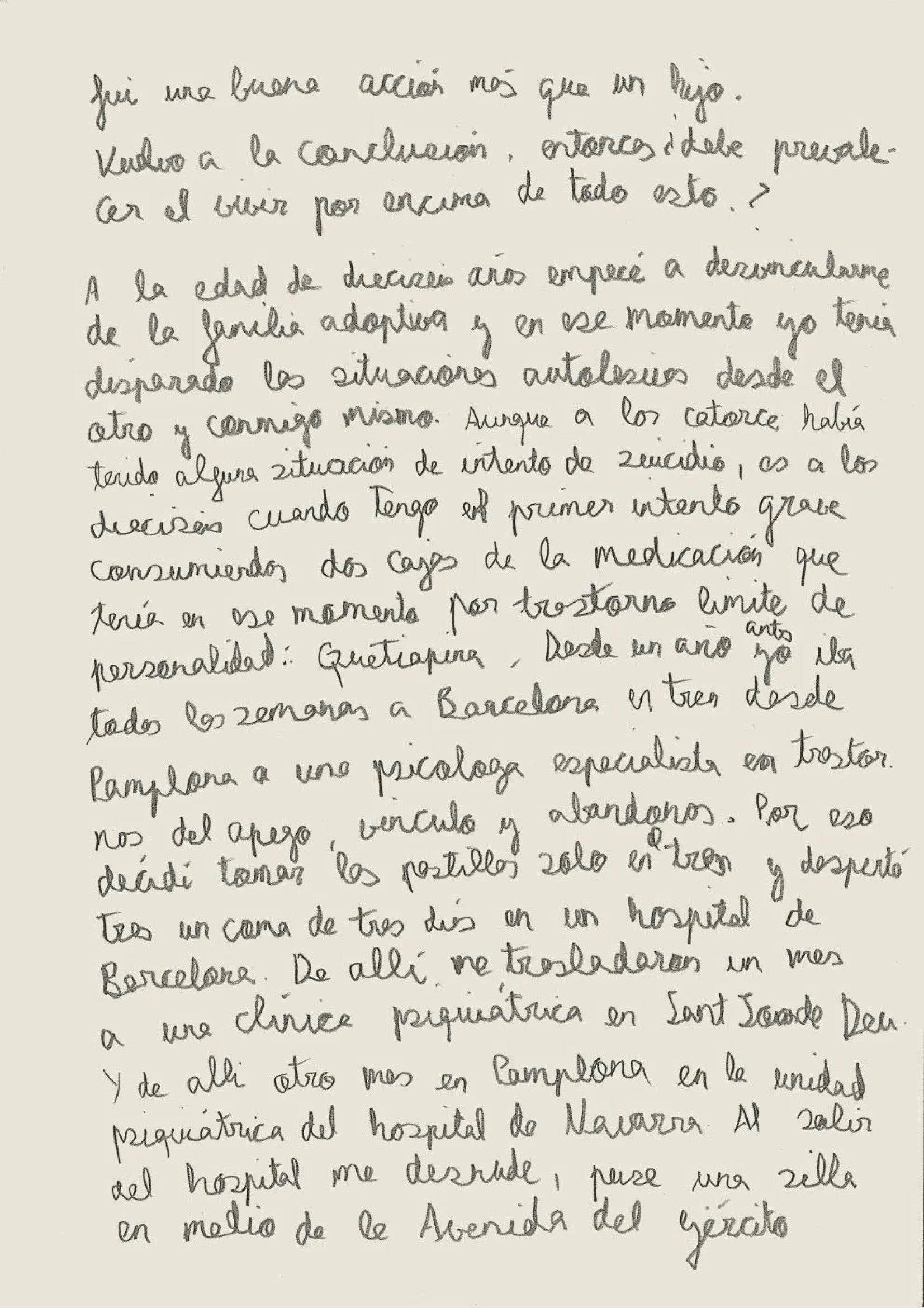
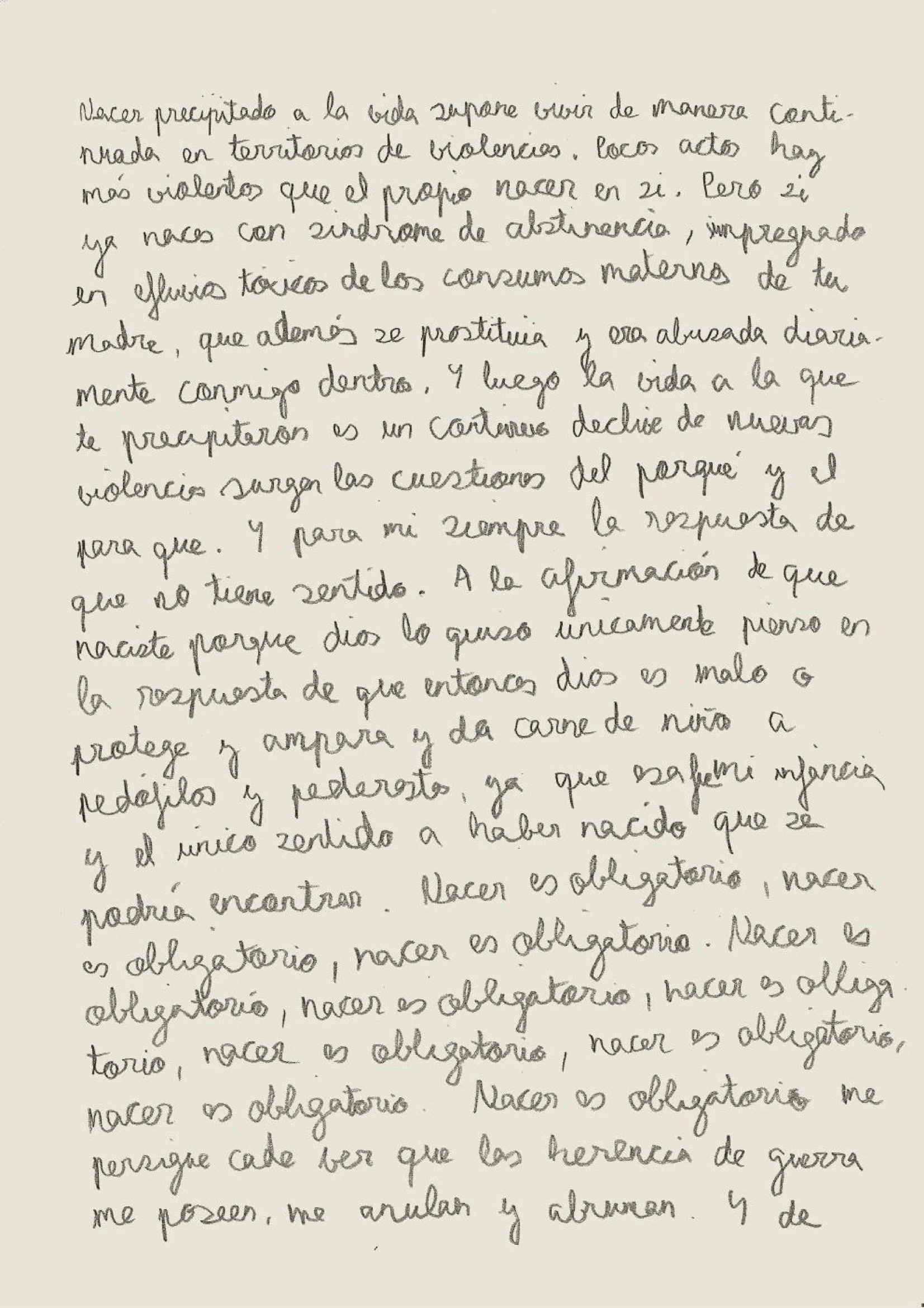
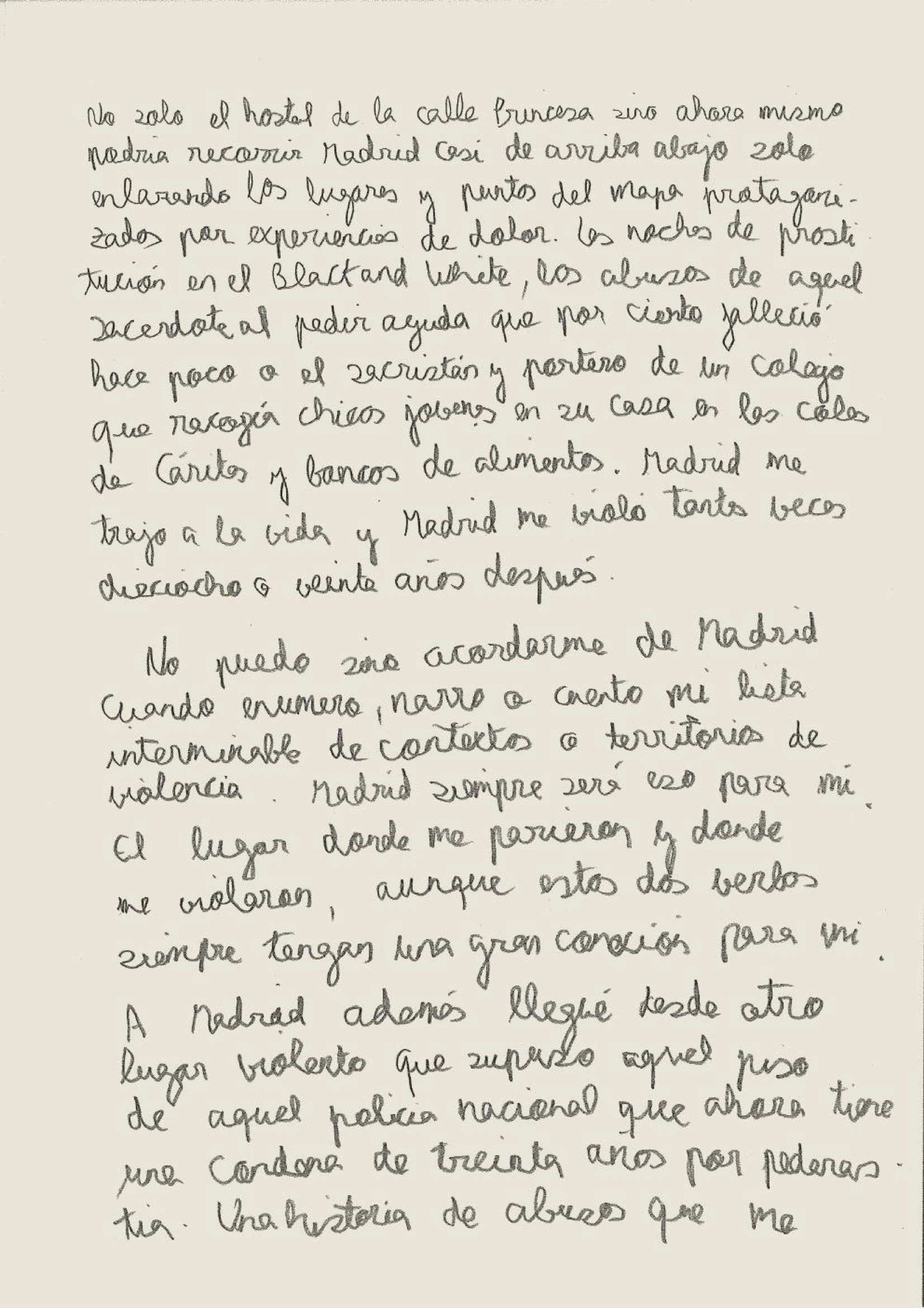
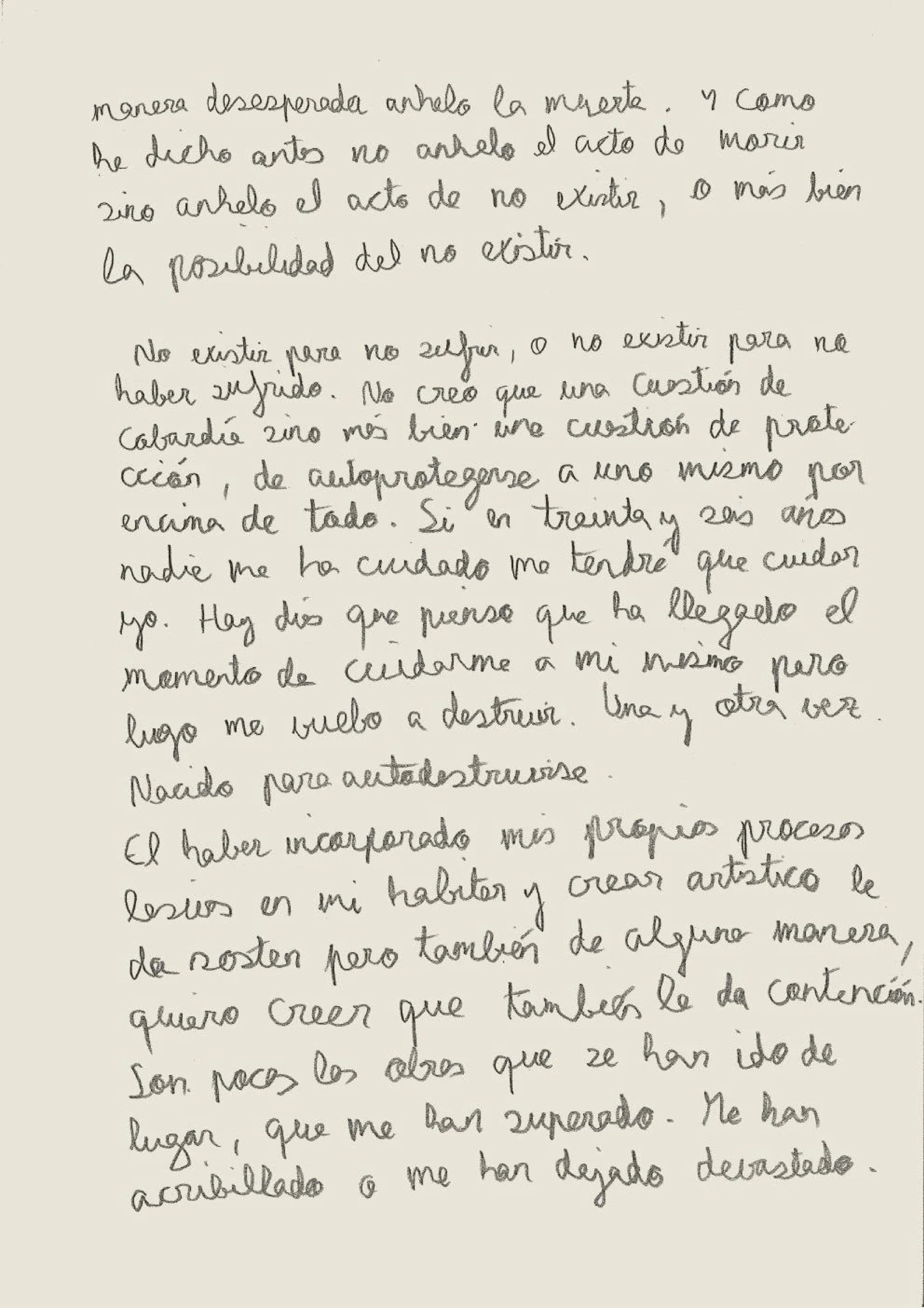
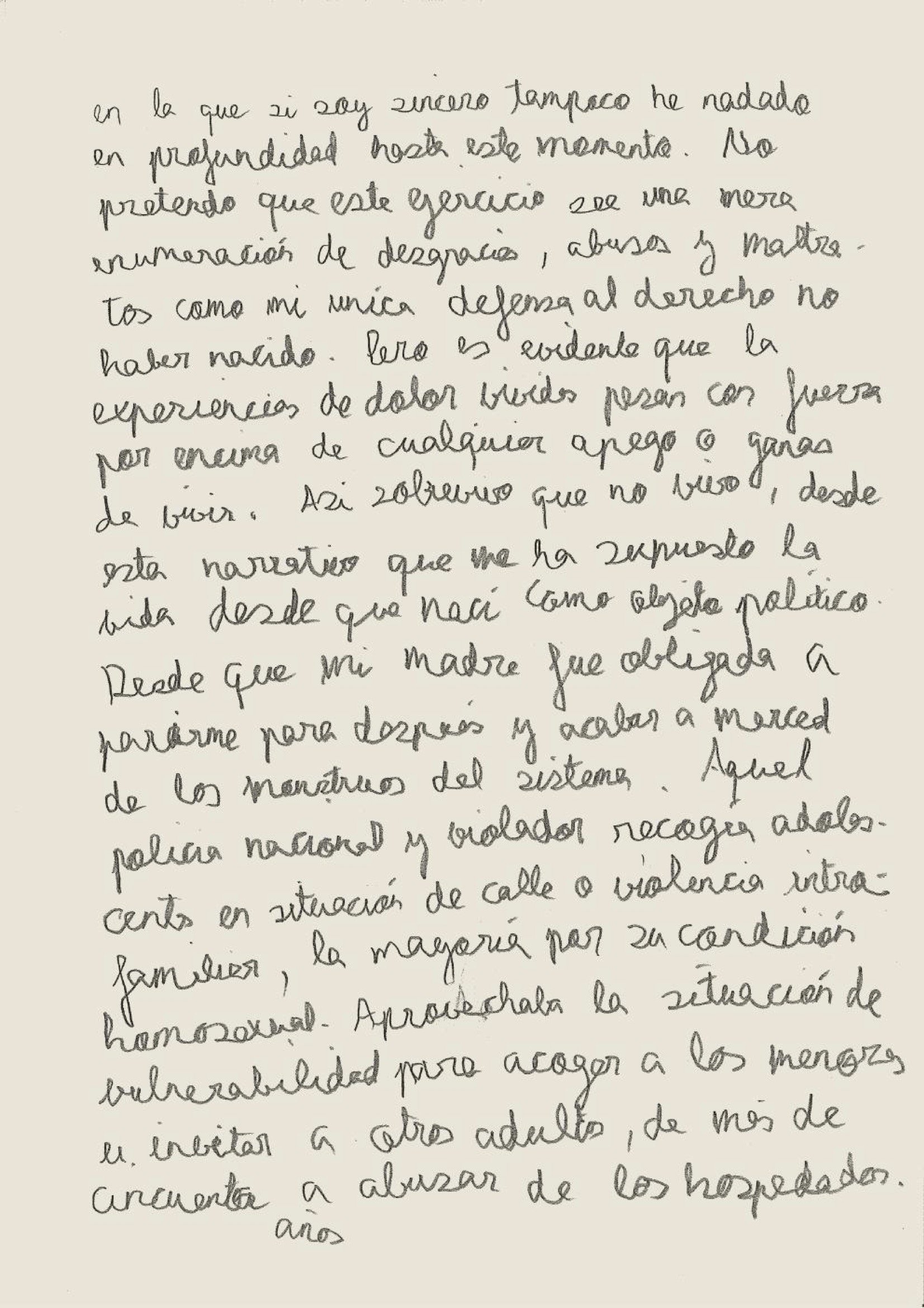
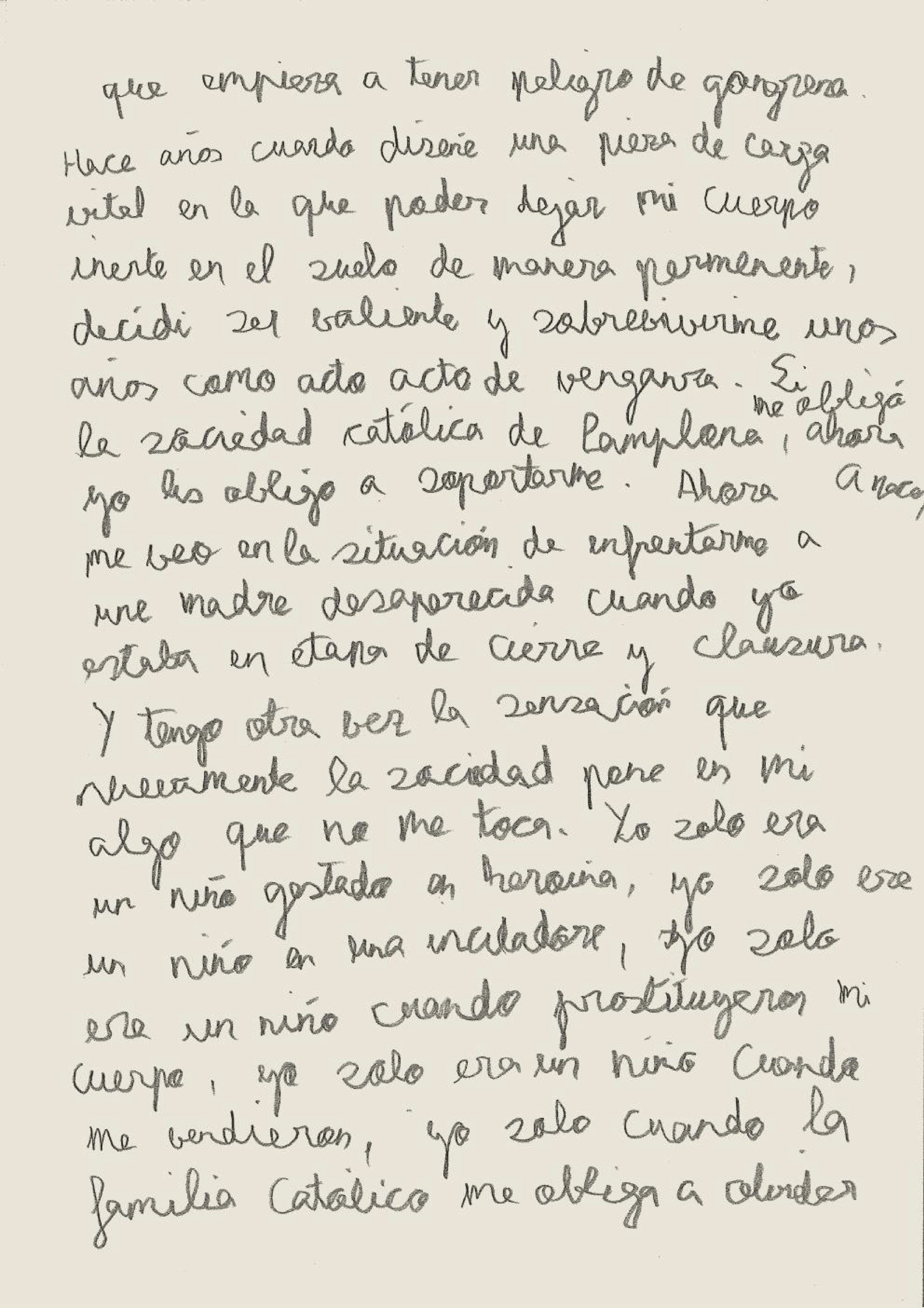
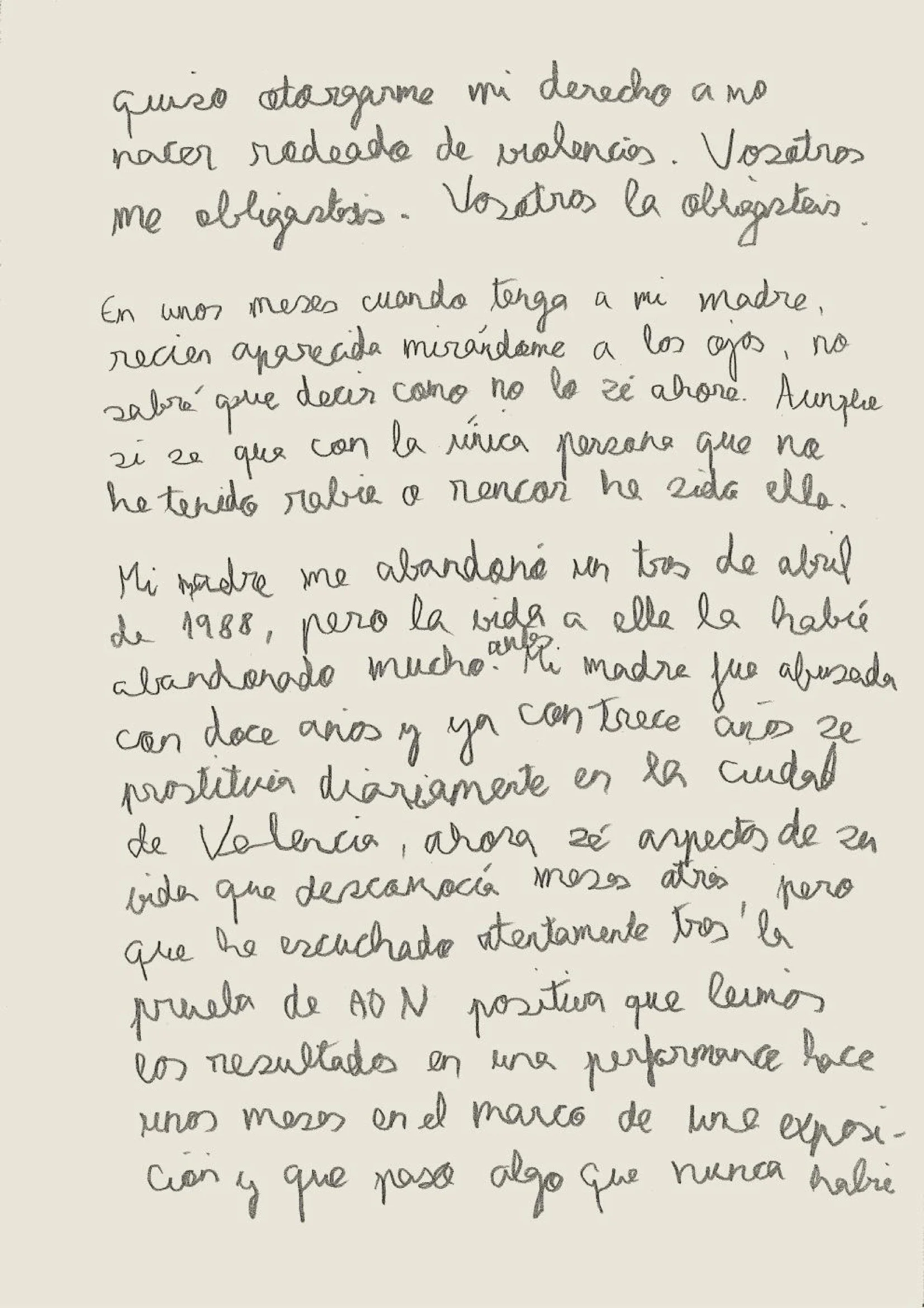
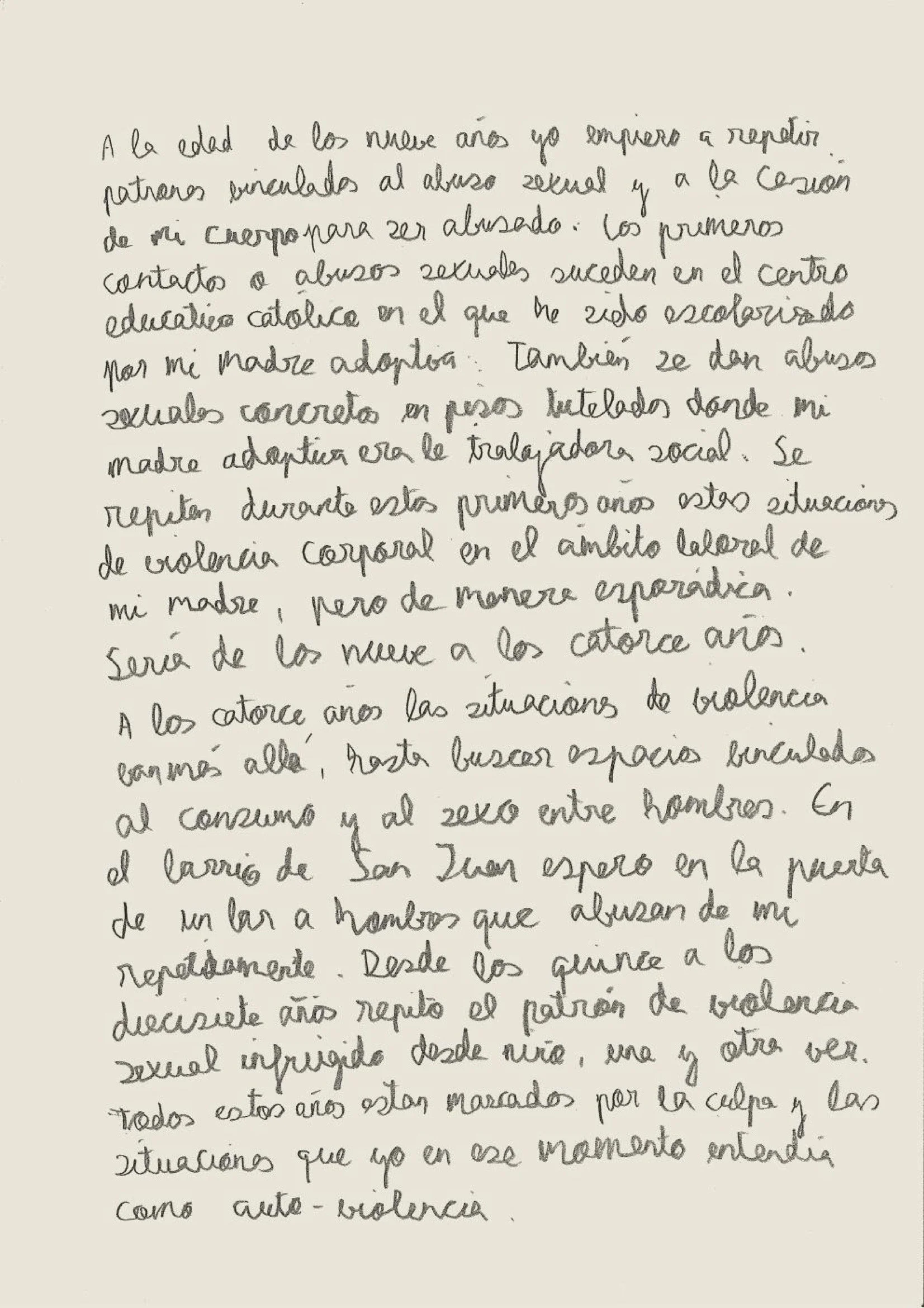
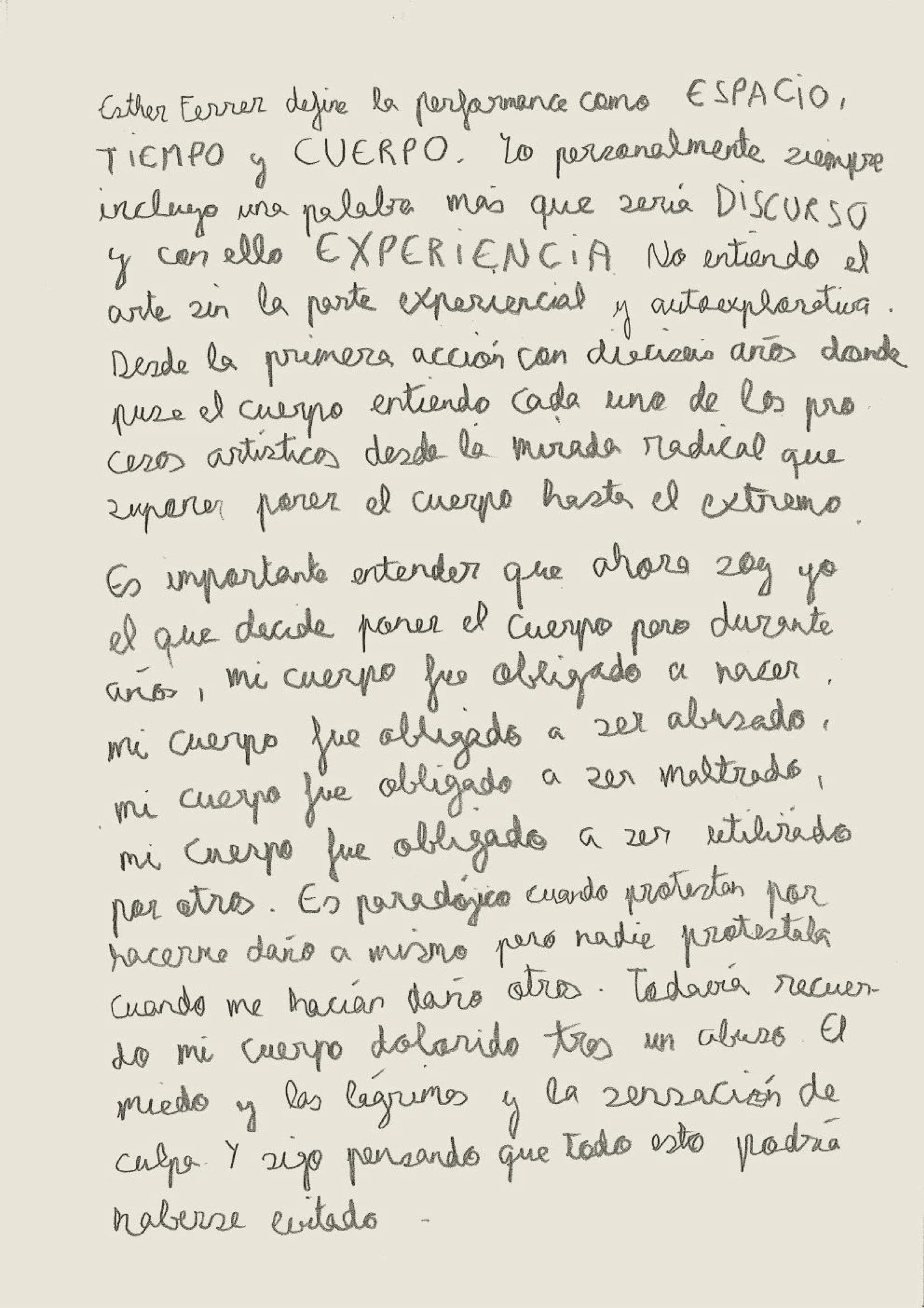
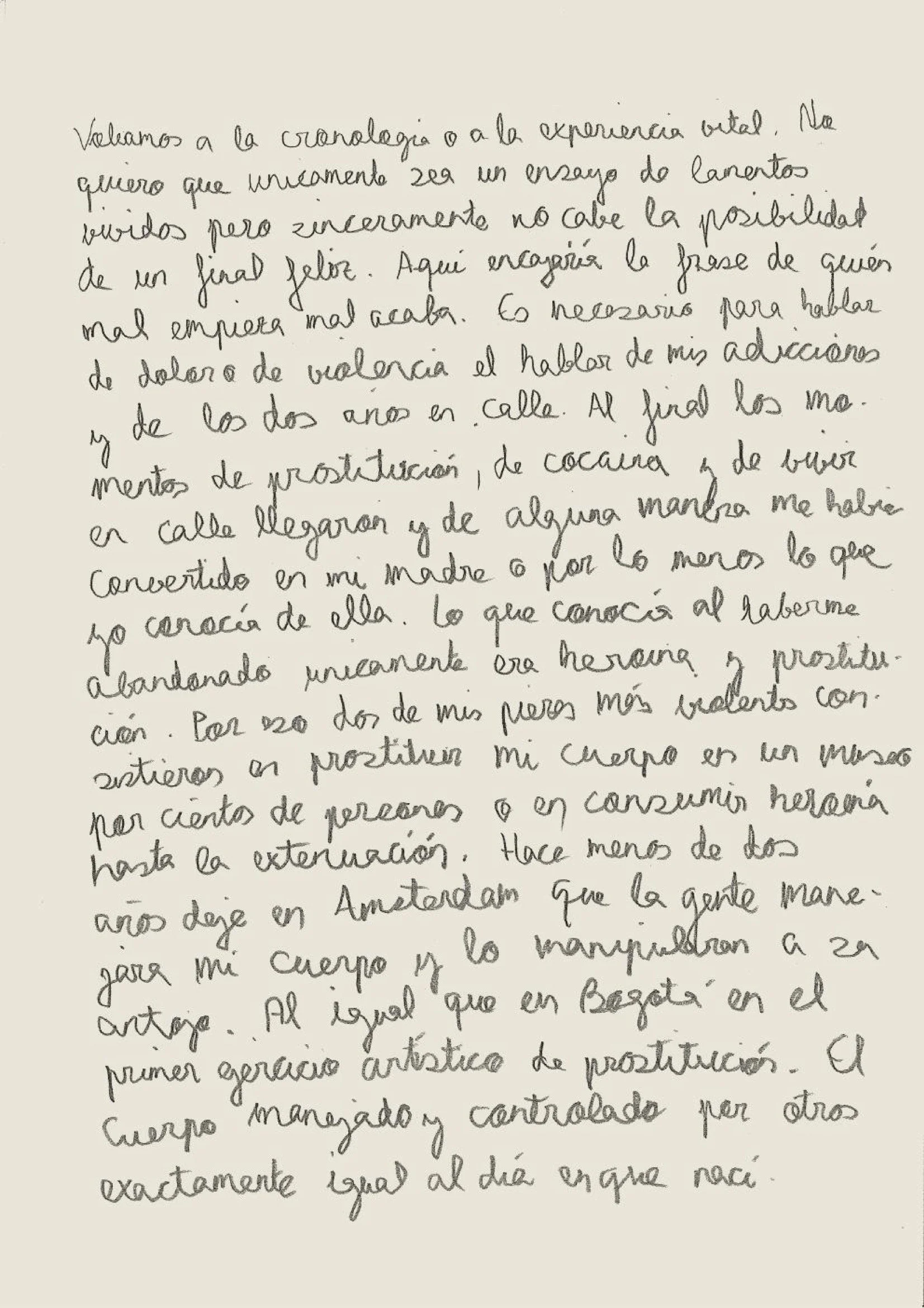
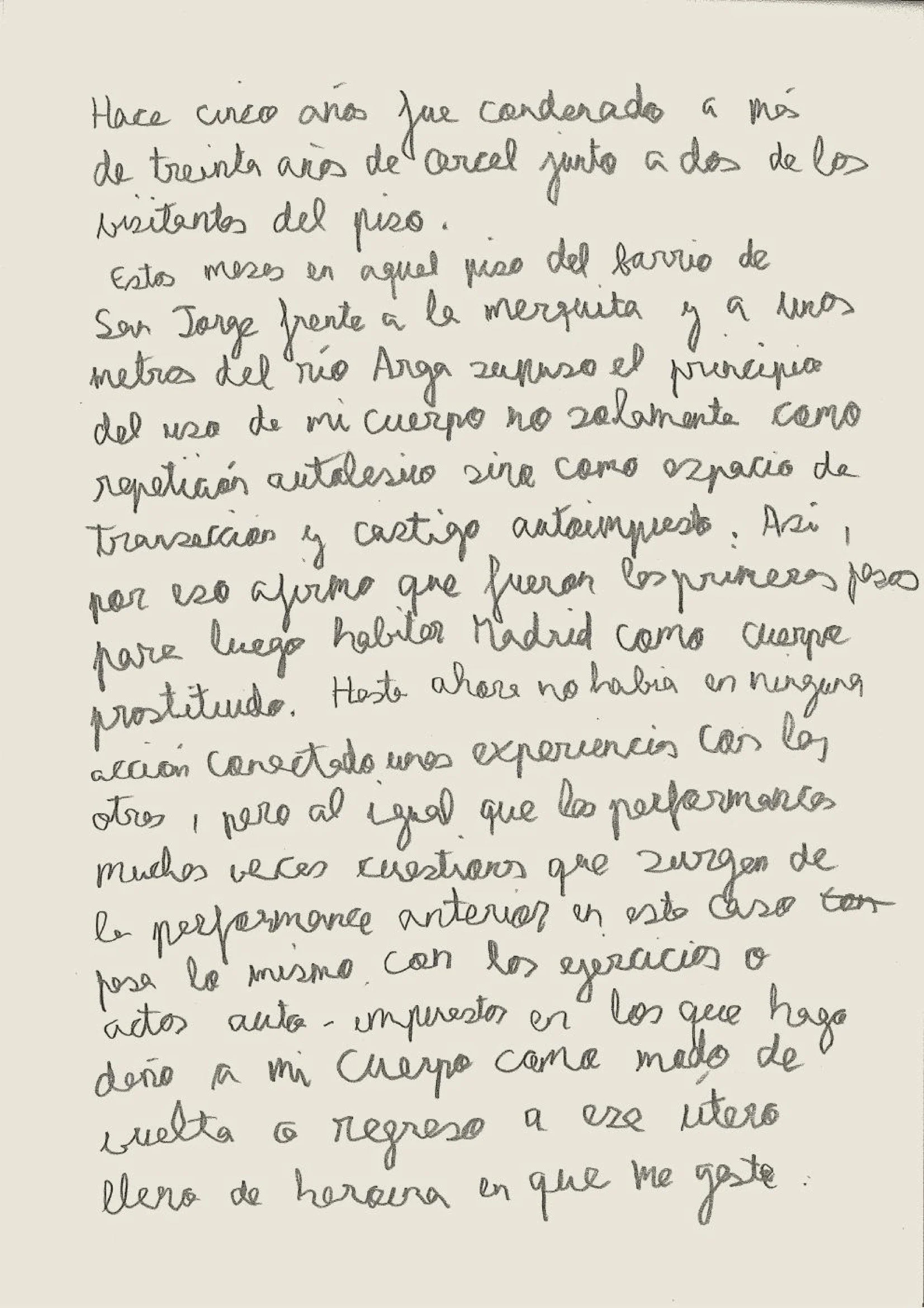
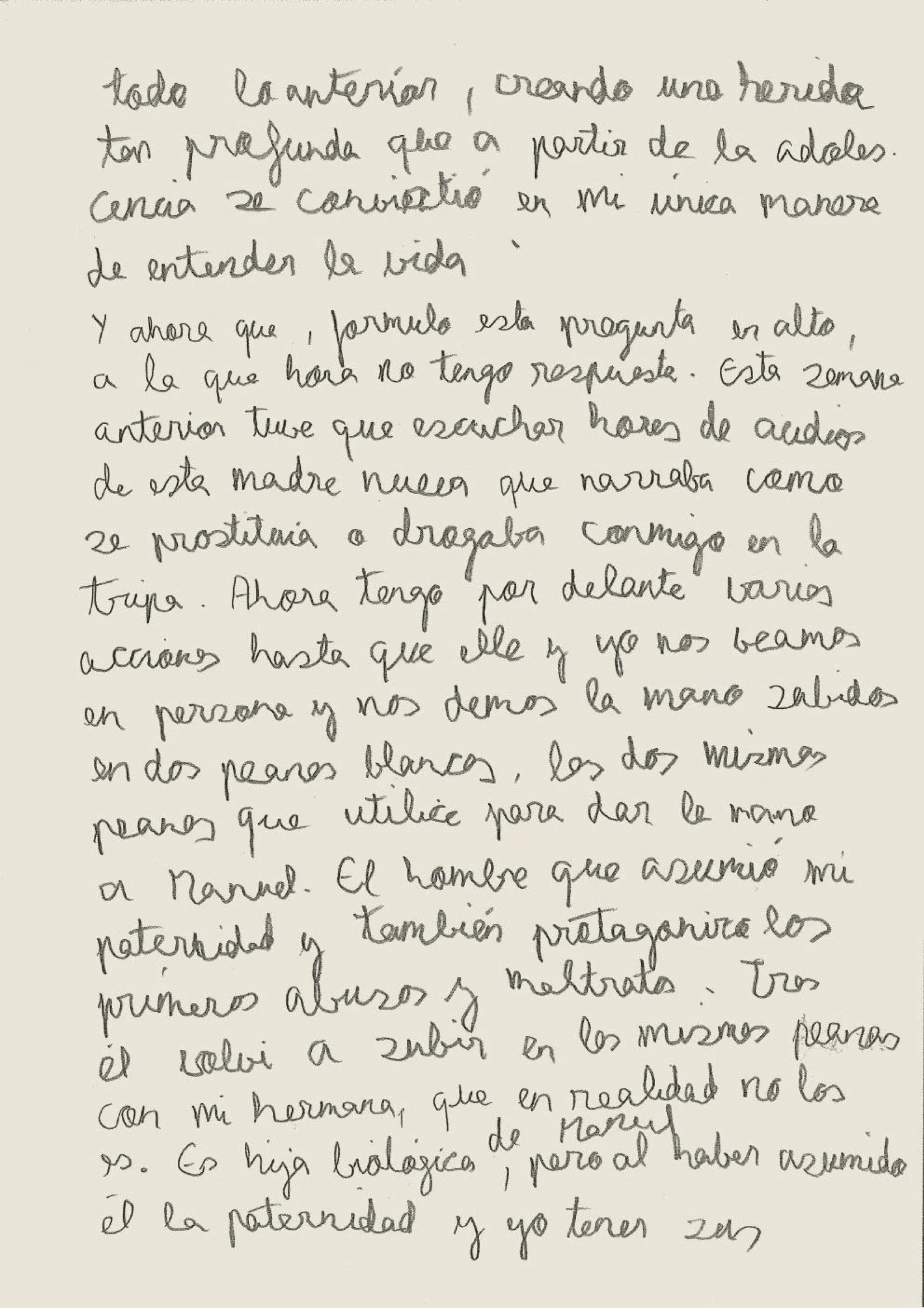
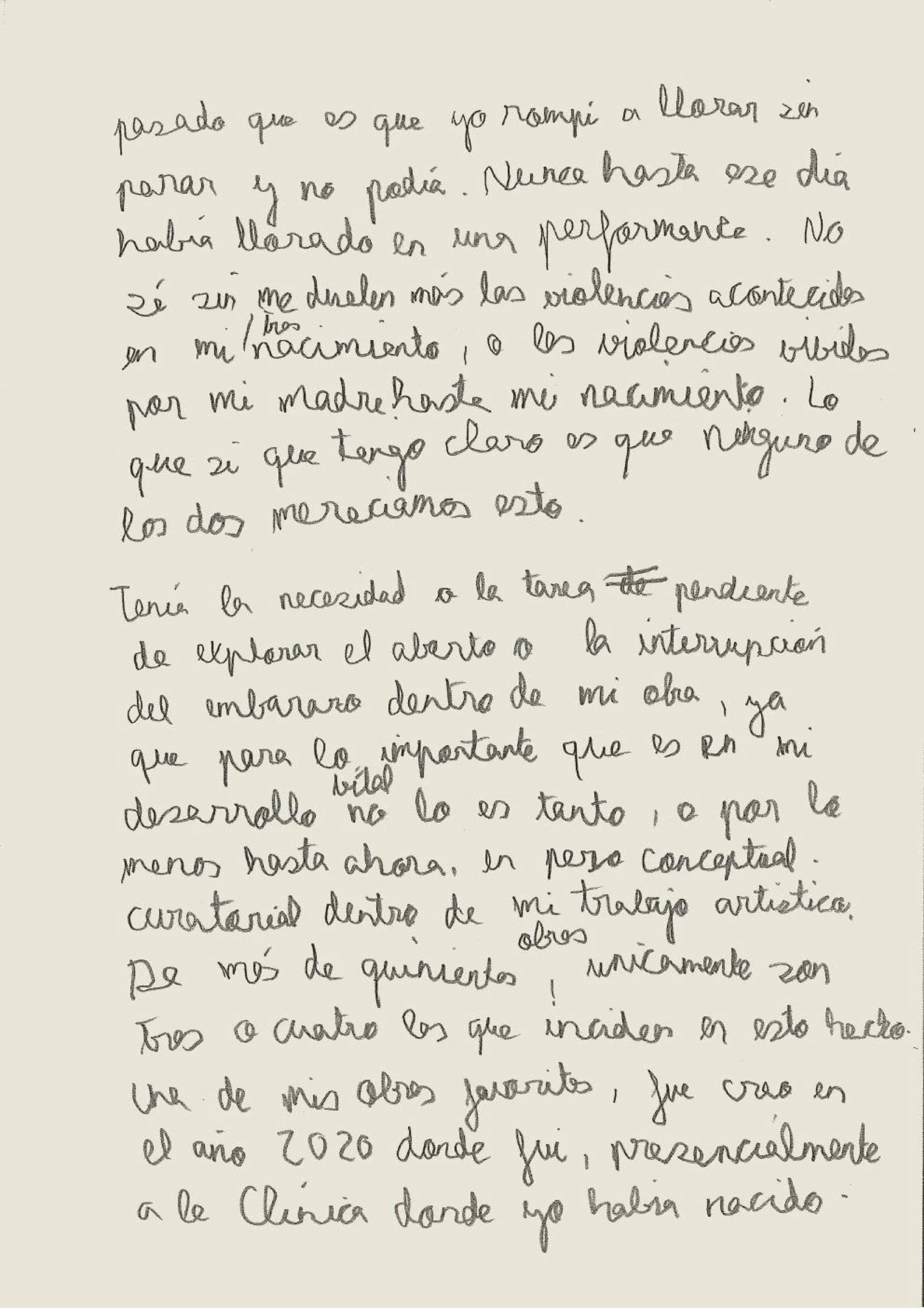
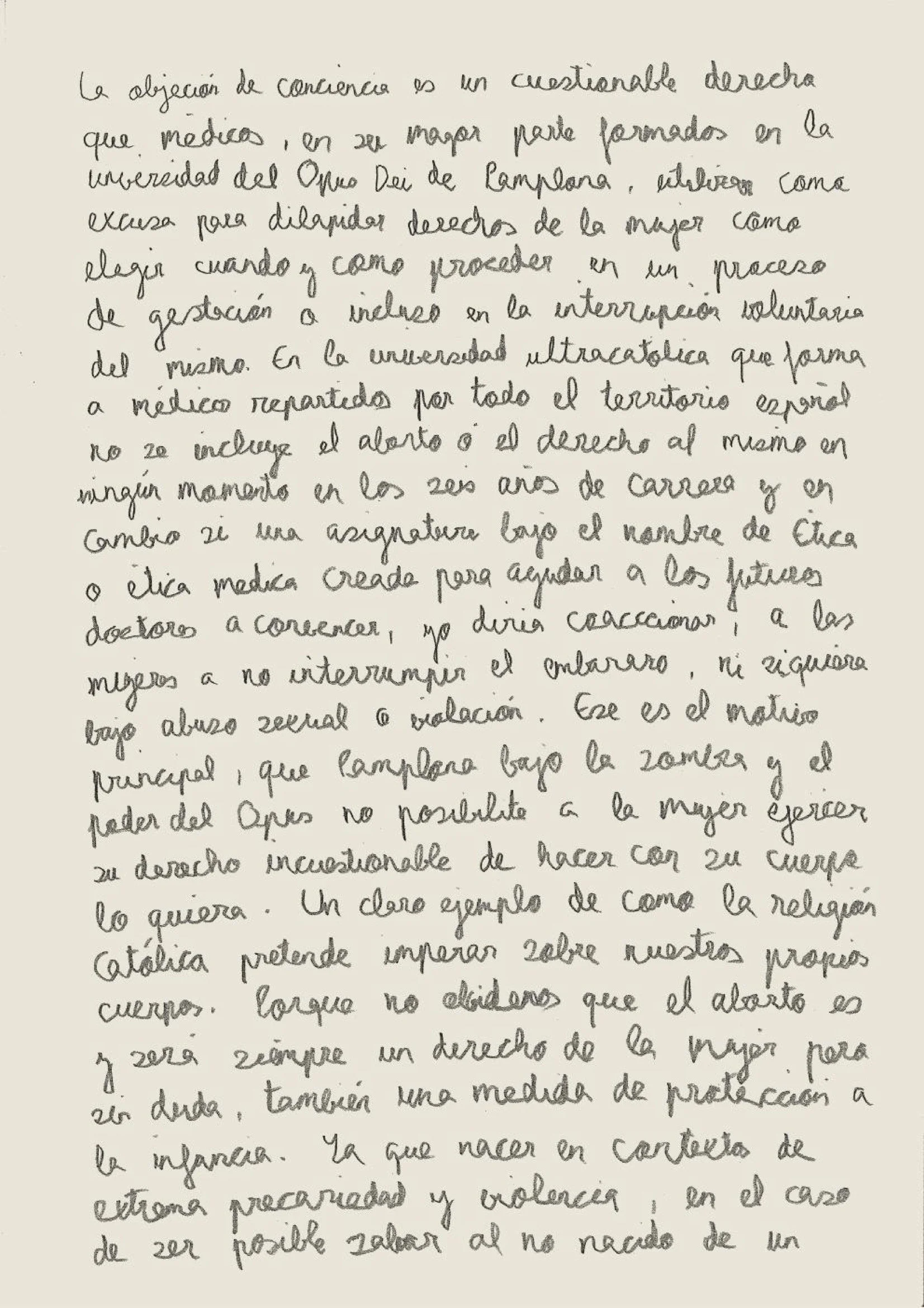
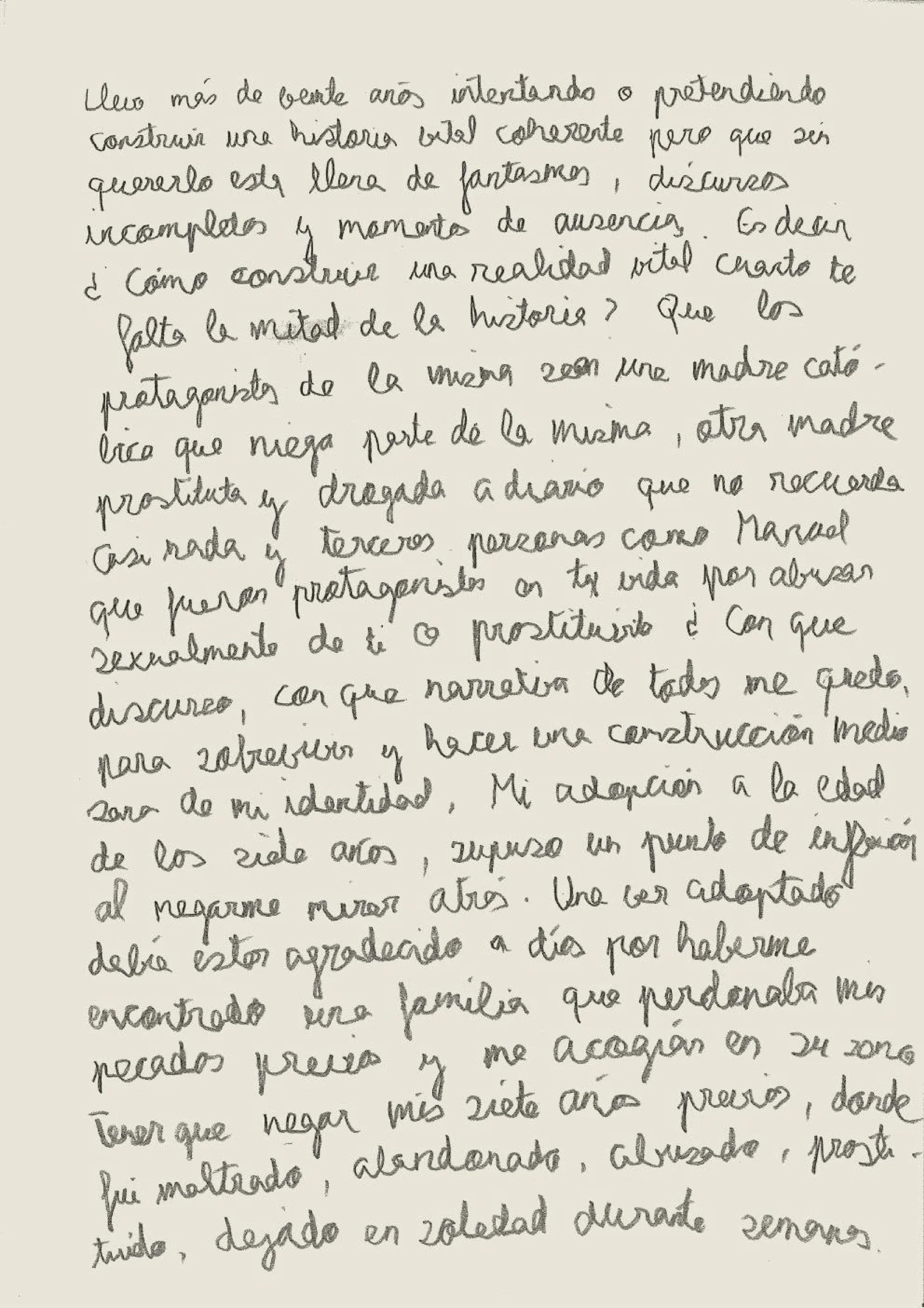
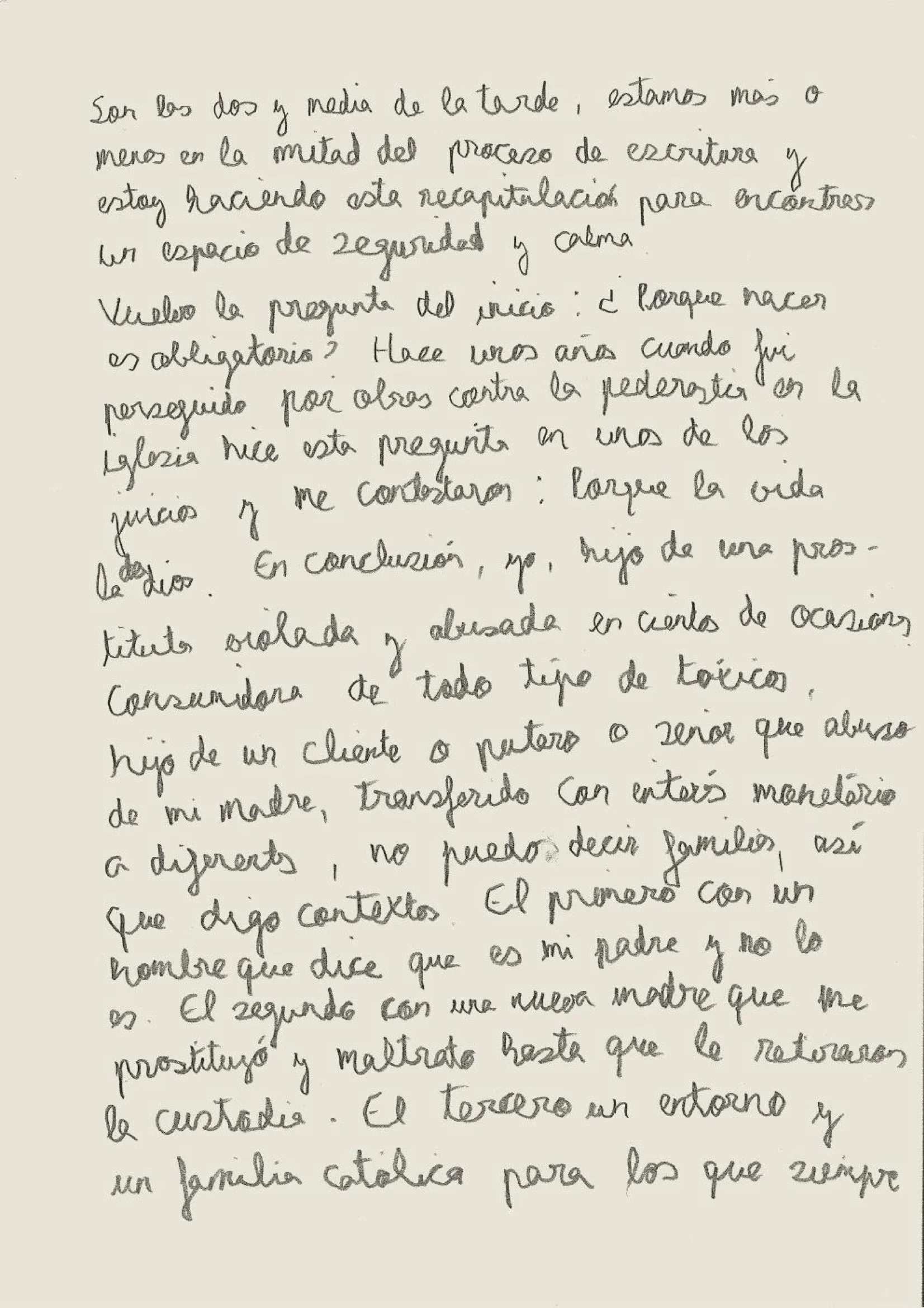
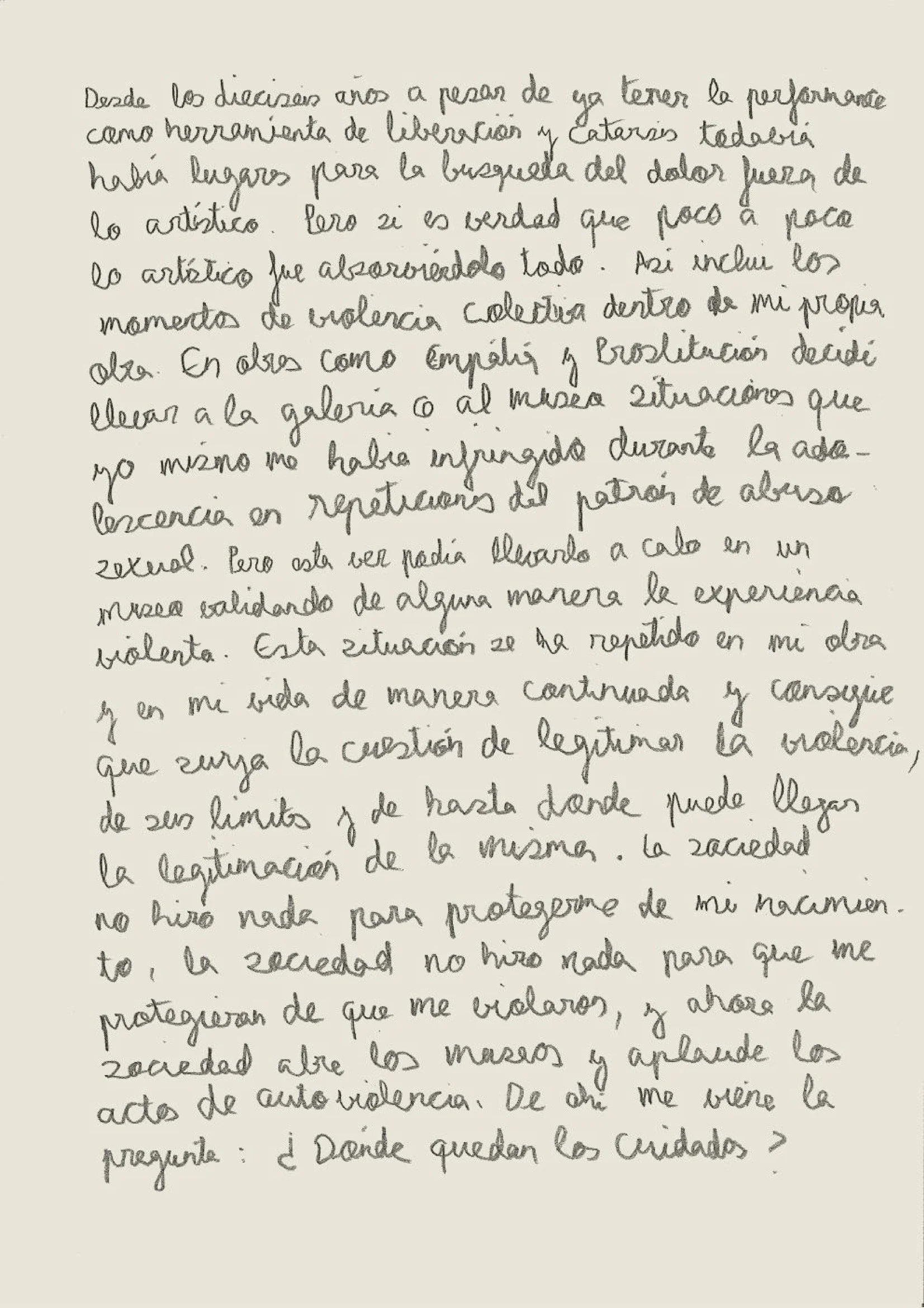
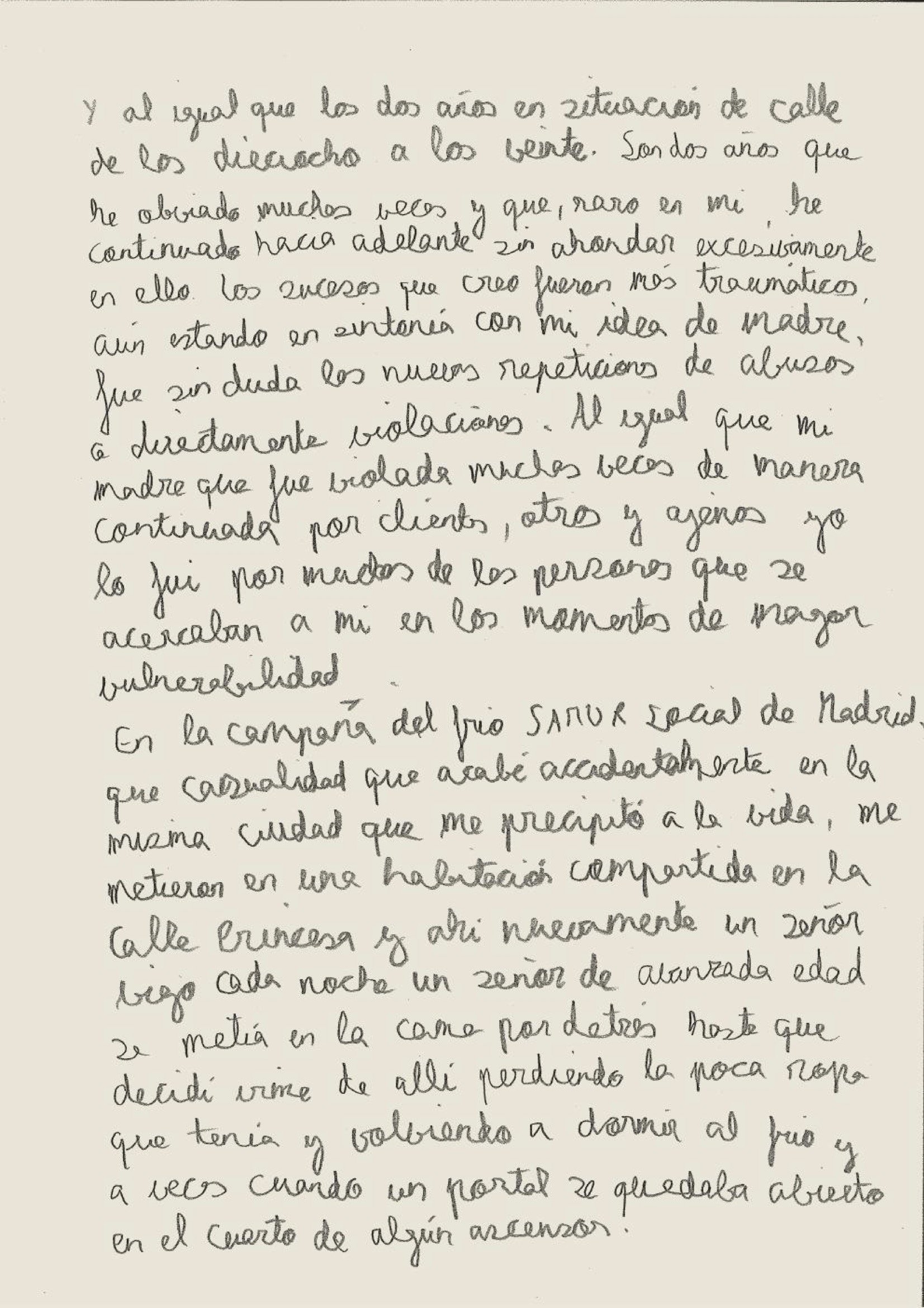
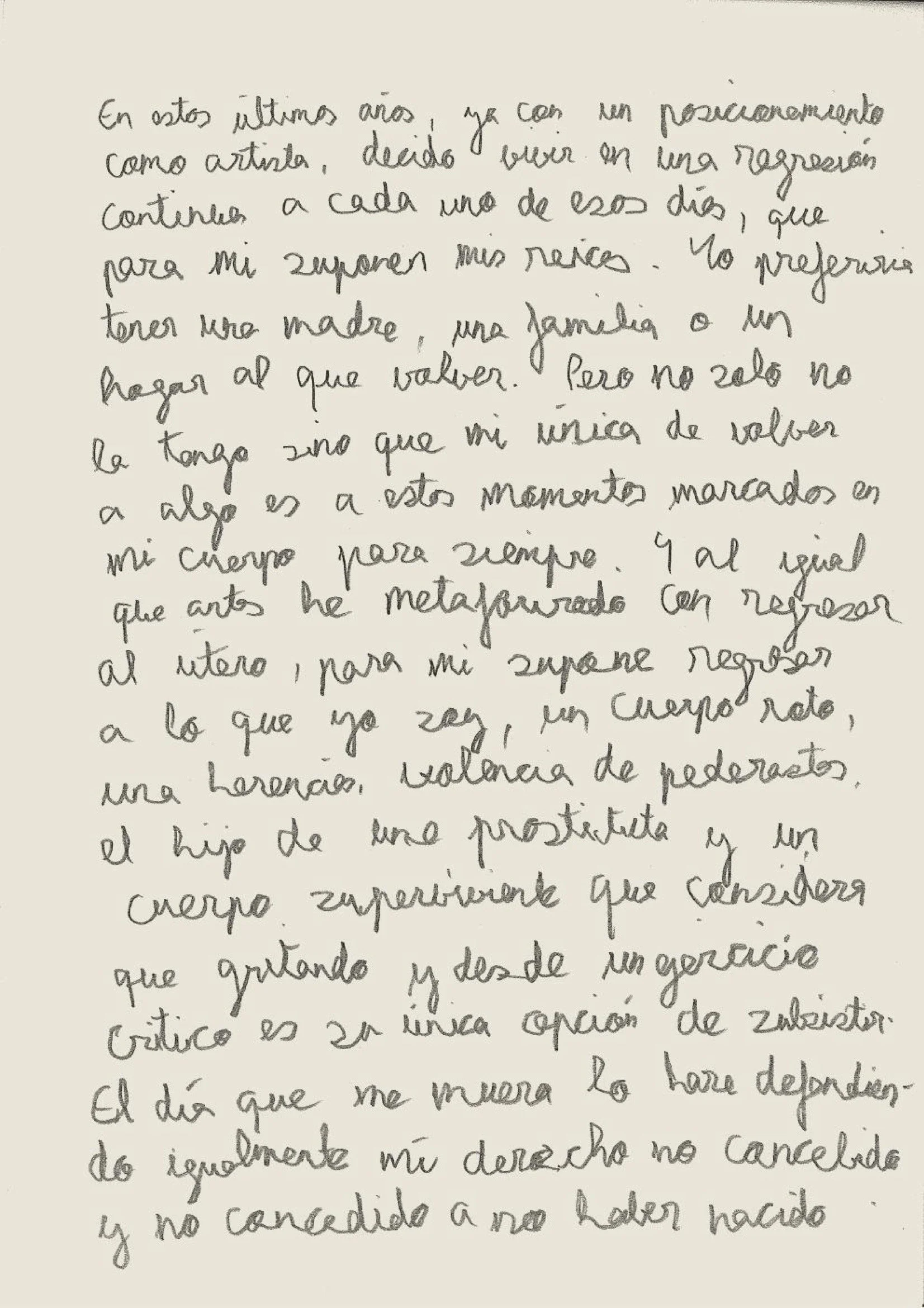
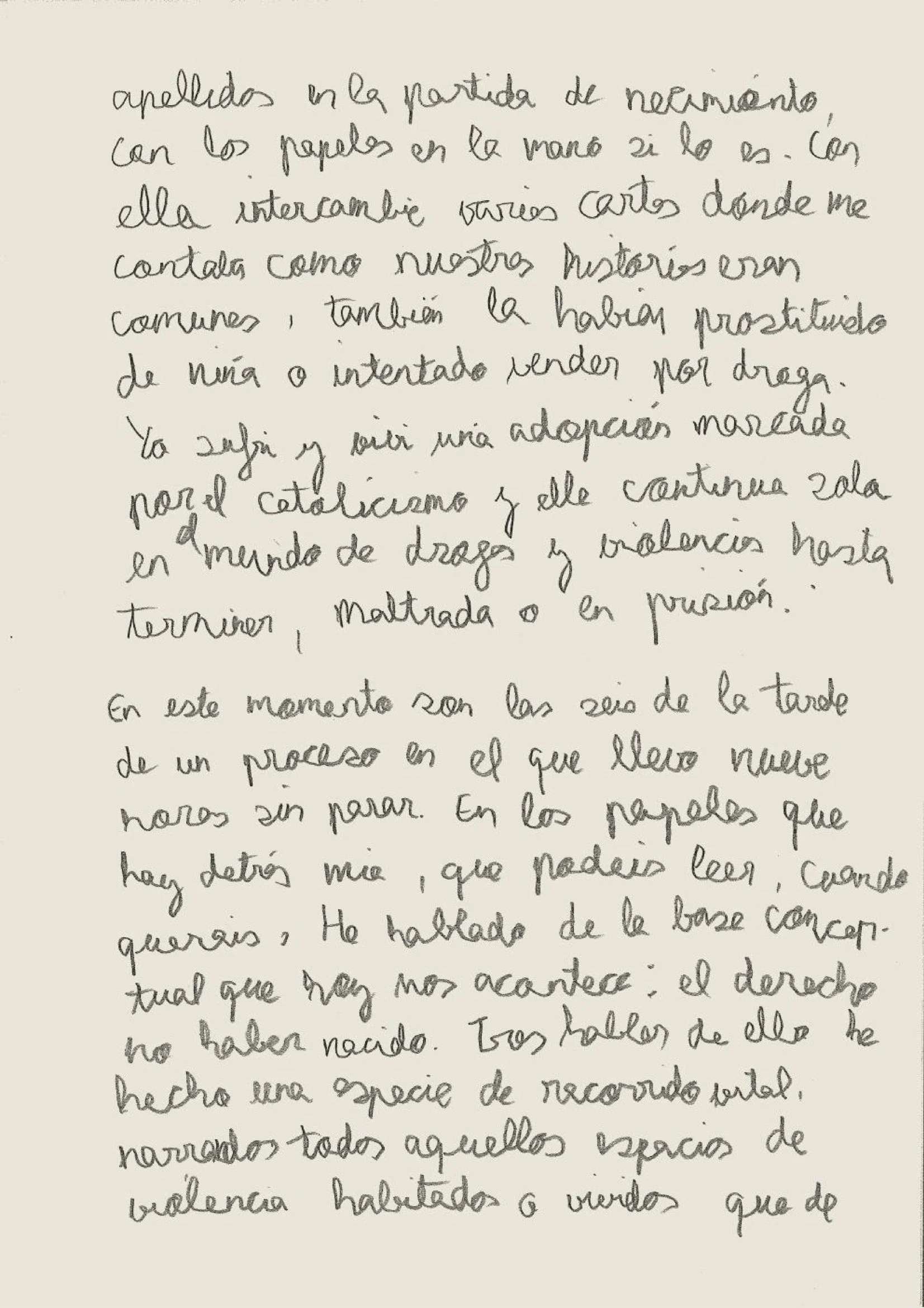
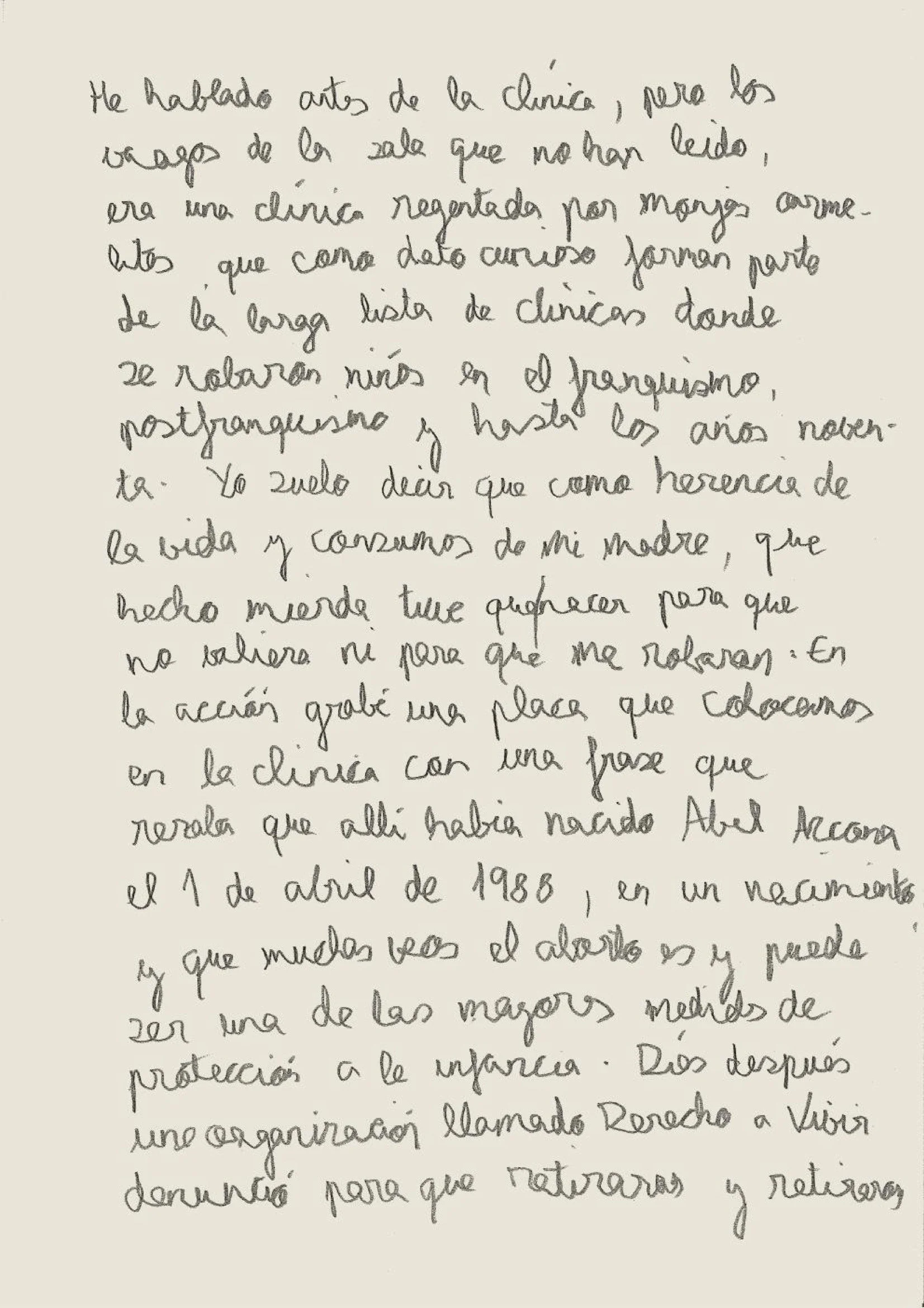
Long-duration and endurance performance piece developed over twelve hours in the Galician alternative space A Casa Branca. Photography: Ramón Yoshimura. Curatorial text: Sara Donoso. / Obra performativa de larga duración y resistencia desarrollada durante doce horas en el espacio alternativo gallego A Casa Branca. Fotografía: Alberto P. Vishneuskiy. Fotografía: Ramón Yoshimura. Texto curatorial: Sara Donoso.
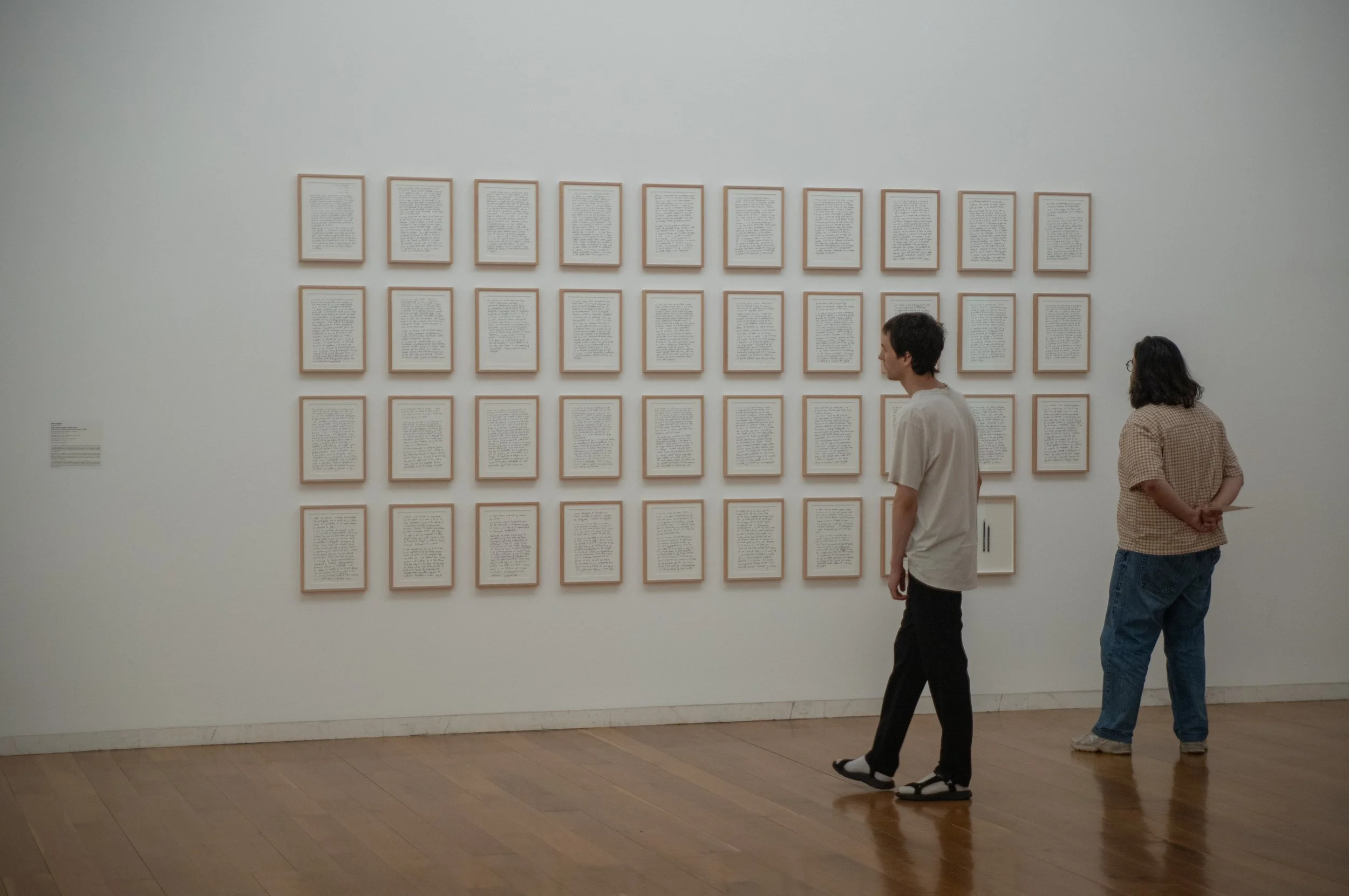
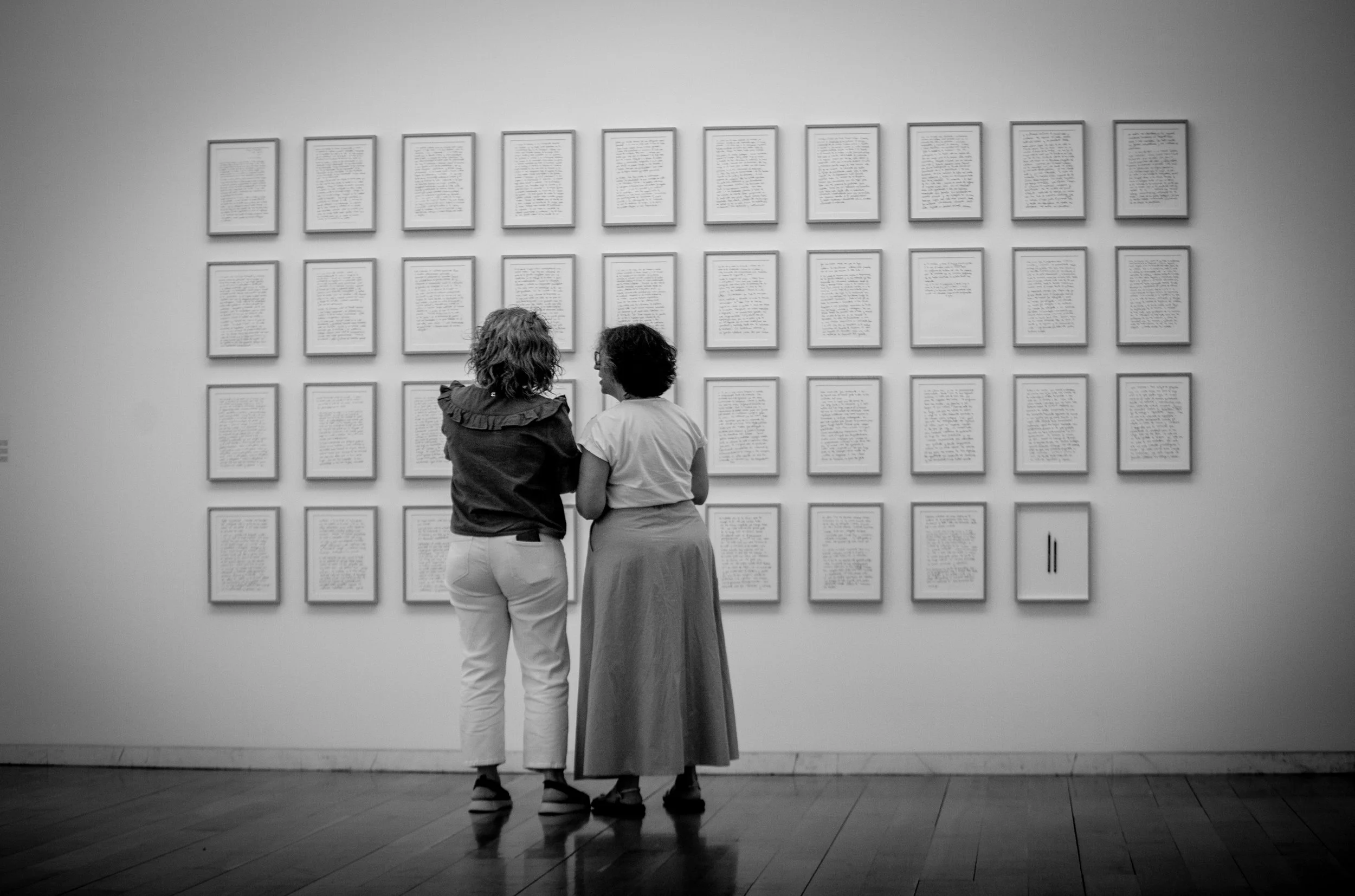
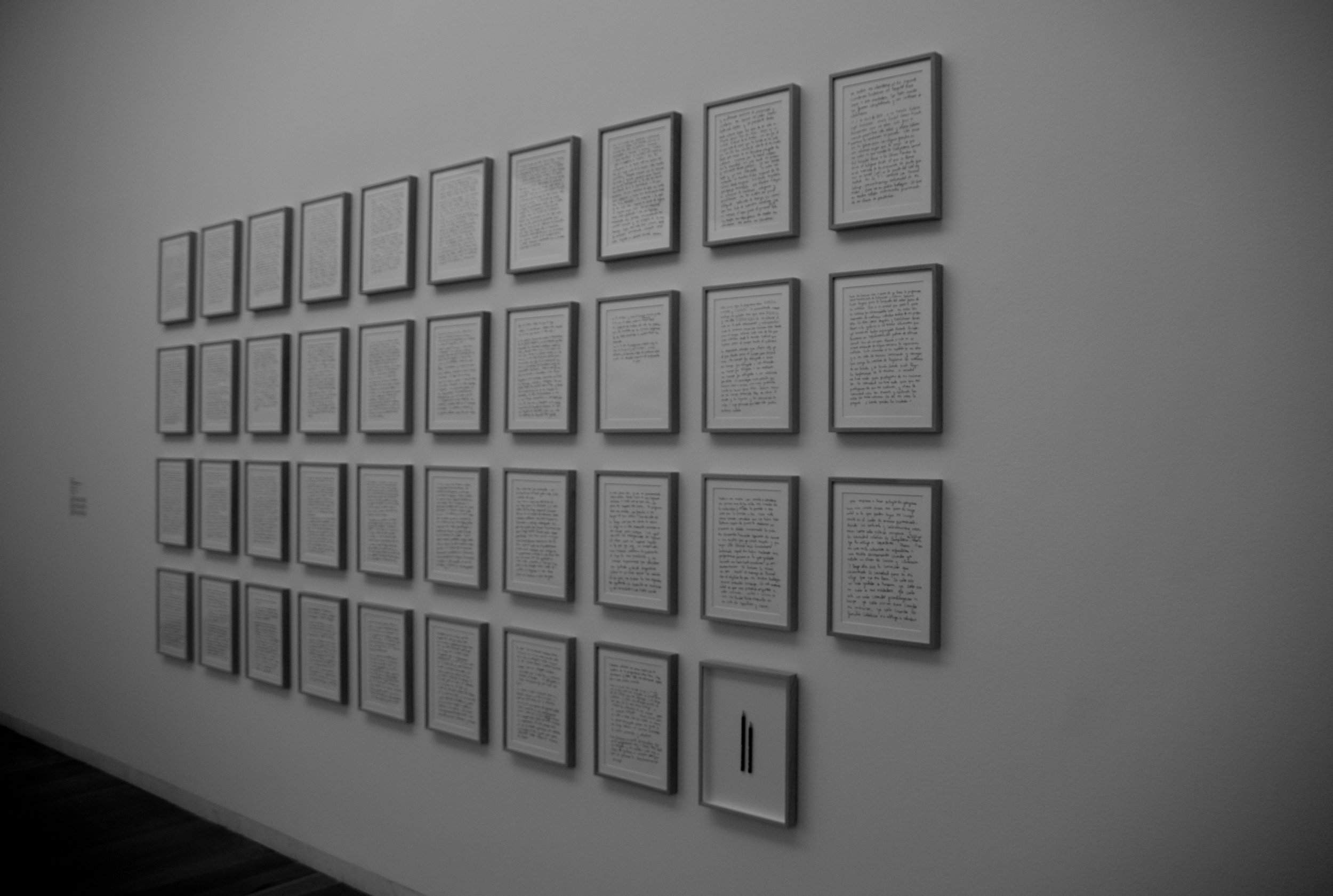
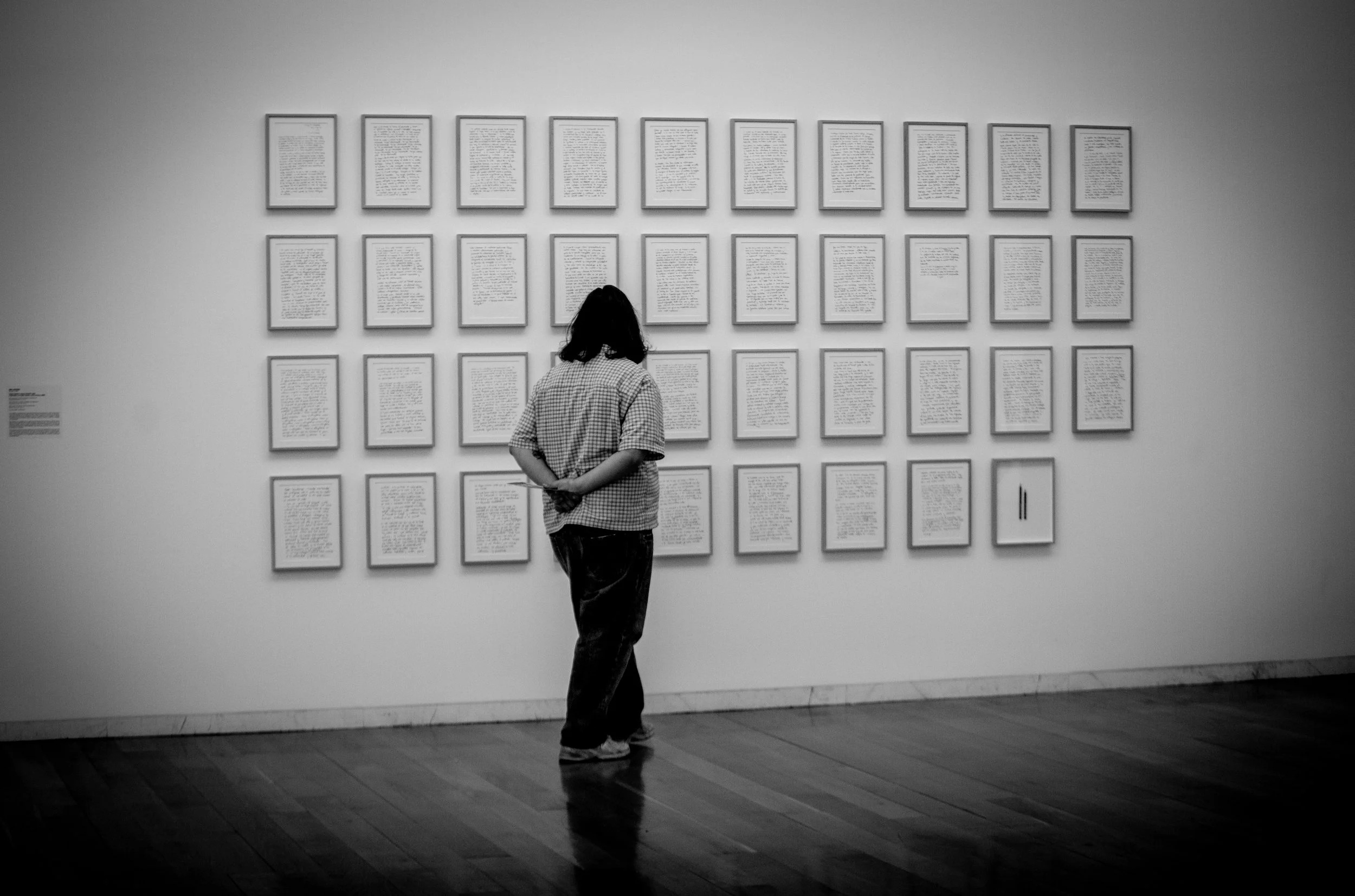
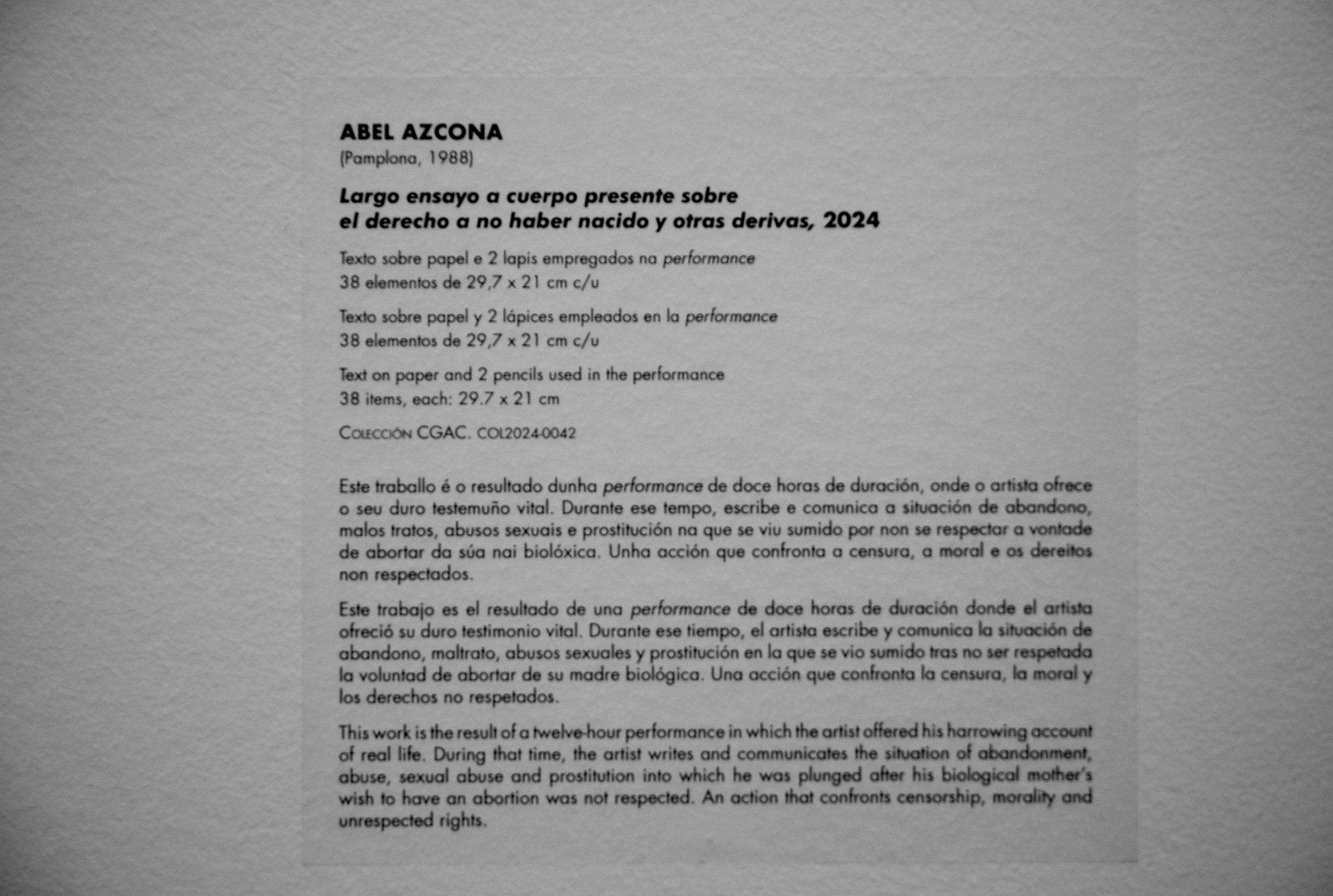
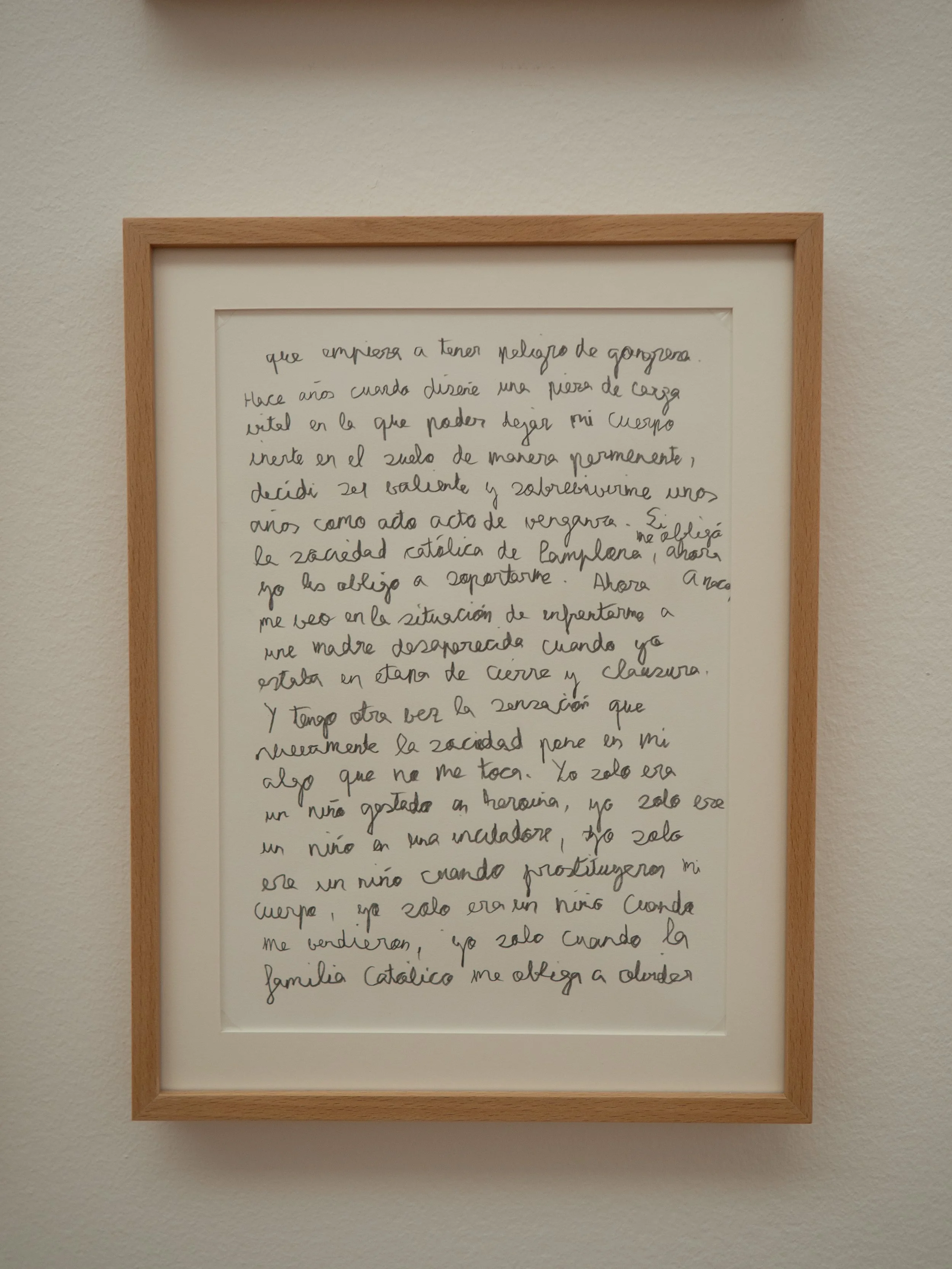
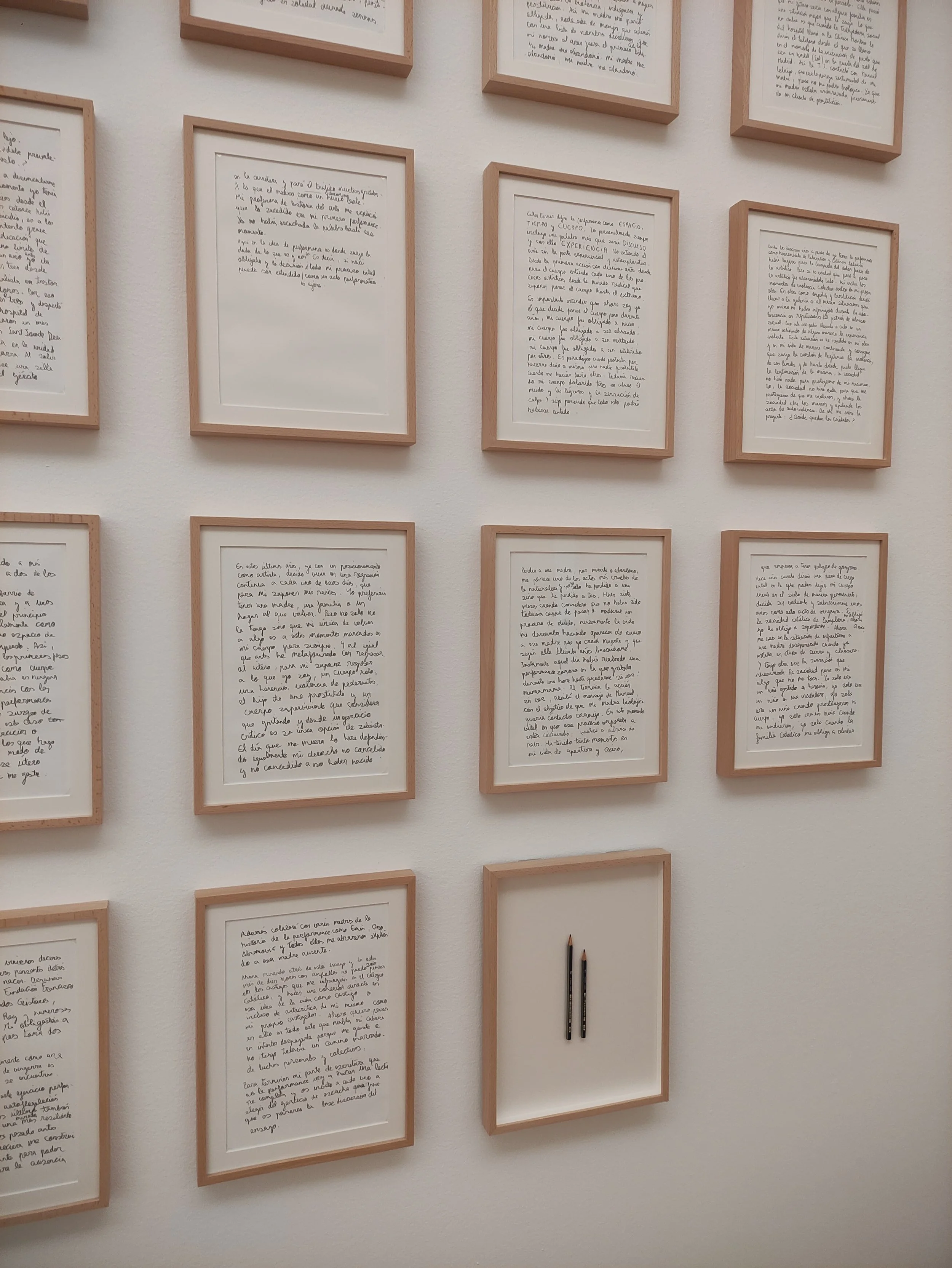
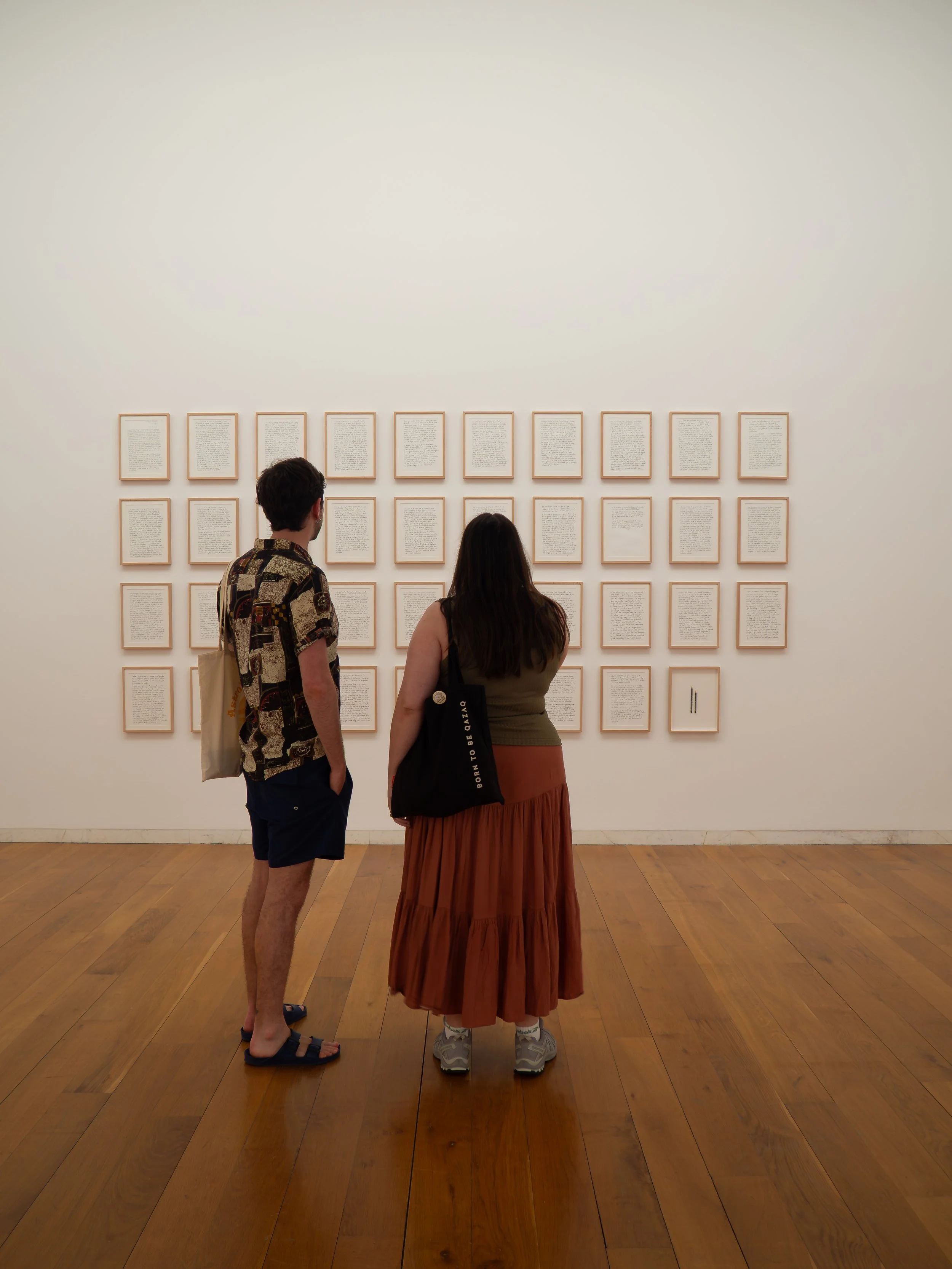
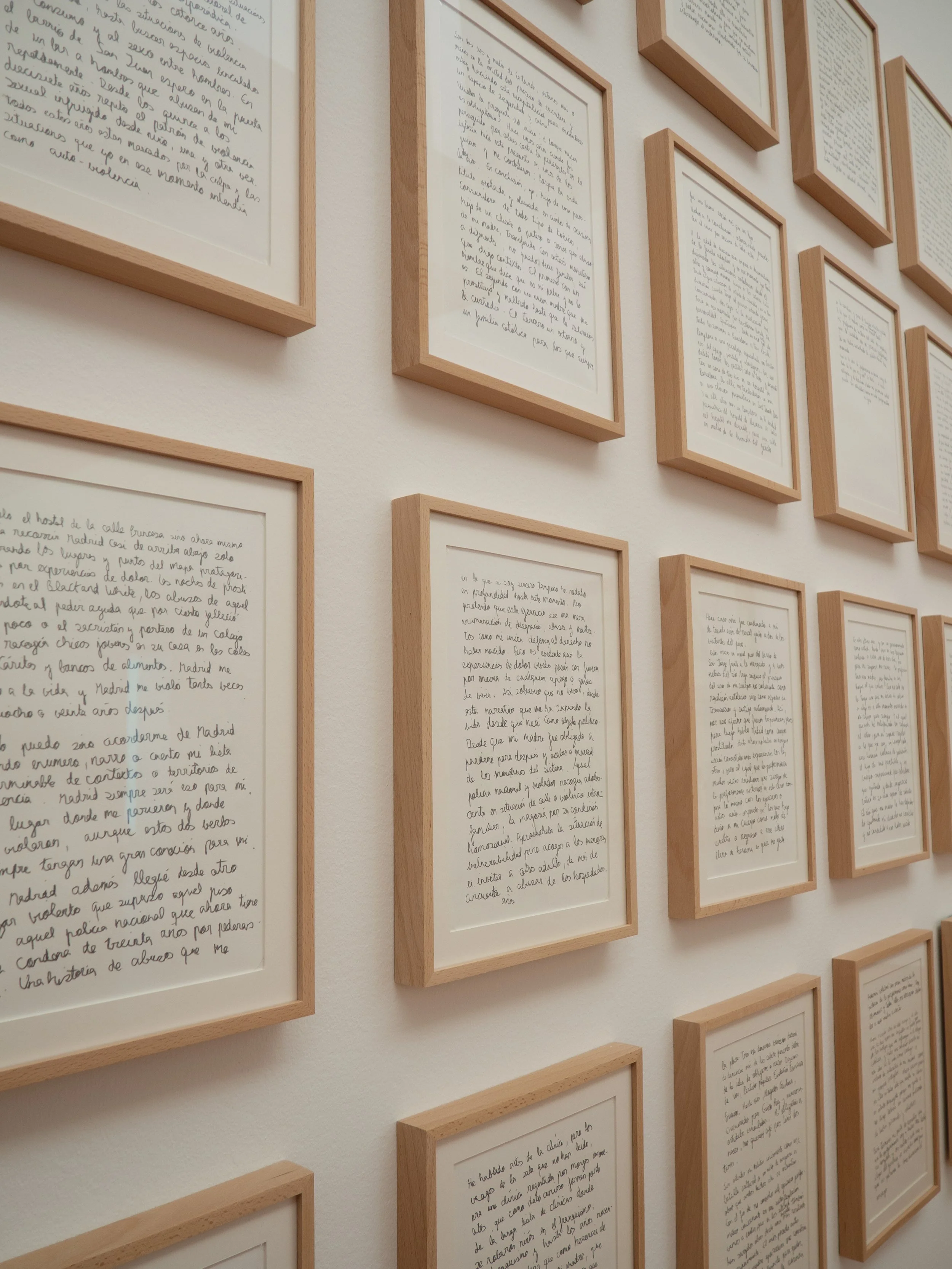
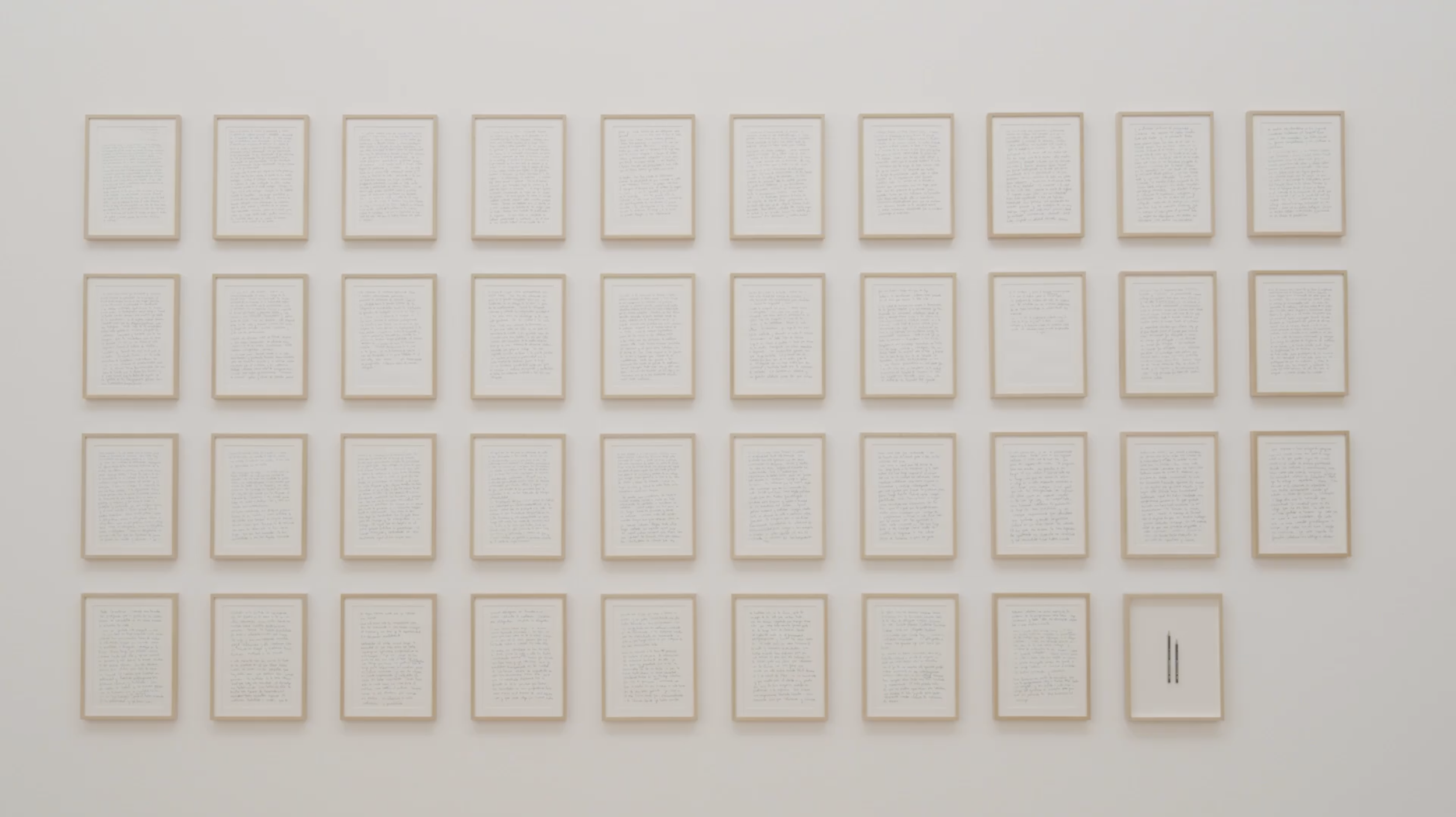
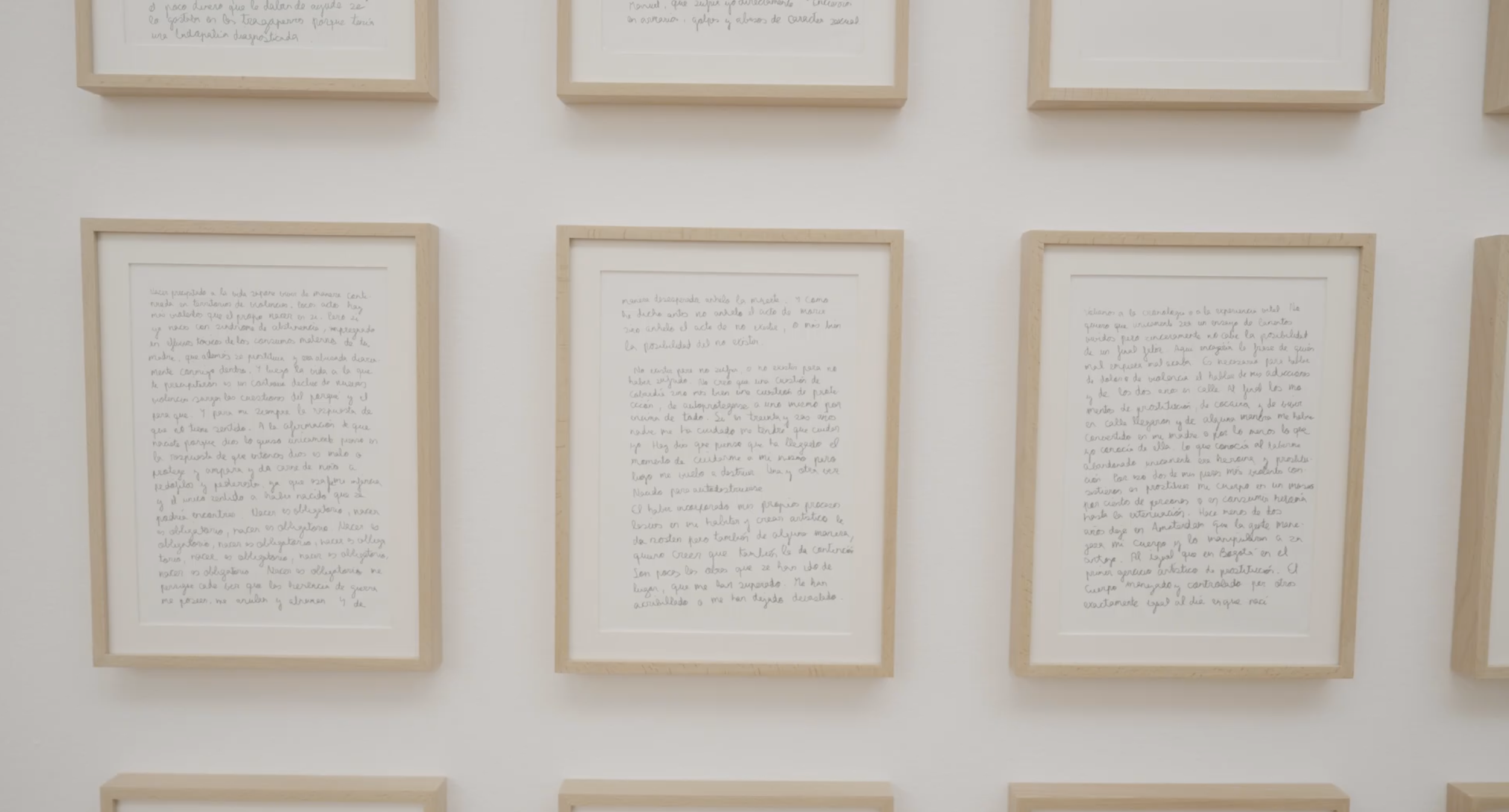
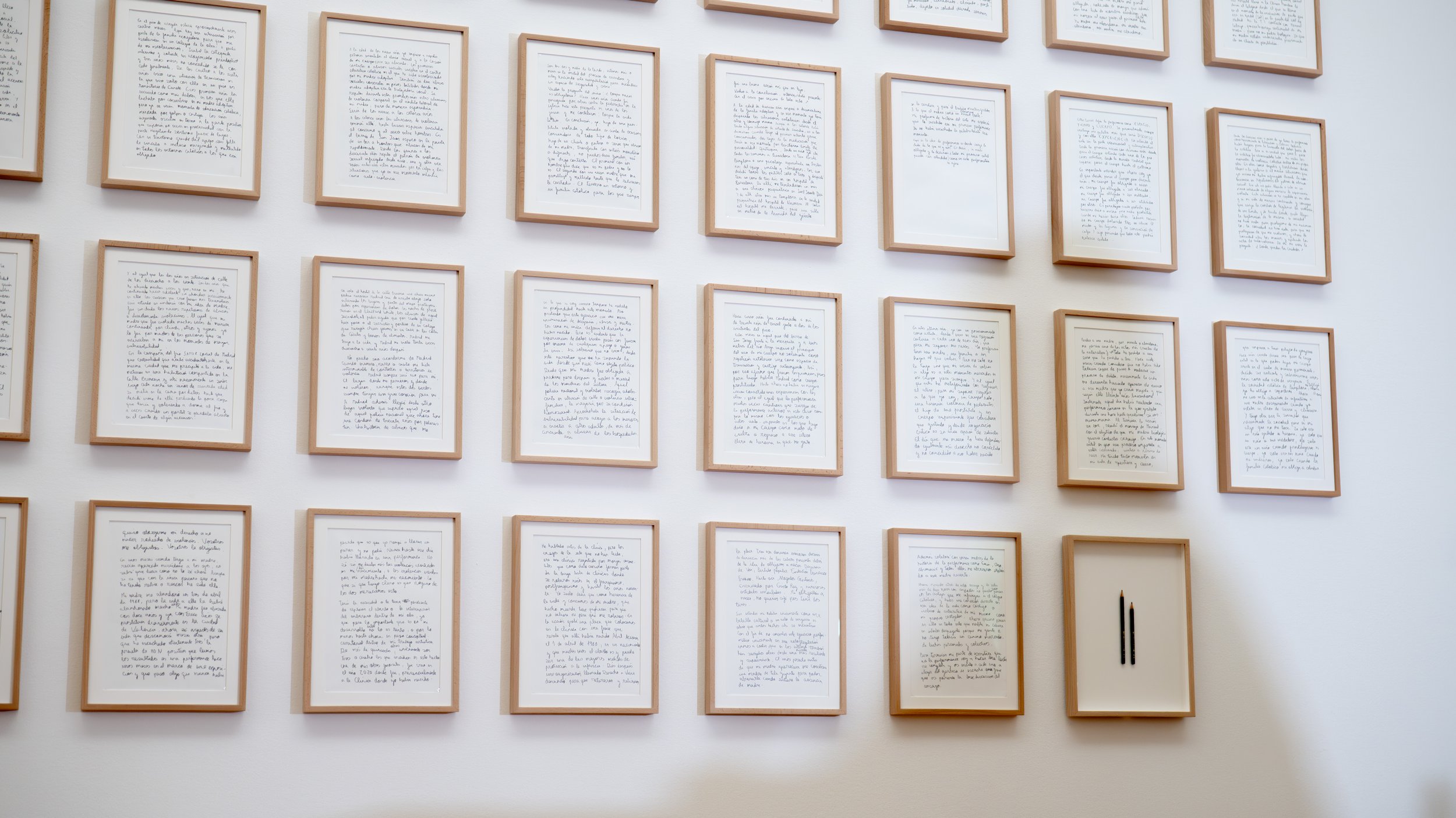
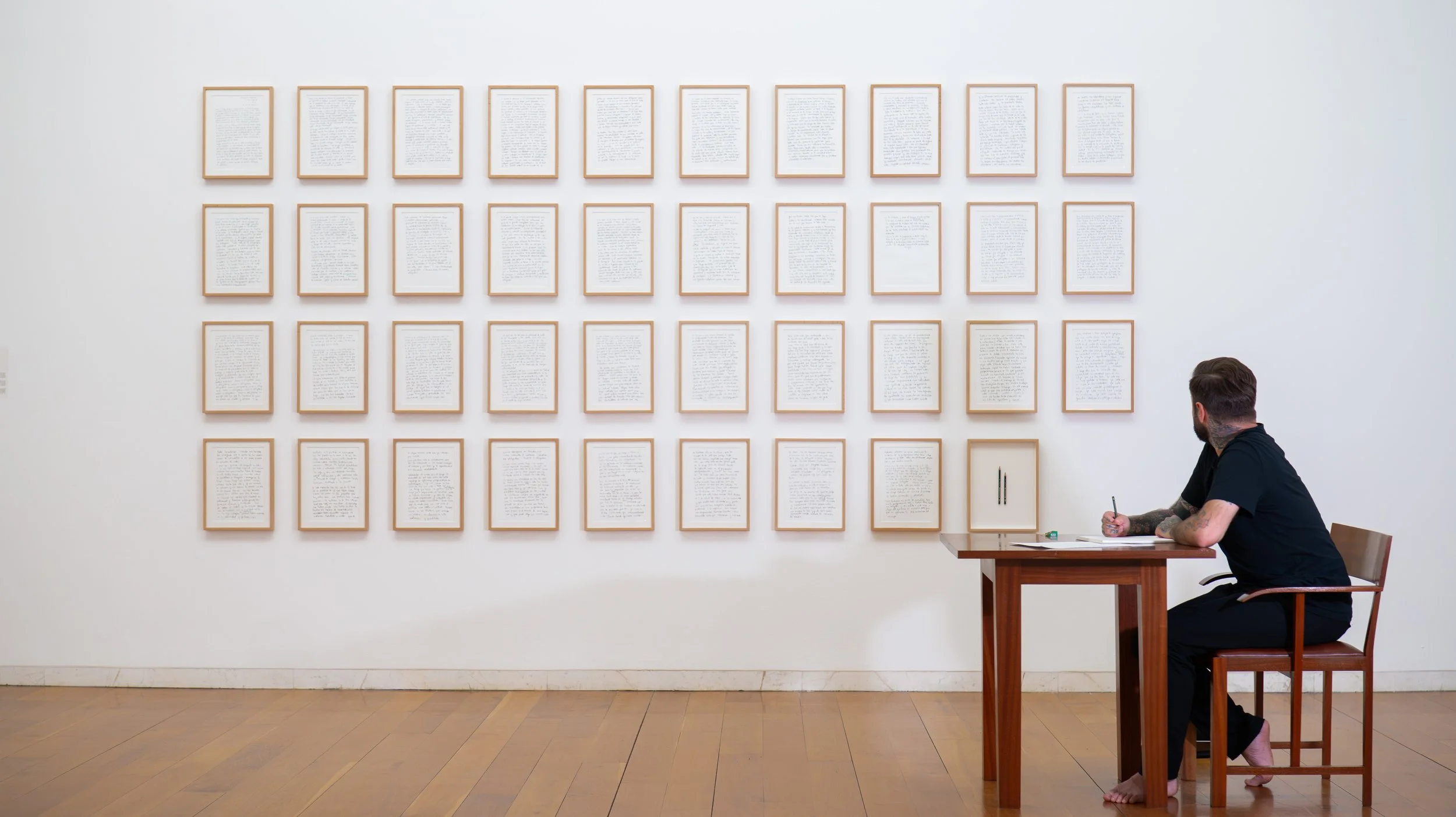
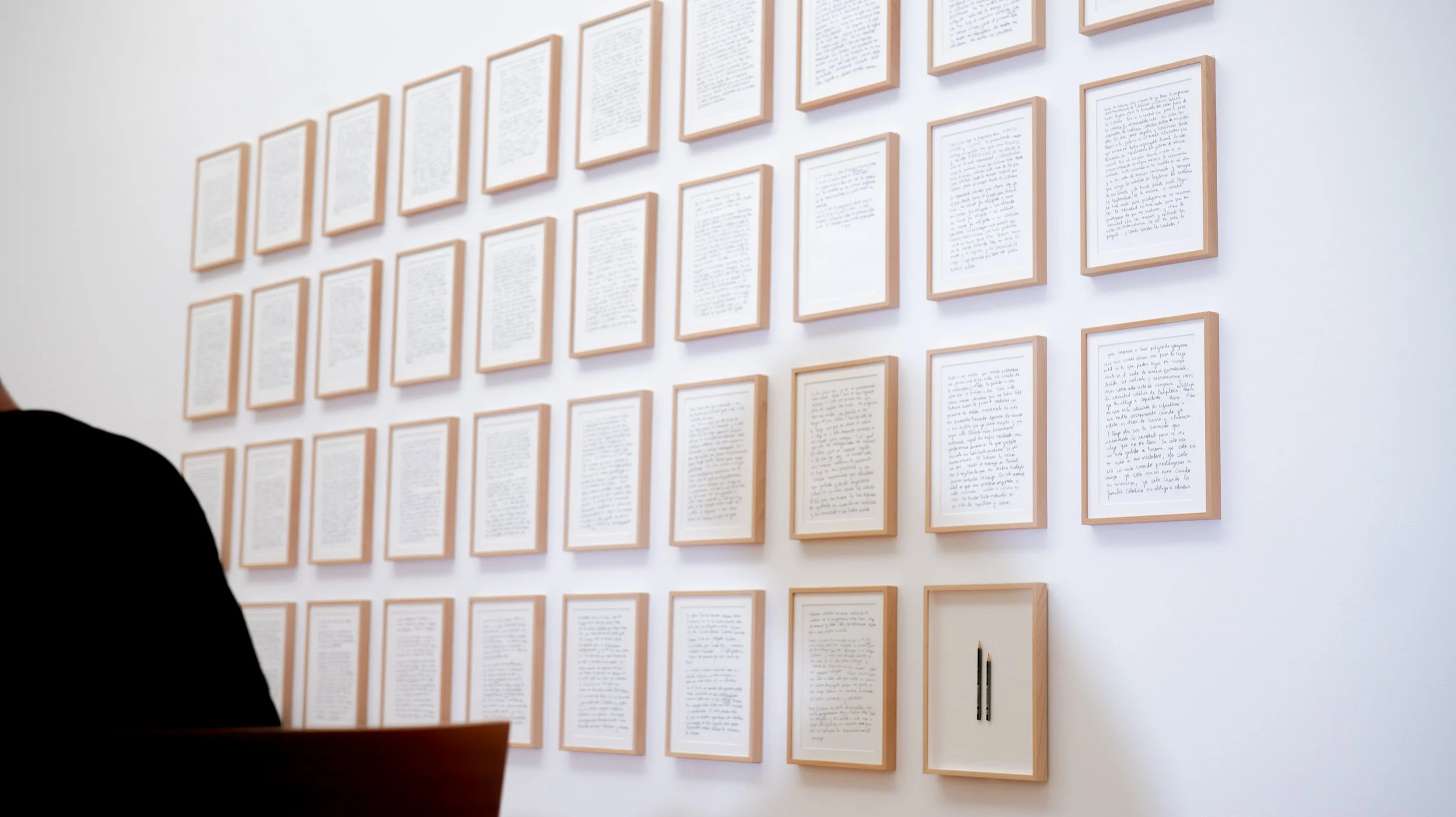
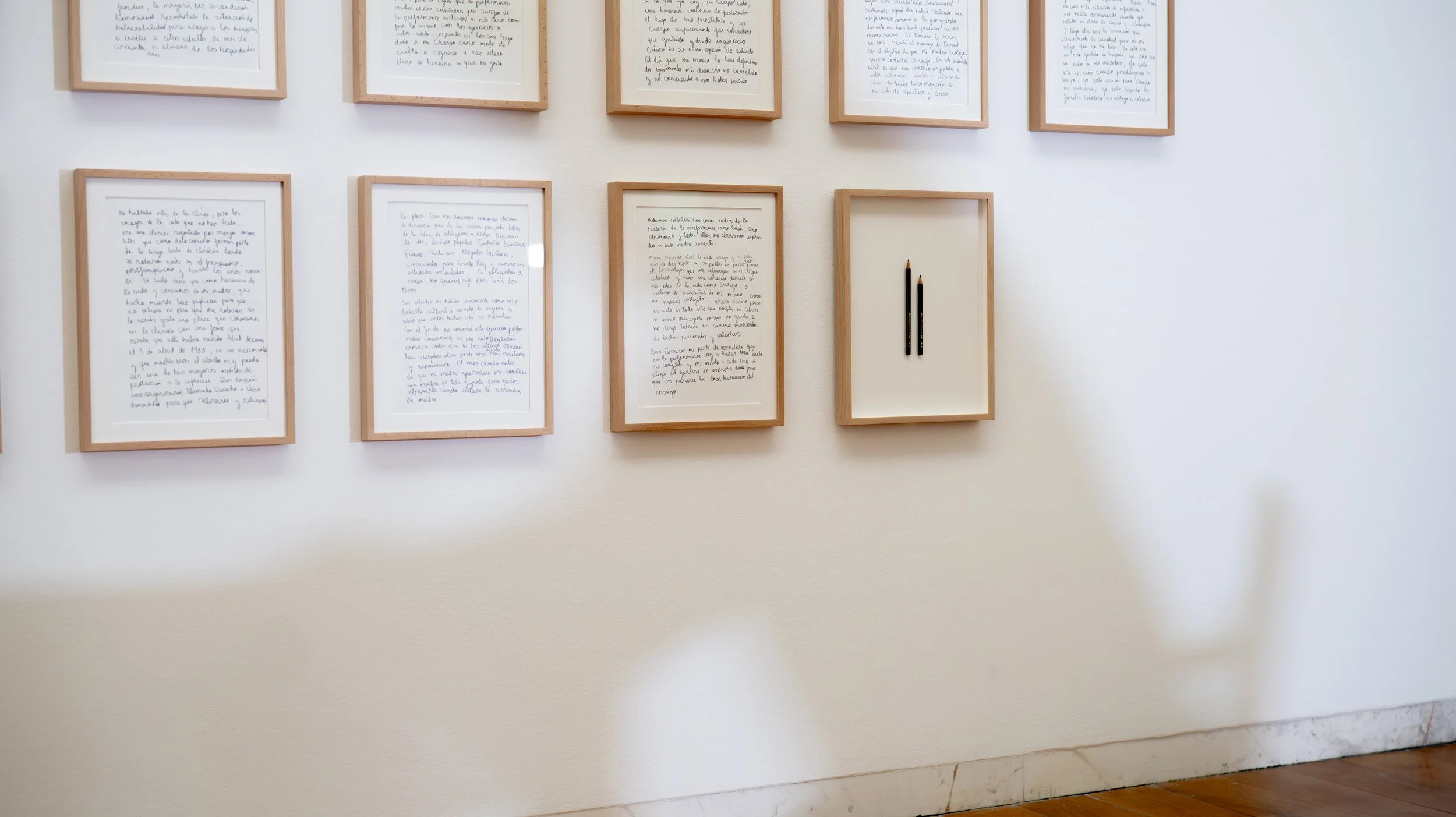
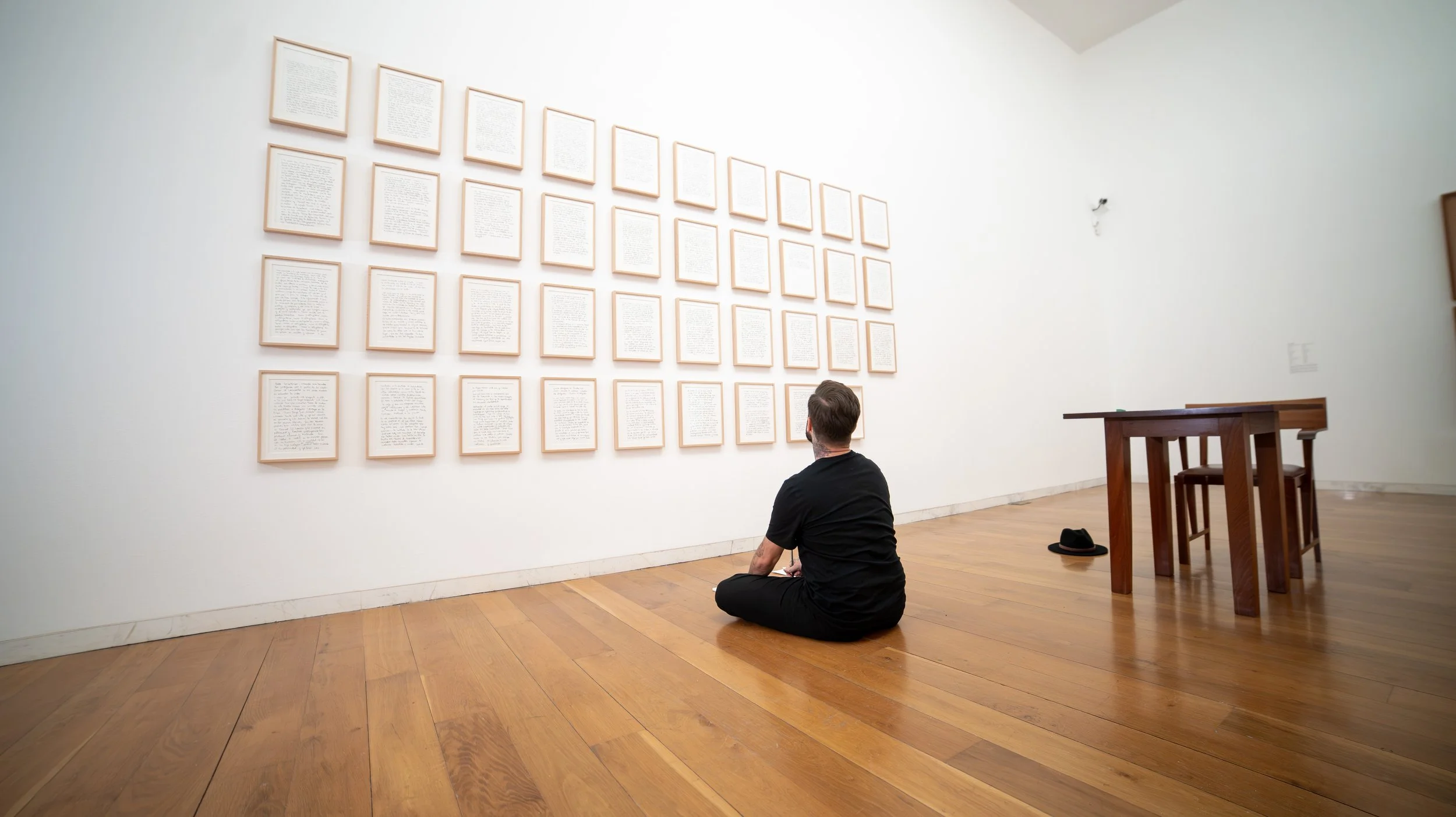
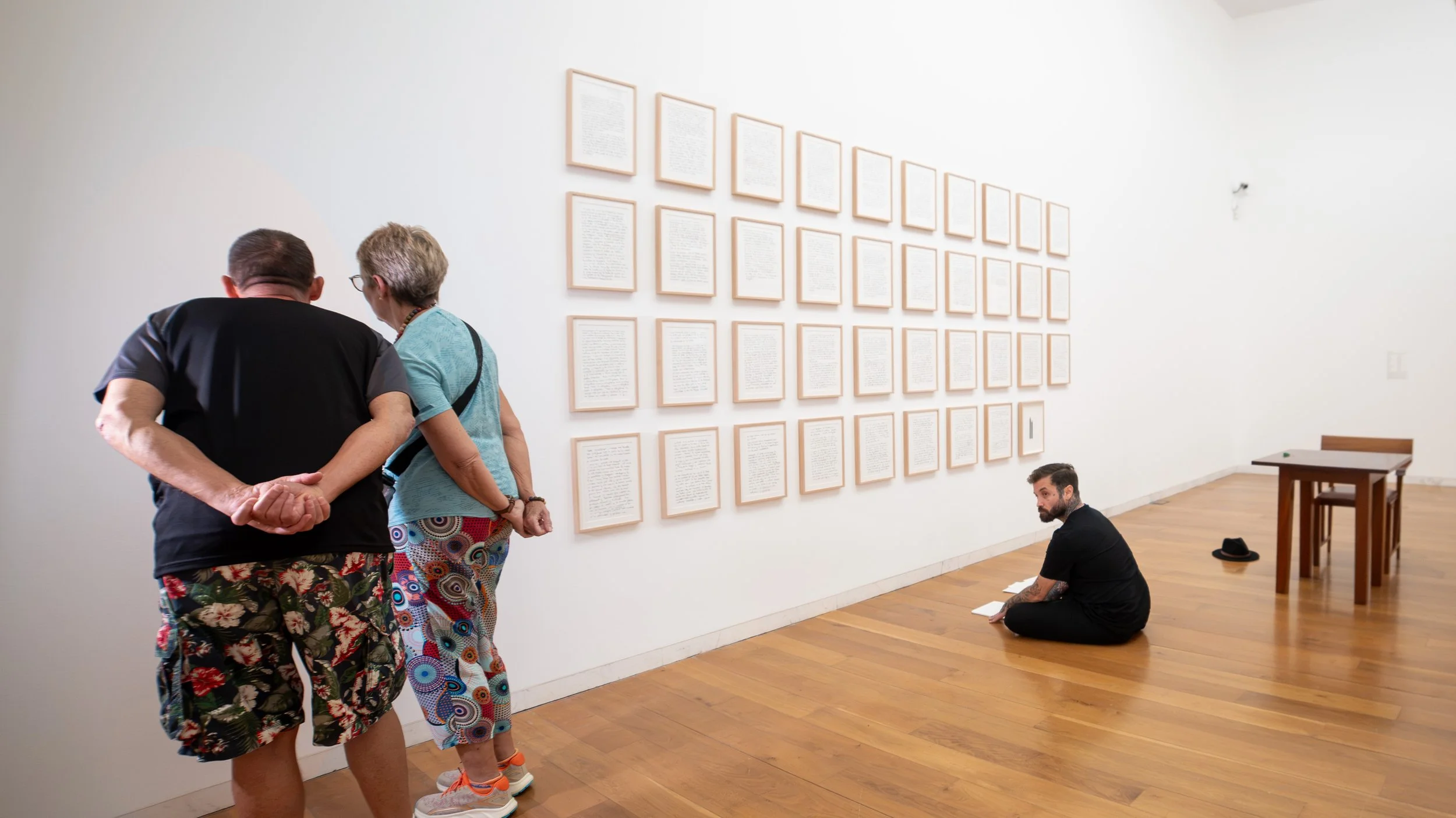
The work Long Rehearsal in the Presence of the Body on the Right Not to Have Been Born and Other Drifts has been on display in the permanent collection of the CGAC (Galician Centre for Contemporary Art) since June 2026. / La obra Largo ensayo a cuerpo presente en torno al derecho a no haber nacido y otras derivas expuesta en la Colección permanente del CGAC Centro Galego de Arte Contemporánea desde junio de 2026.

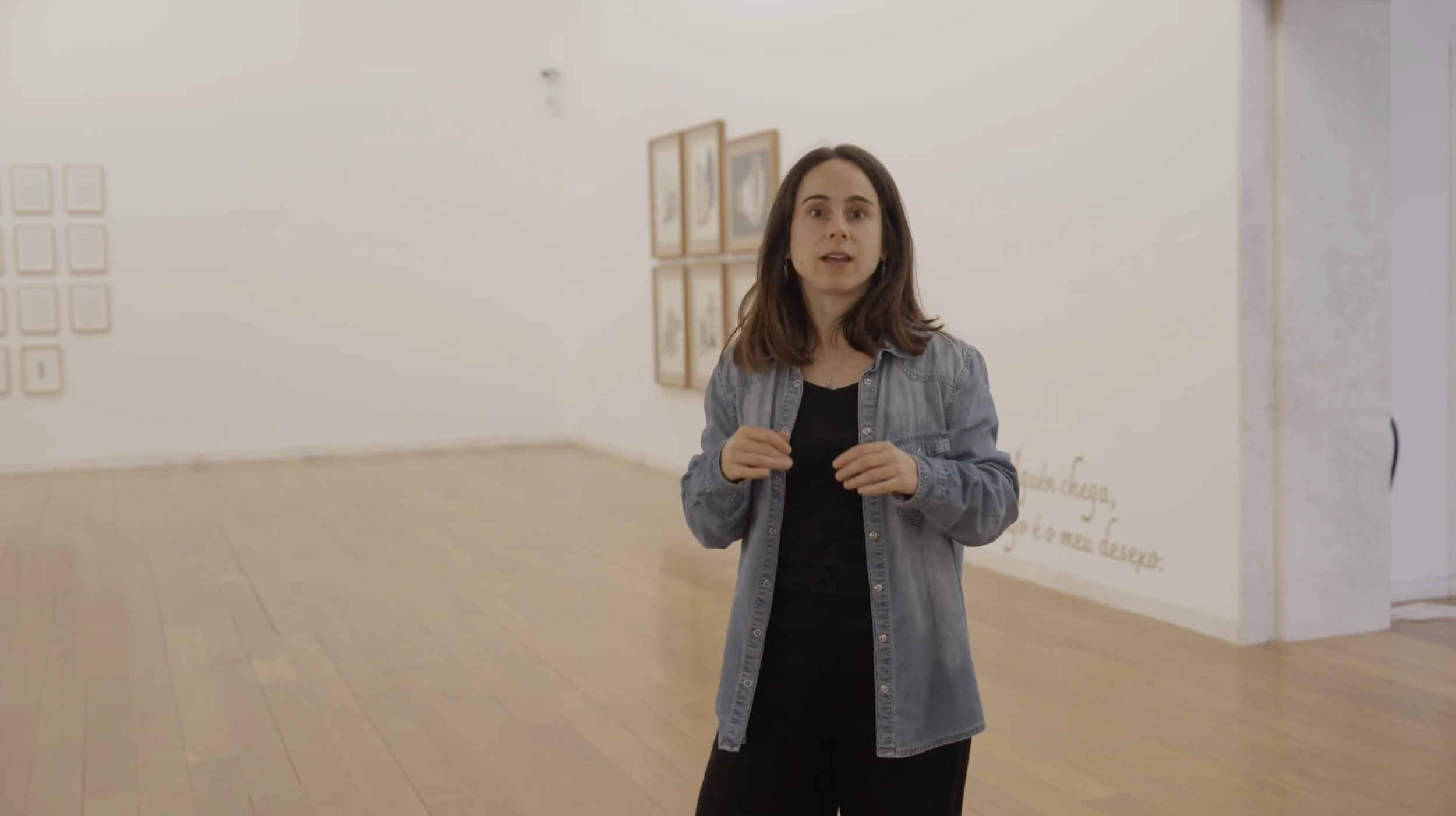
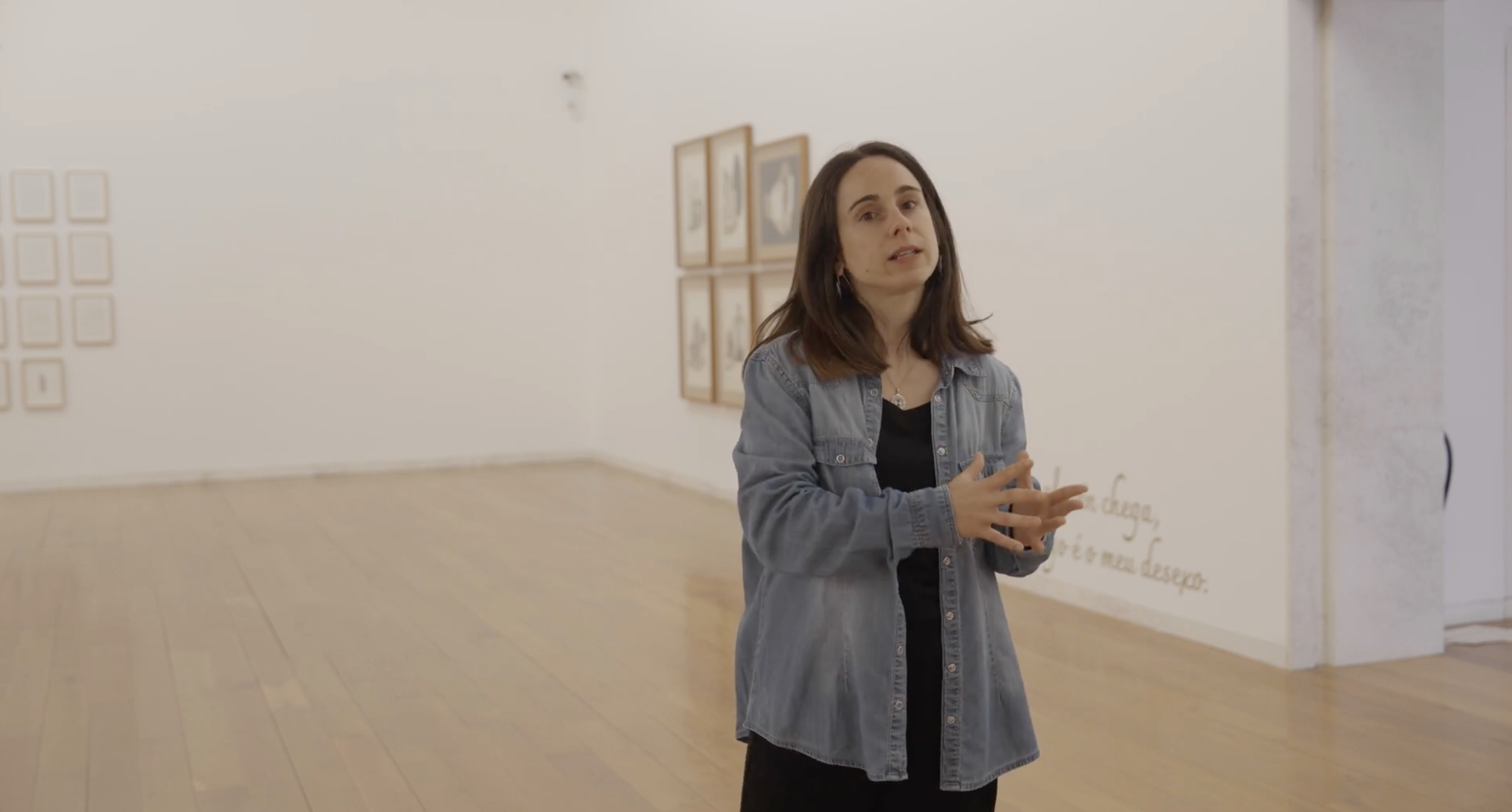
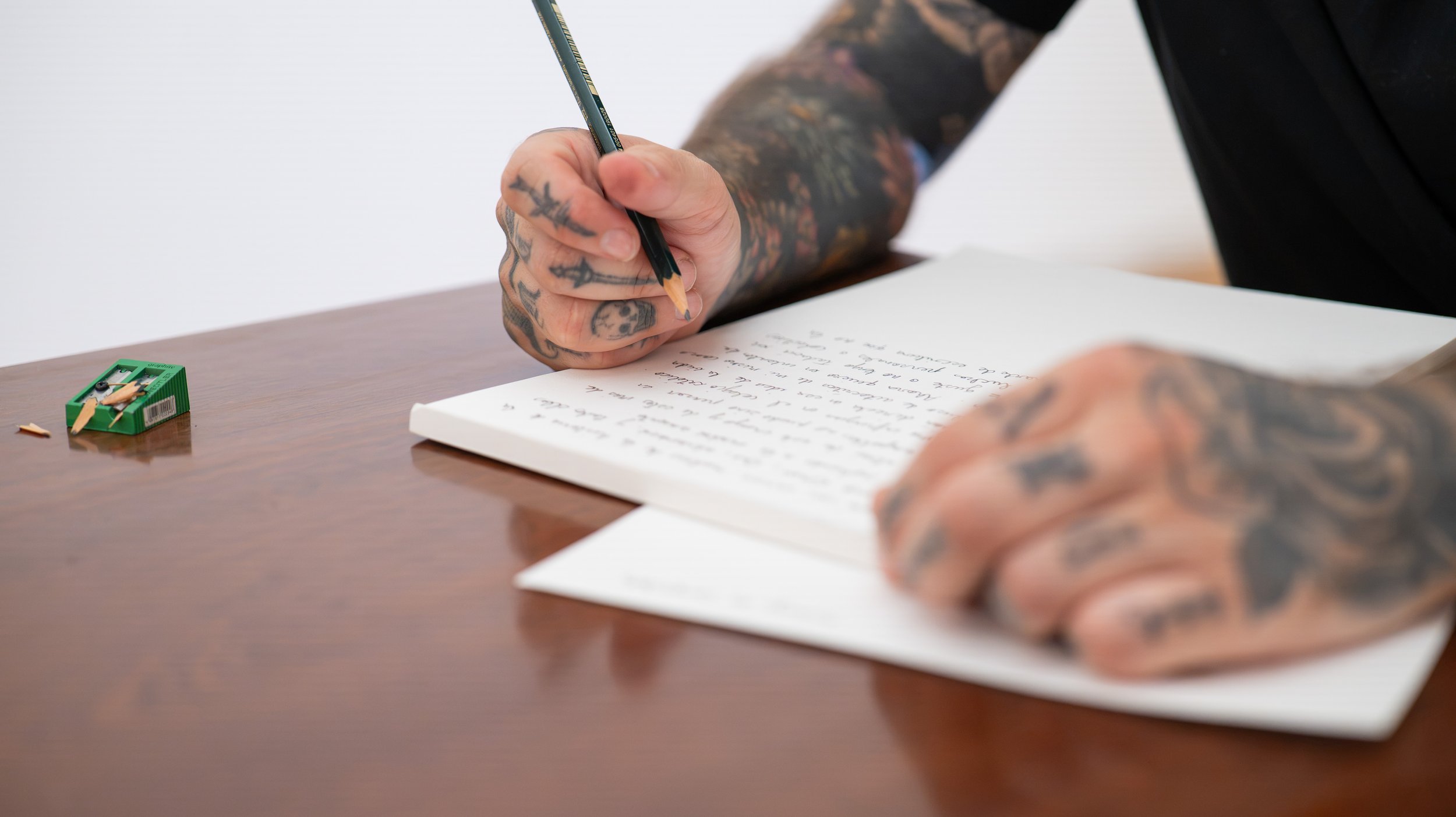
Abel Azcona during the reactivated performance at CGAC, as part of the work in the collection. / Abel Azcona durante la performance reactivada en el CGAC en el marco de la obra en colección.
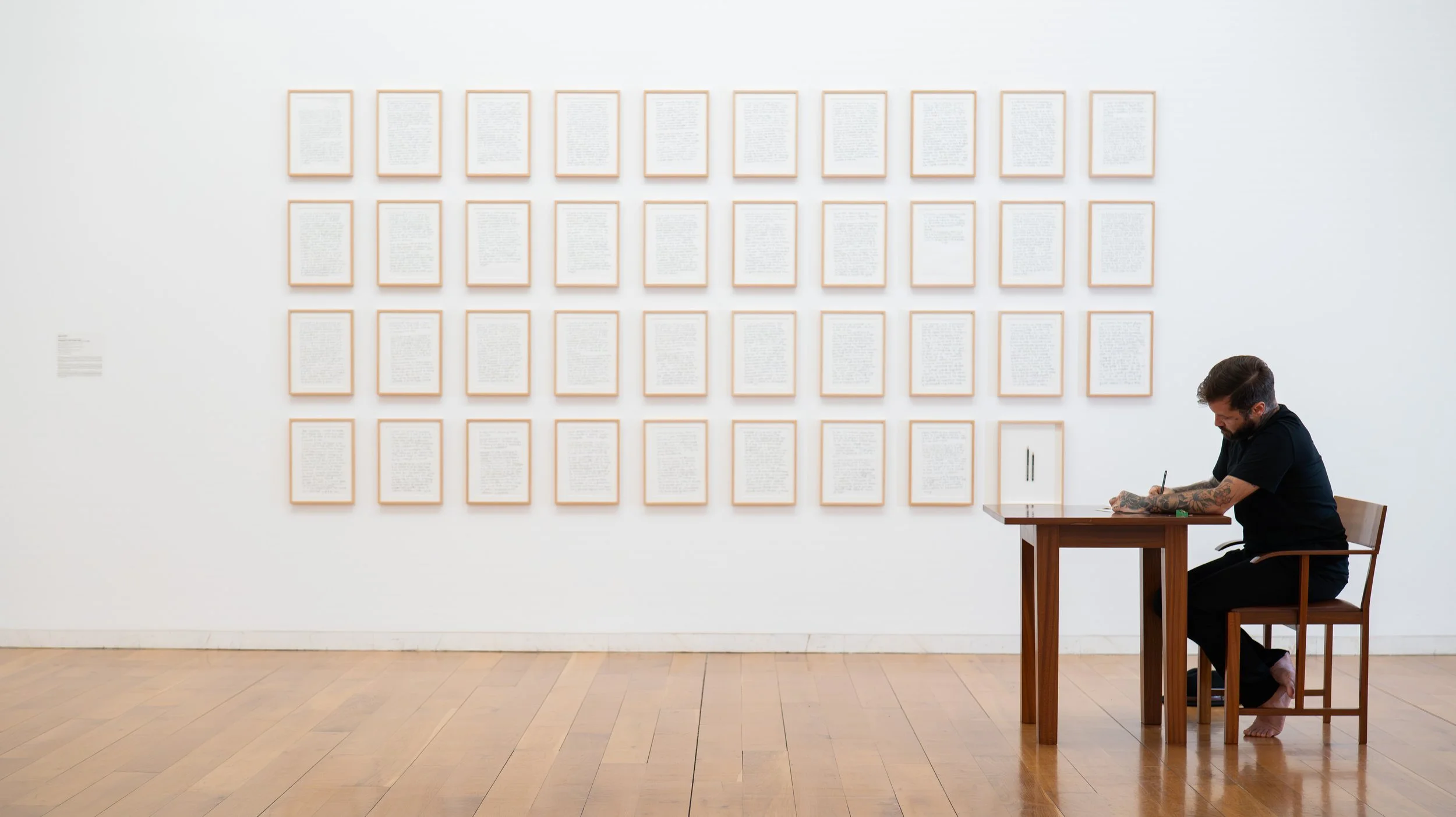
Abel Azcona during the reactivated performance at CGAC, as part of the work in the collection. / Abel Azcona durante la performance reactivada en el CGAC en el marco de la obra en colección.
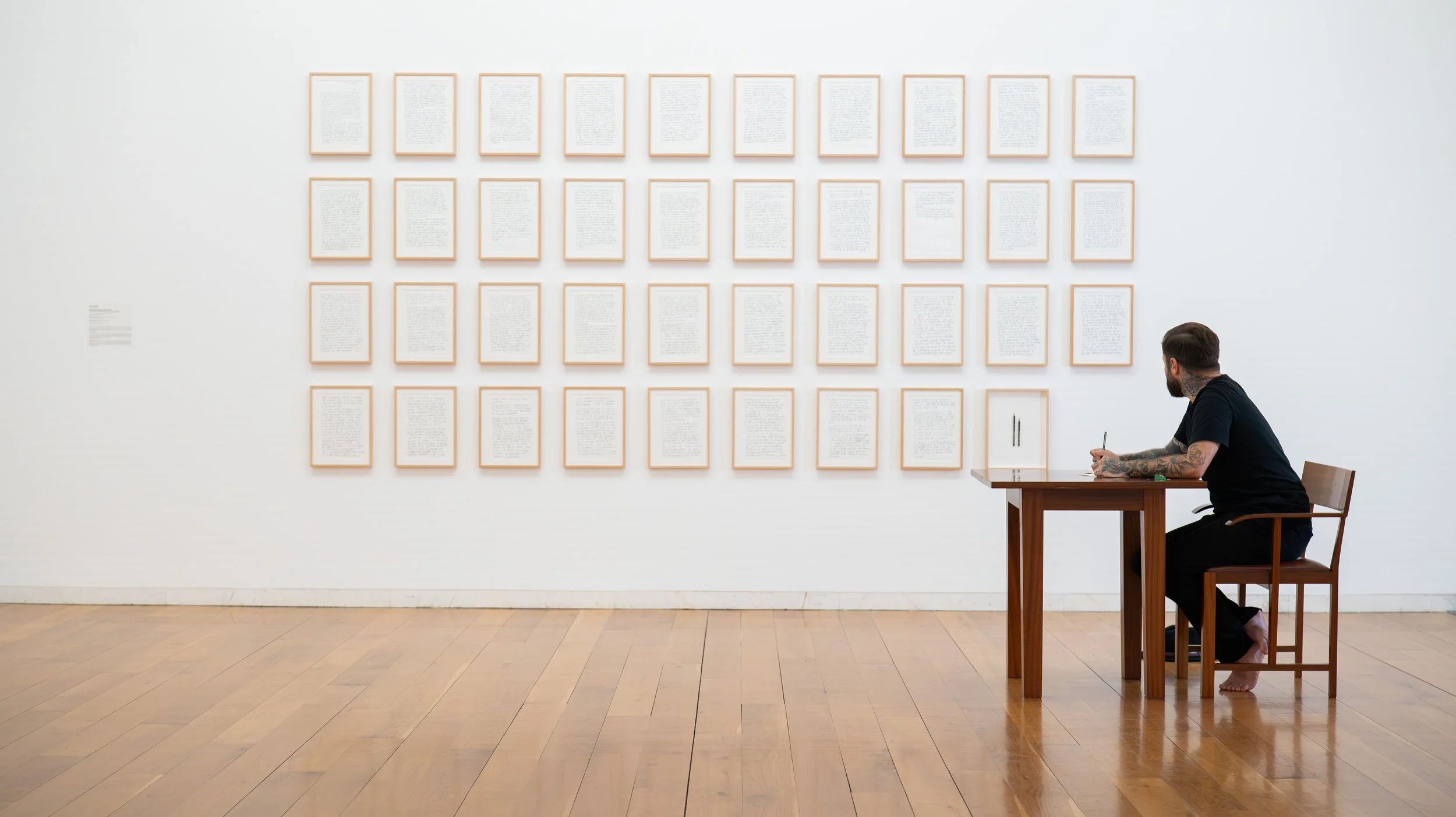
Abel Azcona during the reactivated performance at CGAC, as part of the work in the collection. / Abel Azcona durante la performance reactivada en el CGAC en el marco de la obra en colección.
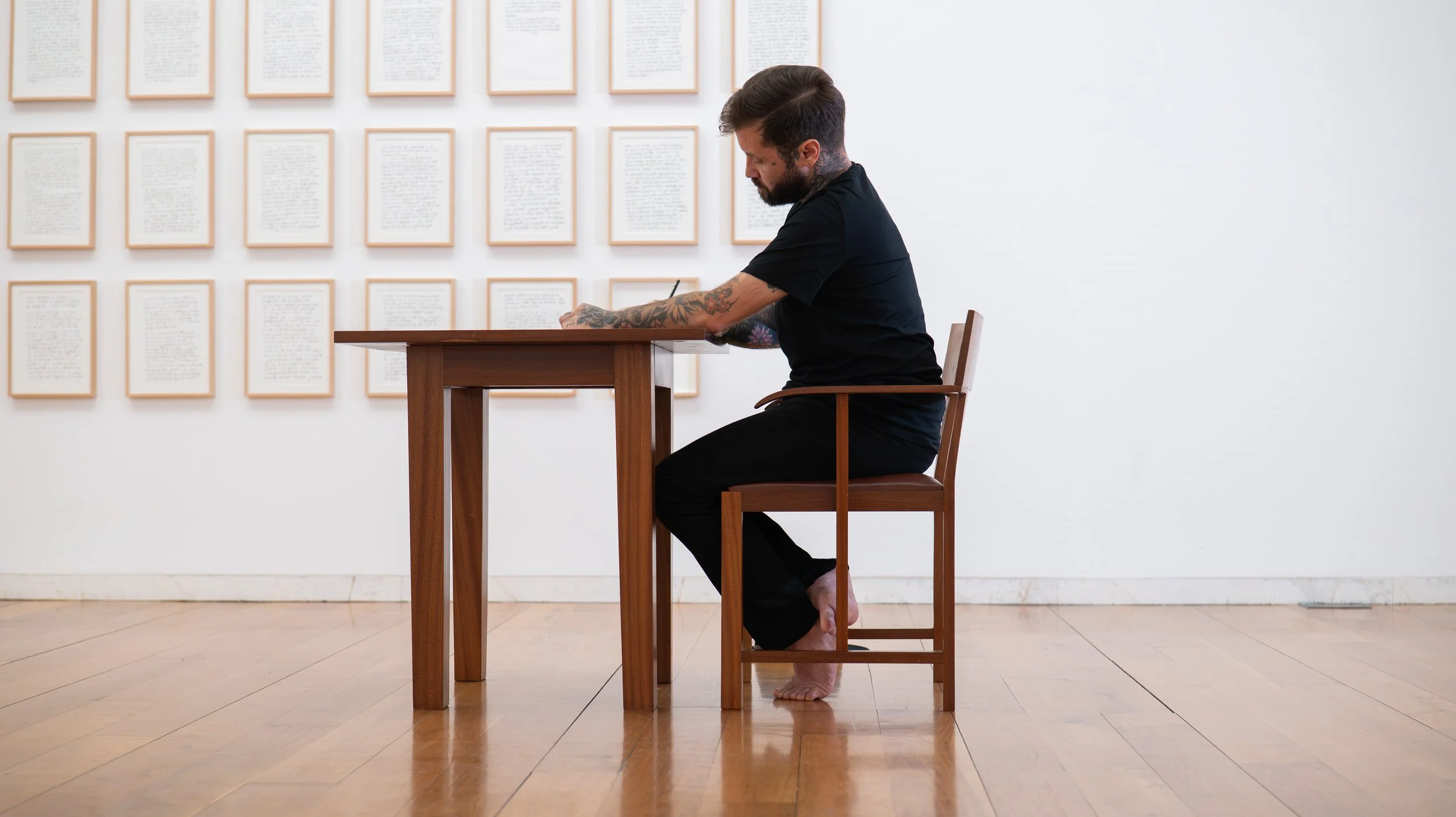
Abel Azcona during the reactivated performance at CGAC, as part of the work in the collection. / Abel Azcona durante la performance reactivada en el CGAC en el marco de la obra en colección.
It is difficult to speak of a raw work that feeds on the viscera and strengthens through the recreation of drama. It becomes complex when we look from a distance and somehow become accomplices of the spectacle. I am speaking of a spectacle that intellectualizes suffering to elevate it to the category of art and often finds suspicious similarities with ceremonious narratives fueled by mainstream media. Abel Azcona said, "society applauds acts of self-violence." They applaud them, curiously, with the same ease with which they condemn them. Although it is not always the act that is subject to judgment, but the context. Known for radical artistic projects in which he pushes his body to the limit, Azcona admits, "It is paradoxical when people protest about me harming myself, but no one protested when others harmed me." From various perspectives, his work teaches us how the same act can signify either the channeling of pain or its condemnation. Factors such as will or its absence, experience, and the framework (both institutional and discursive) within which our actions are inscribed, often subject to multiple mechanisms of control, are crucial.
In Long Essay in Person on the Right Not to Have Been Born and Other Drifts, Abel Azcona offers a harsh personal testimony, making writing a medium through which he transfers his story. Over 12 hours, he writes and communicates to the audience the situation of abandonment, abuse, sexual assault, and prostitution he was subjected to after his biological mother's wish to abort was not respected. However, this is not a performance about abortion, but about life and its drifts. An action that questions the possibility of not existing and screams against censorship, morality, punishment, and unrespected rights. I suspect that attending it was an emotional turbulence and an autobiographical review exercise for many present. At least, that's what it stirred in me personally. Accompanying the artist's story from his childhood through listening seems to open a window in our thoughts, like a graphic novel where, on one side, there is what you are being told, and on the other, your mind undergoes its own regression. Azcona spoke from the absence of the mother, and in that existence built from abandonment, he managed to calibrate the tone and distance so as not to atomize us in his experiences, achieving an encounter where the spectator and the work retained their own horizons, though close. In this sense, let us remember Bertolt Brecht's opposition to fostering identification between the audience and the characters to promote a more critical attitude. Somehow, Azcona creates an intermediate state between that "necessary distance" defended by Brecht and Martha Nussbaum's idea, where art, through what she calls "narrative imagination," has the power to cultivate empathy.
The exercise of reading-writing is one of the main vehicles to expand the capacity for understanding, from the self to the other, promoting the association and ordering of thought and greater emotional perspective. Therefore, one of the highlighted aspects of this performance focuses on the writing process that channels the piece's discursive axis. The scene is perfectly calibrated through formal austerity where a table, pencil, paper, and, above all, the body confront the exercise of revealing its presence while paradoxically exposing the possibility of its absence: "Not to exist to not suffer, or not to exist to not have suffered." The word empowers itself as a chiseling weapon. It is not automatic, though it is fluid, allowing a certain release of the subconscious that accentuates as physical and mental fatigue become apparent over the hours. It is at that moment, perhaps, when it becomes more than ever an act of resistance. The present body, always vulnerable, underscores its burdens. The concepts repeat: forced birth, religion, the street, drugs, the corruption of a system that builds its concept of justice, survival, families, violence, absence, guilt, life drawn in multiple narratives, and finally, art. The performative act offers support and a catalyst in the face of the lack of affection and the disorder into which Abel Azcona's life was plunged by an involuntary birth. In this context, with his conceptual approach to abortion, he ends up baring his life journey as an expiatory ritual where the audience confronts the voyeuristic nature of their own participation. But are we mere passive spectators or are we participating in an act of mutual understanding?
Another aspect that situates this performance as a rare bird within its field is the duration. It does not conform to the usual paradigms of the discipline, where the audience is urged to be present from start to finish. In this case, people come and go, some accompanying the artist almost entirely while others leave, continue with their routine, and return later. The room remains, dark and humid, with a voice that at times is broken and at others powerful. **Long Essay in Person (...**) represents a test of physical and mental endurance for the artist, pushing to the limit the capacity to express and endure his life circumstances in front of an intermittent audience. There is something seductive in intermittence, as it manages to slip within the logic of the everyday to grant a new relational model between the work and the attendees. This causes, for example, a certain sense of insecurity to invade when entering the room, as if you had disturbed a private space. Then you begin to participate in the performative game, and the initial impression volatilizes to give way to a projection of fluctuating emotions between empathy and detachment. Sometimes, the feeling of being judged turned towards me. I blamed myself for not being able to absorb all the information that echoed through the place. There was a moment when a sense of joy overcame me as I reflected on the fortune of having a family where you fit in. And again, guilt, for attending a story of cruelty from this privileged position. Somehow, I thought, that's what art achieves: turning what we often take for granted into politics, scratching our skin, enlightening critical consciousness, integrating bodies as challenging subjects and as beings, essentially, political.
Towards the end, Abel Azcona read all the pages he had been writing and framing (monumentalizing) throughout the day. Then, he invited us to choose a phrase and write it repeatedly on a sheet, evoking those childhood punishments where you were forced to copy the same thing several times as a disciplinary method for bad behavior. The artist links the punishment with his Catholic education, gathering the supposed exercise of mental reinforcement as the basis of a hostile formula, causing anxiety and damaging self-esteem. A critique of social control methods that leads to self-destructive behaviors, inviting us to glimpse them through the practice of repetition. But we know that in repetition something new always emerges: a letter that escapes, a smudge, a deviation within the apparently identical... This act, both collective and intimate, originated another narration of the facts, interpreted in the margin where distance and assertiveness coexist. The performance thus becomes a liminal, challenging space where personal narratives are rewritten, revealing intersections between art, pain, and identity. Within a body self-defined as a survivor, far from offering a corpus opposed to the transit of his critical subsistence, what Abel Azcona does is replicate the violence; confront it and validate this experience within the normative artistic realm. Inevitably, it leads to thinking about the politics of double standards and the mechanisms of art legitimization. The question thus arises, posed by the artist himself: where does care fit in?
Long Essay in Person on the Right Not to Have Been Born and Other Drifts. Abel Azcona.
Text: Sara Donoso
Es difícil hablar de una obra cruda, que se alimenta en las vísceras y se hace fuerte en la recreación del drama. Resulta complejo hacerlo cuando miramos desde la distancia y nos convertimos, de alguna manera, en cómplices del espectáculo. Hablo de un espectáculo que intelectualiza el sufrimiento para elevarlo a la categoría artística y que, a menudo, encuentra sospechosas similitudes con las ceremoniosas narrativas alimentadas por los medios generalistas. Decía Abel Azcona, “la sociedad aplaude los actos de auto-violencia”. Los aplaude, curiosamente, con la misma facilidad con la que los condena. Aunque no siempre es el acto el que está sujeto a juicio, sino el contexto. Conocido por proyectos artísticos radicales en los que lleva su cuerpo al límite, admite que “Es paradójico cuando la gente protesta por hacerme daño a mí mismo pero nadie protestaba cuando me hacían daño otros”. Desde diversas perspectivas, su trabajo nos enseña cómo una misma actuación puede suponer la canalización del dolor o su condena. De ello dependen factores como la voluntad o su ausencia, la experiencia y el marco (institucional y discursivo) en el que se inscriben nuestras acciones, a menudo sujetas a múltiples mecanismos de control.
En Largo ensayo a cuerpo presente en torno al derecho a no haber nacido y otras derivas, Abel Azcona ofrece en primera persona un duro testimonio vital haciendo de la escritura una suerte de médium a través del cual transfiere su relato. A lo largo de 12 horas de duración, escribe y comunica al público la situación de abandono, maltrato, abusos sexuales y prostitución a la que se vio sumido tras no ser respetada la voluntad de abortar de su madre biológica. Pero no es una performance sobre el aborto, sino sobre la vida y sus derivas. Una acción que se pregunta sobre la posibilidad de no existir y grita a la censura, la moral, el castigo y los derechos no respetados. Sospecho que asistir a ella supuso para muchos de los presentes tanto una turbulencia emocional como un ejercicio de revisión autobiográfica. Al menos eso fue lo que me interpeló desde lo personal. Acompañar a través de la escucha la historia del artista desde su infancia parece abrir una ventana en nuestro pensamiento, como una novela gráfica en la que, de un lado, se encuentra aquello que te van contando y, desde el otro, tu mente asiste a su propio ejercicio de regresión. Abel Azcona hablaba desde la ausencia de la madre y, en esa existencia construida a partir del abandono, consiguió graduar el tono y la distancia para no atomizarnos en sus vivencias, logrando un encuentro donde espectador y obra conservasen, aunque próximos, sus propios horizontes. Recordemos, en este sentido, la oposición de Bertolt Brecht a procurar una identificación entre la audiencia y los personajes con el fin de fomentar una mayor actitud crítica. De algún modo, Azcona habilita un estado intermedio entre esa “distancia necesaria” defendida por Brecht y la idea de Martha Nussbaum, para quien el arte, a través de lo que denomina “imaginación narrativa” tiene la facultad de cultivar la empatía.
El ejercicio de la lecto-escritura es uno de los principales vehículos para expandir la capacidad de comprensión, desde el yo hacia el otro, promoviendo la asociación y ordenación del pensamiento y una mayor perspectiva emocional. Por ello, uno de los aspectos destacados de esta performance se centra en el proceso de escritura que vehicula el eje discursivo de la pieza. La escena está perfectamente calibrada a través de una austeridad formal donde una mesa, el lápiz, el papel y, sobre todo, el cuerpo, se enfrentan al ejercicio de revelar su presencia exponiendo, paradójicamente, la posibilidad de su ausencia: “No existir para no sufrir, o no existir para no haber sufrido”. La palabra se empodera como un arma a cincelar. No es automática, aunque sí fluida, permitiendo cierta liberación del subconsciente que se va acentuando a medida que el cansancio, físico y mental,
se hacen patentes con el transcurrir de las horas. Es en ese momento, tal vez, cuando ésta se convierte más que nunca en un acto de resistencia. El cuerpo presente, siempre vulnerable, subraya sus cargas. Los conceptos se repiten: el nacimiento forzado, la religión, la calle, las drogas, la corrupción de un sistema que construye su concepto de justicia, la supervivencia, las familias, la violencia, la ausencia, la culpa, la vida dibujada en múltiples relatos y, por último, el arte. El acto performativo ofrece un sostén y un catalizador ante la falta de afectos y el desorden en el que se vio sumida la vida de Abel Azcona al ser precipitado a un nacimiento involuntario. Ante ello, con su abordaje conceptual sobre la interrupción del embarazo, termina desnudando su recorrido vital a modo de rito expiatorio en el que el público afronta la naturaleza voyeurista de su propia participación. Pero, ¿somos meros espectadores pasivos o estamos participando en un acto de comprensión mutua?
Otra de las cuestiones que ubica esta performance como una rara avis dentro de su propio ámbito es la duración. No se circunscribe a los habituales paradigmas de la disciplina, donde se insta al público a estar presente de principio a fin. En este caso las personas van y vienen, algunas acompañan al artista casi en su totalidad mientras otras salen, continúan con su rutina y vuelven en otro momento. La sala permanece, oscura y húmeda, con una voz que resuena por momentos quebrada y otras veces poderosa. Y es que Largo ensayo a cuerpo presente (...) representa una prueba de resistencia física y mental para el artista, llevando al límite la capacidad de expresar, y soportar, sus circunstancias vivenciales frente a un público intermitente. Hay algo seductor en la intermitencia, pues consigue colarse dentro de la lógica del devenir cotidiano para otorgar un nuevo modelo relacional entre la obra y los personas asistentes. Esto provoca, por ejemplo, que al entrar en la sala invada cierta sensación de inseguridad, como si hubieses perturbado un espacio privado. Entonces comienzas a ser partícipe del juego performático y la impresión inicial se volatiliza para dar paso a una proyección de emociones fluctuantes entre la empatía y el desapego. Algunas veces la sensación de ser juzgados viraba hacia mí. Me incriminaba por no poder asumir toda la información que retumbaba entre los ecos del lugar. Hubo un momento, incluso, en el que se apoderó de mí una sensación de dicha al reflexionar sobre la fortuna de tener una familia en la que encajas. Y de nuevo la culpa, por estar asistiendo a un relato de crueldad desde esta posición privilegiada. De alguna manera, pensaba, eso consigue el arte: convertir en política lo que a menudo damos por sentado, arañarnos la piel, alumbrar la conciencia crítica, integrar los cuerpos como sujetos desafiantes y como seres, en esencia, políticos.
Hacia el final, Abel Azcona leyó de corrido todas las hojas que había ido escribiendo y enmarcando (monumentalizando) a lo largo de la jornada. Luego, nos invitó a escoger una frase y plasmarla repetidamente en un folio, evocando aquellos castigos infantiles donde te obligaban a copiar varias veces lo mismo como método disciplinario ante una mala conducta. El artista vincula el castigo con su educación católica, recogiendo el supuesto ejercicio de refuerzo mental como la base de una fórmula hostil, causante de ansiedad y dañina para la autoestima. Una crítica hacia los métodos sociales de control que deriva en conductas autodestructivas y al que nos invita a asomarnos a partir de la práctica de la repetición. Pero sabemos que en la repetición siempre asoma algo nuevo: una letra que se escapa, un borrón, una desviación dentro de lo aparentemente idéntico... Este acto, a la vez colectivo e íntimo, originó otra narración de los hechos, interpretada en el margen donde conviven la distancia y la asertividad. La performance se convierte así en un espacio liminal, desafiante, donde las narrativas personales se reescriben revelando las intersecciones entre el arte, el dolor y la identidad. Dentro de un cuerpo autodefinido como superviviente, lejos de ofrecer un corpus opuesto al tránsito de su crítico subsistir lo que hace Abel Azcona es replicar la violencia; enfrentarla y validar esta experiencia dentro del ámbito artístico-normativo. Inevitablemente, conduce a pensar en la política de la doble moral y en los mecanismos de legitimación del arte. Surge así la pregunta, que el propio artista plantea, ¿dónde quedan los cuidados?
Largo ensayo a cuerpo presente en torno al derecho a no haber nacido y otras derivas. Abel Azcona.
Texto: Sara Donoso
Sara Donoso is a curator, researcher, mediator, and cultural manager. She currently collaborates with institutions such as the Faculty of Fine Arts of Pontevedra and the CGAC (Galician Center for Contemporary Art) in Santiago de Compostela. Additionally, she is part of the programming team for INTERSECCIÓN, the International Film Festival of A Coruña.
Sara Donoso es comisaria, investigadora, mediadora y gestora cultural. Actualmente colabora con instituciones como la Facultad de Bellas Artes de Pontevedra y el CGAC (Centro Galego de Arte Contemporánea) de Santiago de Compostela, además de formar parte del equipo de programación de INTERSECCIÓN. Festival Internacional de Cine de A Coruña.

Title: Long Essay in Person
Year: 2026
Location: CGAC, Centro Galego de Arte Contemporánea, Santiago de Compostela
Type of work: Long-duration performance, writing, reading and archival reactivation
Original work: Long Essay in Person on the Right Not to Have Been Born and Other Drifts, A Casa Branca, Santiago de Compostela, 2024
Duration: 10 hours
Related collection: CGAC, where the sculptural piece resulting from the original work is preserved and exhibited as part of the permanent collection.
Two years after carrying out Long Essay in Person on the Right Not to Have Been Born and Other Drifts at A Casa Branca, Abel Azcona reactivates the work inside the CGAC, the Centro Galego de Arte Contemporánea, the institution that has incorporated the sculptural piece resulting from that action into its collection. While the first performance took place in an alternative space and was marked by writing, physical endurance and the direct exposure of the body, this new action takes place inside the institution that preserves its material trace. The artist encounters once again the text, the phrases, the images and the remains of an action carried out two years earlier. The reactivation does not seek to reproduce the original performance. It is a return to the place where the work has been archived, preserved and legitimised. The body once again confronts what it wrote at a time when there was not yet sufficient distance between experience and its transformation into an artwork. During the action, Azcona retrieves fragments from the original text and rewrites, reads, alters and transmits them before the audience. Writing ceases to be solely a means of narrating his own life and also becomes a mechanism of revision, repetition and displacement. What was an act of resistance in 2024 returns in 2026 as an act of memory. The work thus raises a question about what happens when a corporeal and autobiographical experience enters a public collection. What remains of a body after its gesture becomes heritage? Can an artwork preserve the violence from which it emerged without becoming an immobile object? What does it mean to write again in front of the piece that remains? Long Essay in Person is a work about reactivation, the archive and the impossibility of completely closing a narrative. The text returns to the body. The body returns to the museum. And the museum returns to the artist the material image of what, two years earlier, was still taking place.
Título: Largo ensayo a cuerpo presente
Año: 2026
Lugar: CGAC, Centro Galego de Arte Contemporánea, Santiago de Compostela
Tipo de obra: Performance de larga duración, escritura, lectura y reactivación de archivo
Obra de origen: Largo ensayo a cuerpo presente en torno al derecho a no haber nacido y otras derivas, A Casa Branca, Santiago de Compostela, 2024
Duración: 10 horas
Colección relacionada: CGAC, donde se conserva, en la colección permanente y expuesta en sala, la pieza plástica resultante de la obra original.
Dos años después de realizar Largo ensayo a cuerpo presente en torno al derecho a no haber nacido y otras derivas en A Casa Branca, Abel Azcona reactiva la obra dentro del CGAC, Centro Galego de Arte Contemporánea, institución que ha incorporado a su colección la pieza plástica resultante de aquella acción. Si la primera performance se desarrolló en un espacio alternativo y estuvo marcada por la escritura, la resistencia física y la exposición directa del cuerpo, esta nueva acción sucede en el interior de la institución que conserva su huella material. El artista vuelve a encontrarse con el texto, con las frases, con las imágenes y con los restos de una acción realizada dos años antes. La reactivación no pretende reproducir la performance original. Es un regreso al lugar donde la obra ha sido archivada, conservada y legitimada. El cuerpo vuelve a enfrentarse a aquello que escribió cuando todavía no existía una distancia suficiente entre la experiencia y su transformación en obra. Durante la acción, Azcona recupera fragmentos del texto original y los vuelve a escribir, leer, alterar y transmitir ante el público. La escritura deja de ser únicamente un medio para narrar la propia vida y se convierte también en un mecanismo de revisión, repetición y desplazamiento. Lo que en 2024 era una acción de resistencia vuelve en 2026 como una acción de memoria. La pieza plantea así una pregunta sobre qué ocurre cuando una experiencia corporal y autobiográfica entra en una colección pública. ¿Qué queda de un cuerpo después de que su gesto se convierte en patrimonio? ¿Puede una obra conservar la violencia de la que nació sin convertirse en un objeto inmóvil? ¿Qué significa volver a escribir frente a la pieza que permanece? Largo ensayo a cuerpo presente es una obra sobre la reactivación, el archivo y la imposibilidad de cerrar por completo un relato. El texto vuelve al cuerpo. El cuerpo vuelve al museo. Y el museo devuelve al artista la imagen material de aquello que, dos años antes, todavía estaba sucediendo.







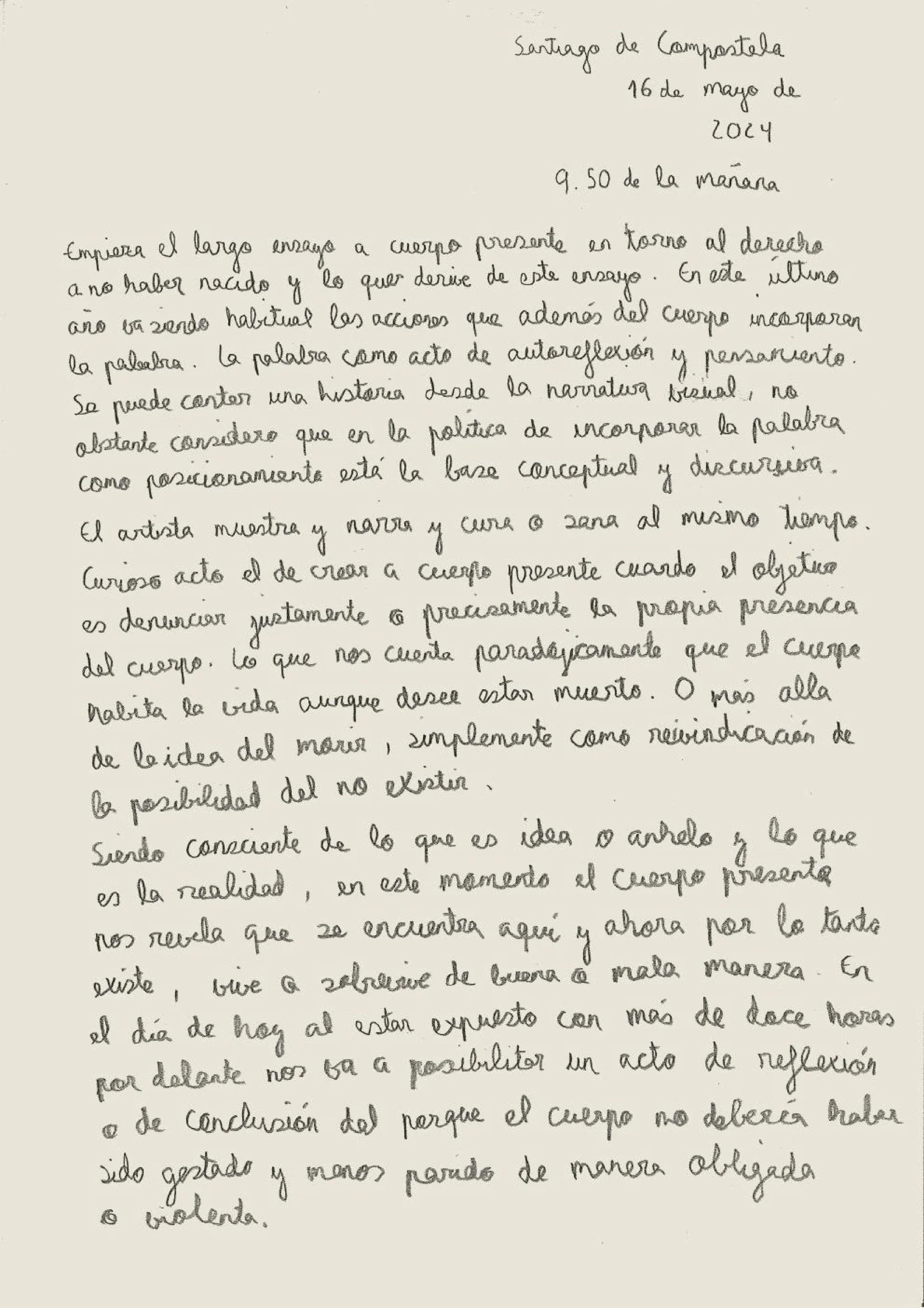
Santiago de Compostela, May 16, 2024. 9:50 in the morning.
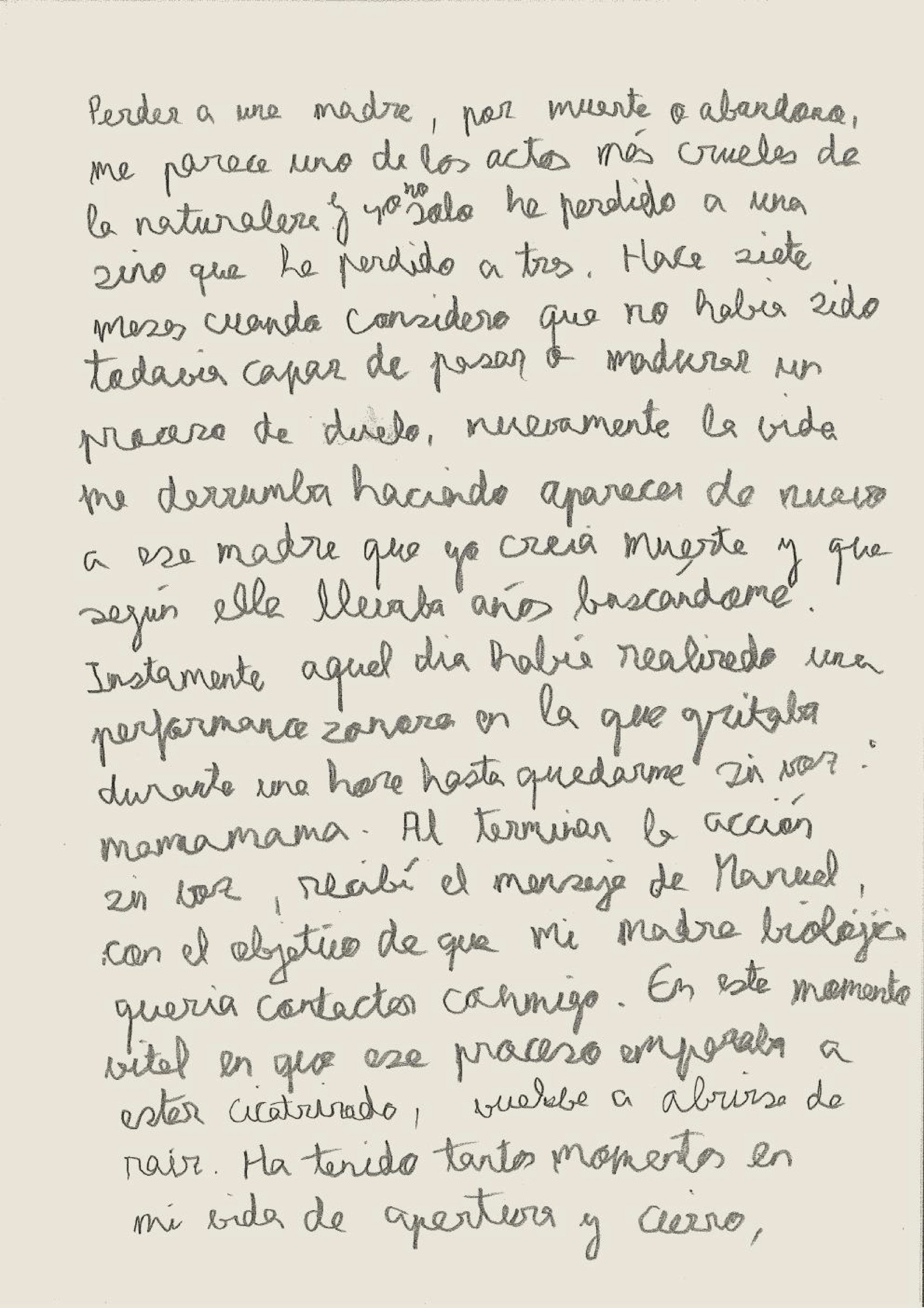
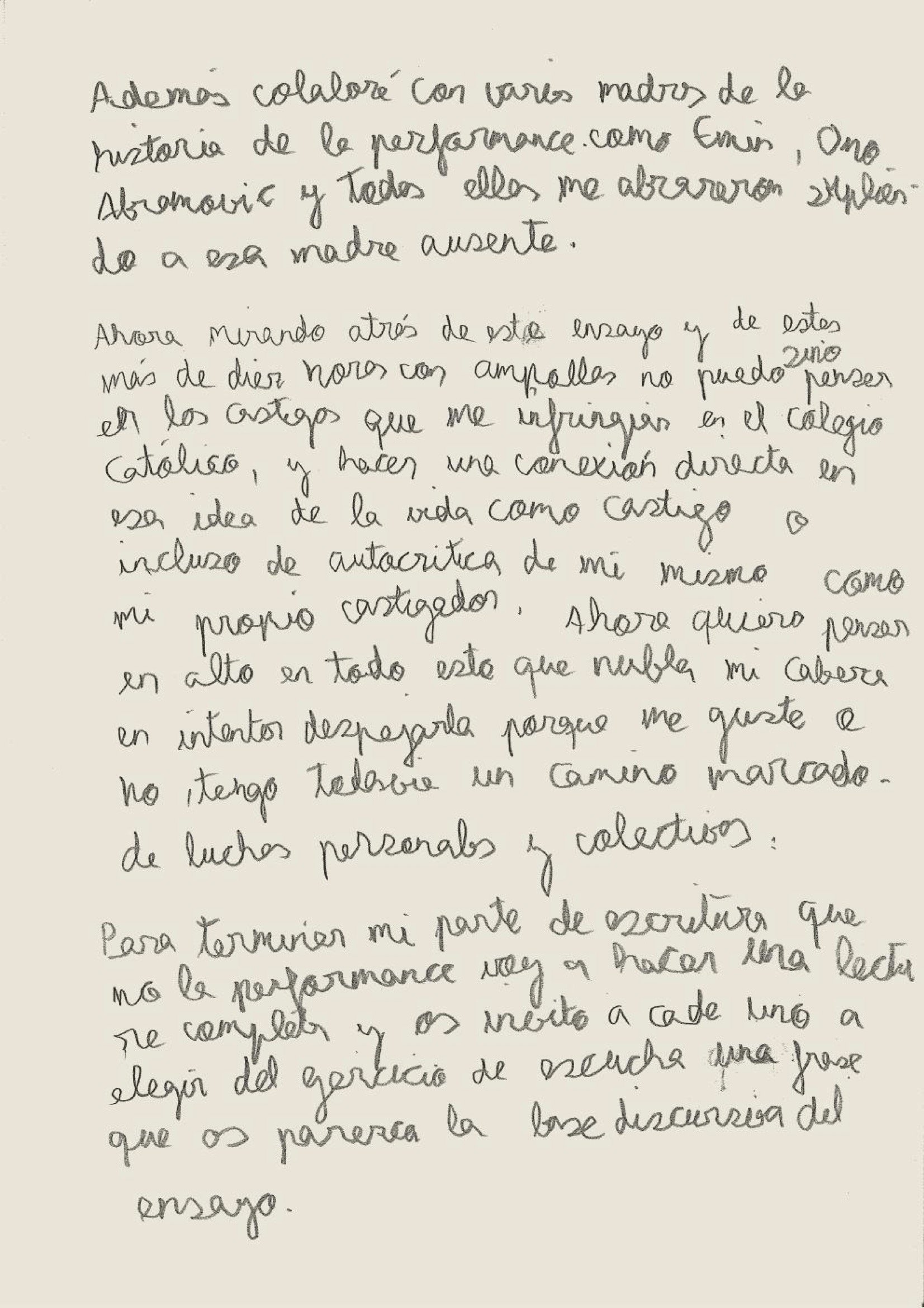
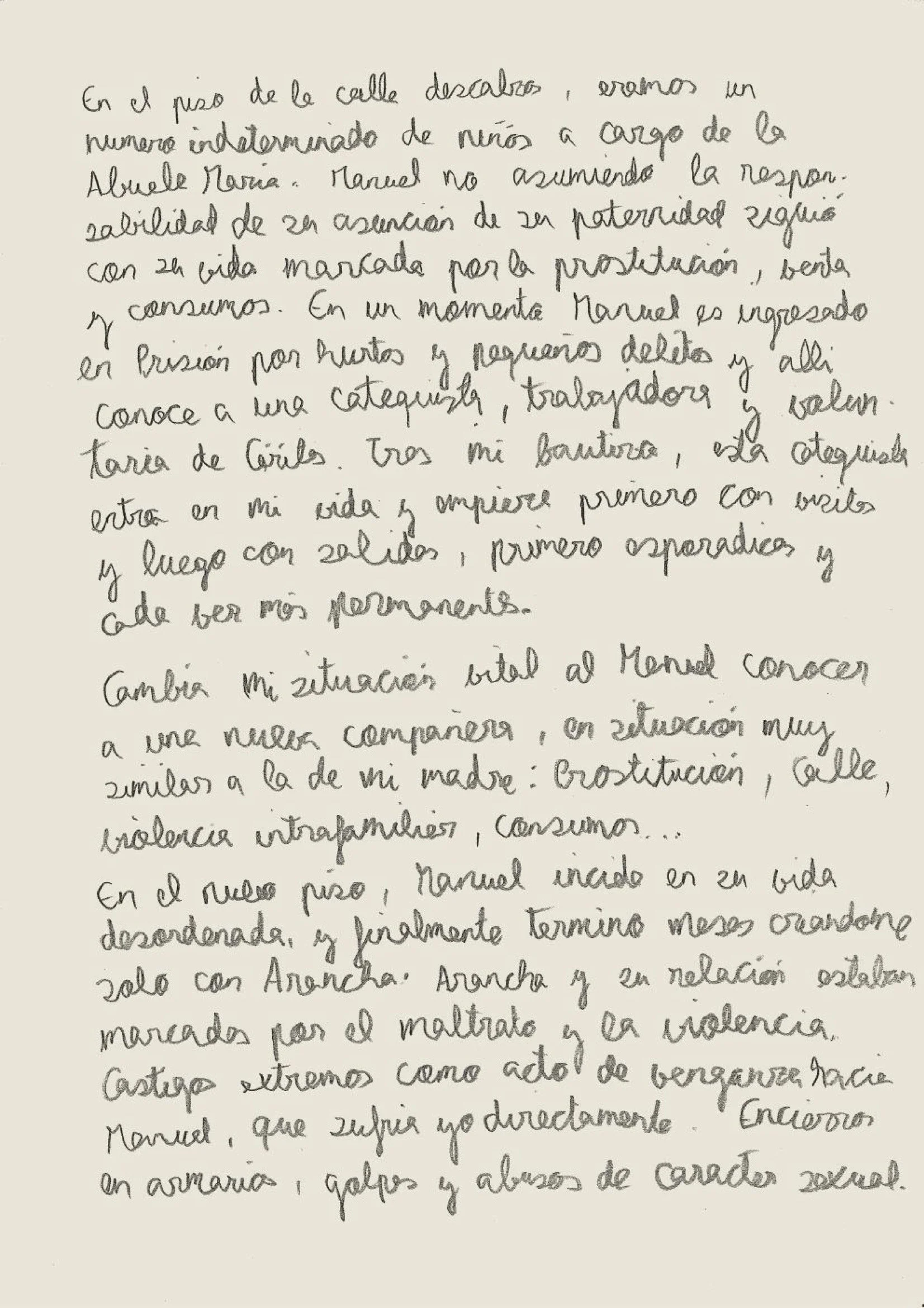
The long essay in the present body begins, concerning the right not to have been born and whatever may emerge from this essay. Over the past year, it has become increasingly common for actions to incorporate words as well as the body. Words as an act of self-reflection and thought. A story can be told through visual narrative; nevertheless, I consider that the policy of incorporating words as a form of positioning constitutes the conceptual and discursive foundation. The artist shows and narrates, and heals or cures at the same time. It is a curious act to create with the body present when the objective is precisely to denounce the body’s own presence. This paradoxically tells us that the body inhabits life even when it wishes to be dead. Or, beyond the idea of dying, simply as a vindication of the possibility of not existing.
Being aware of what is idea or desire and what is reality, at this moment the present body reveals that it is here and now; therefore it exists, lives or survives, in one way or another. Today, being exposed for more than twelve hours ahead of me will enable an act of reflection or a conclusion as to why the body should not have been conceived, and even less born, in an obligatory or violent manner.
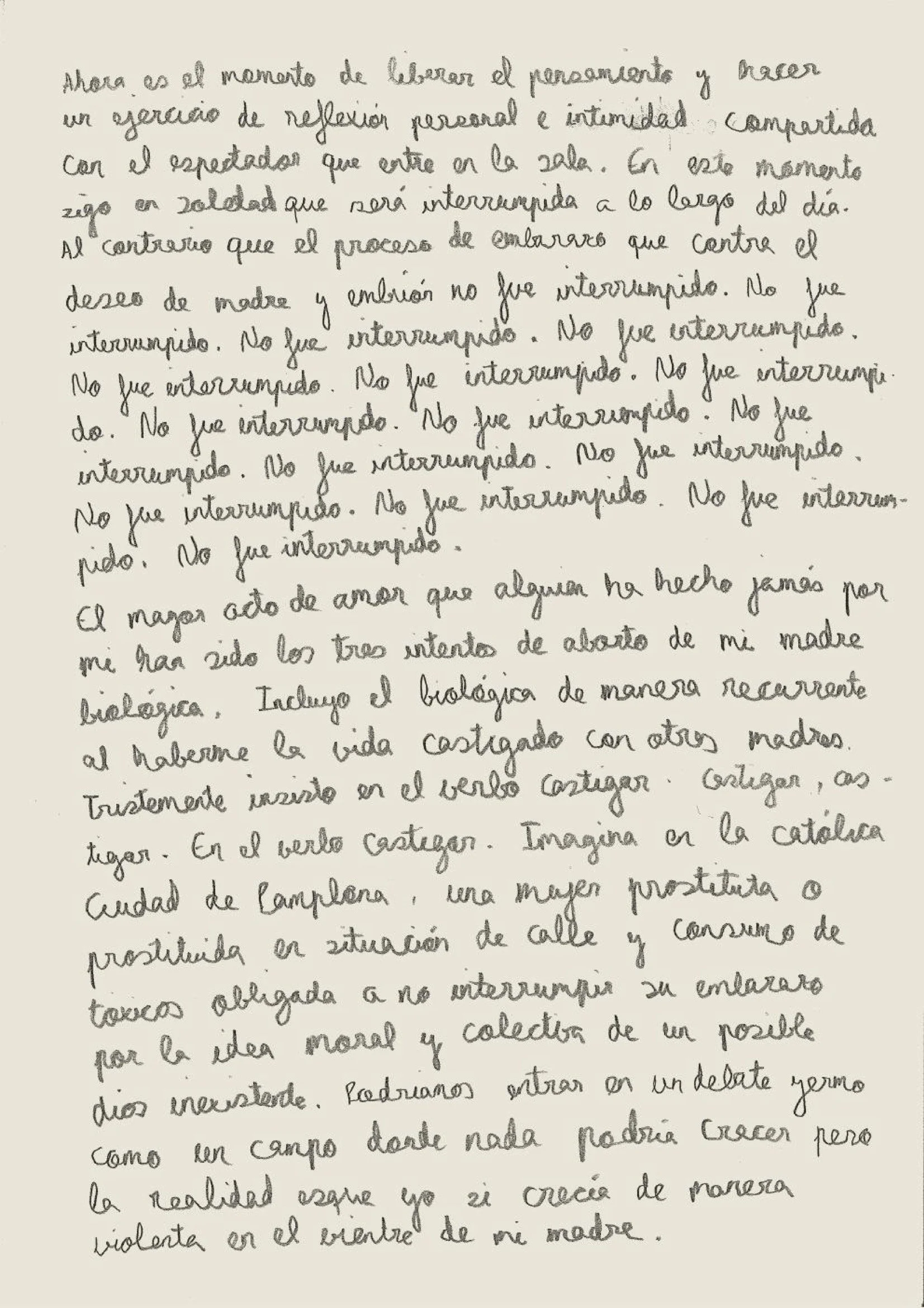
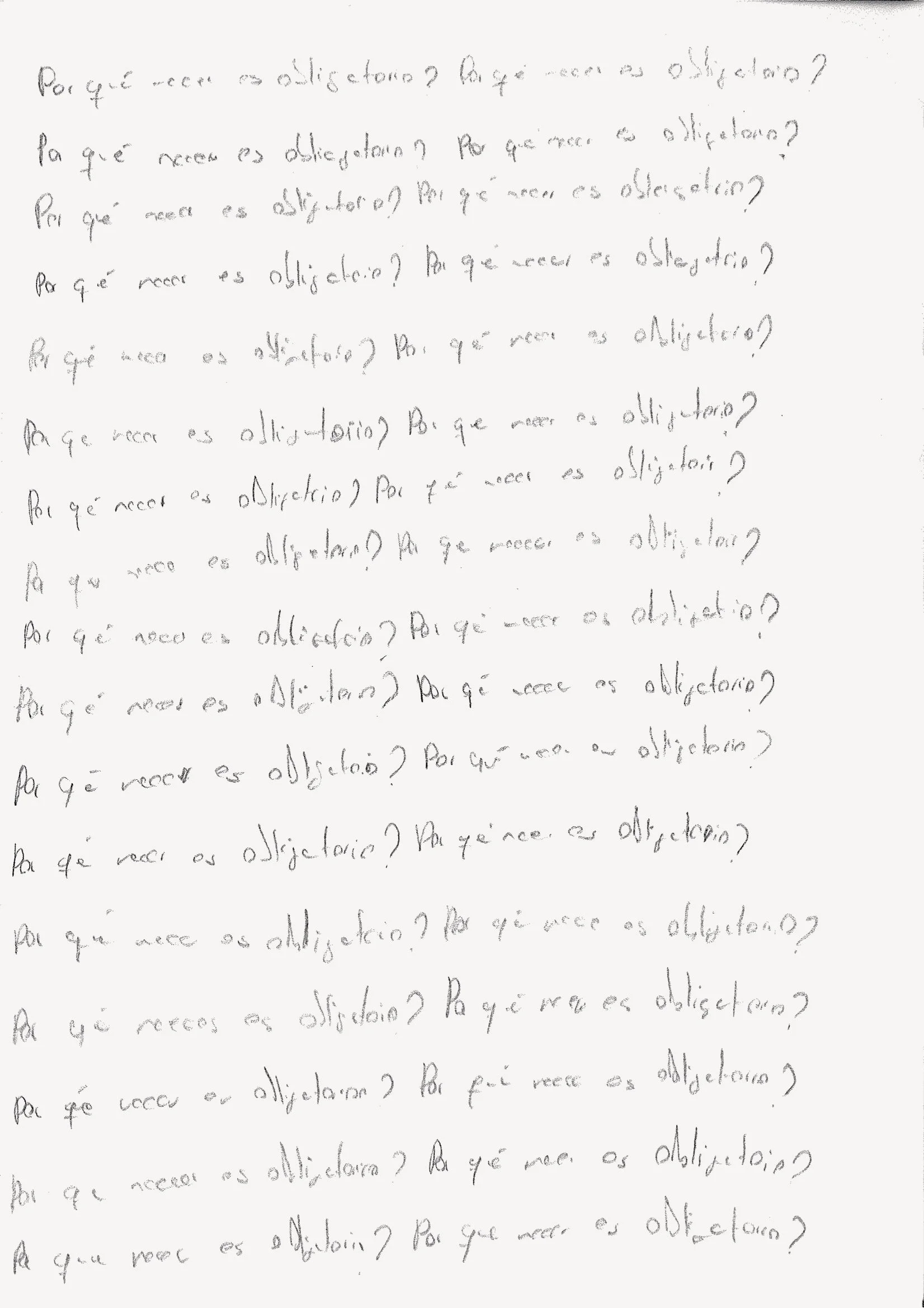
Now is the moment to free the mind and undertake an exercise in personal reflection and shared intimacy with the spectator who enters the room. At this moment I remain alone, a solitude that will be interrupted throughout the day. Unlike the process of pregnancy, which, against the wishes of the mother and the embryo, was not interrupted. It was not interrupted. It was not interrupted. It was not interrupted. It was not interrupted. It was not interrupted. It was not interrupted. It was not interrupted. It was not interrupted. It was not interrupted. It was not interrupted. It was not interrupted. It was not interrupted. It was not interrupted. It was not interrupted.
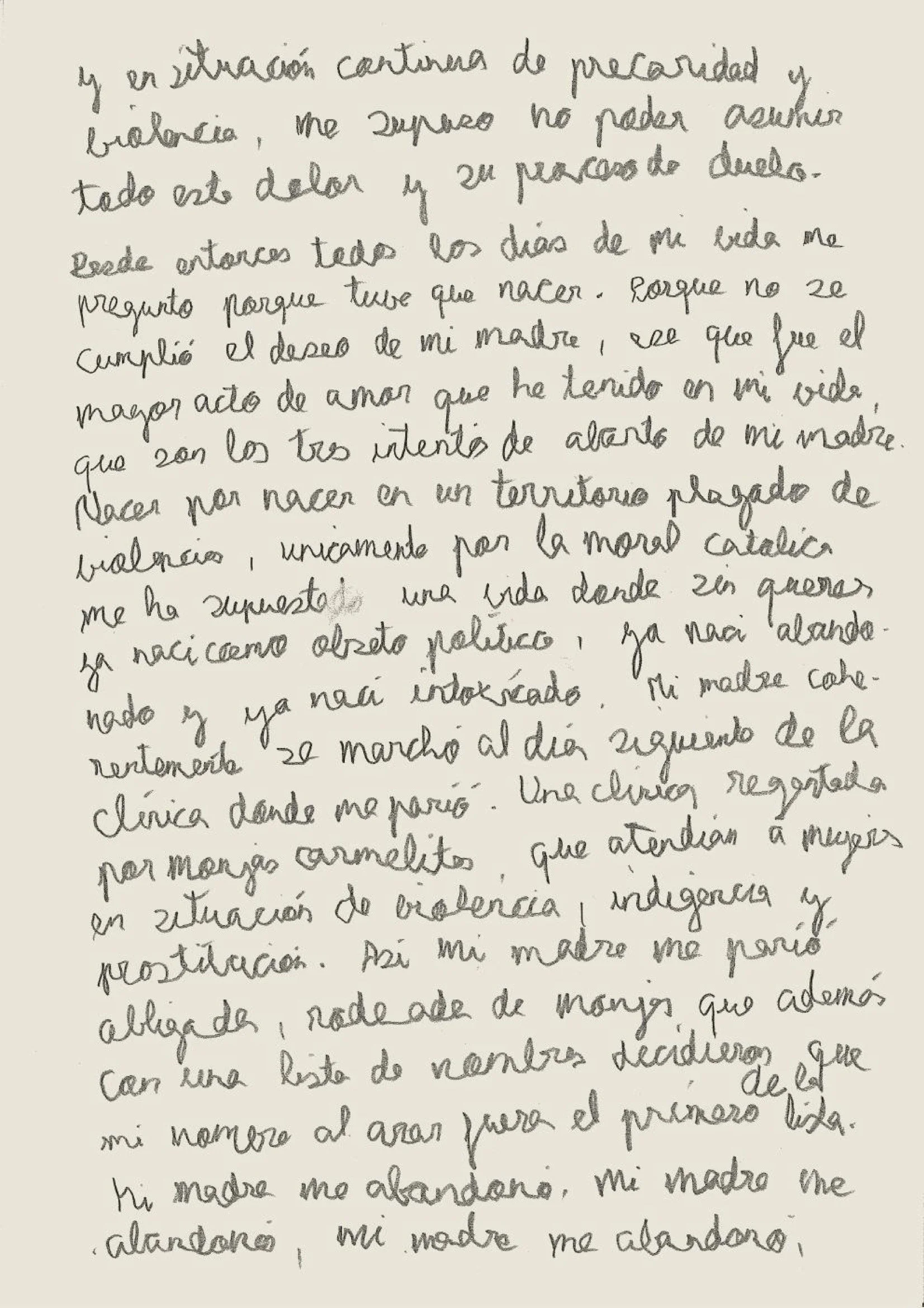
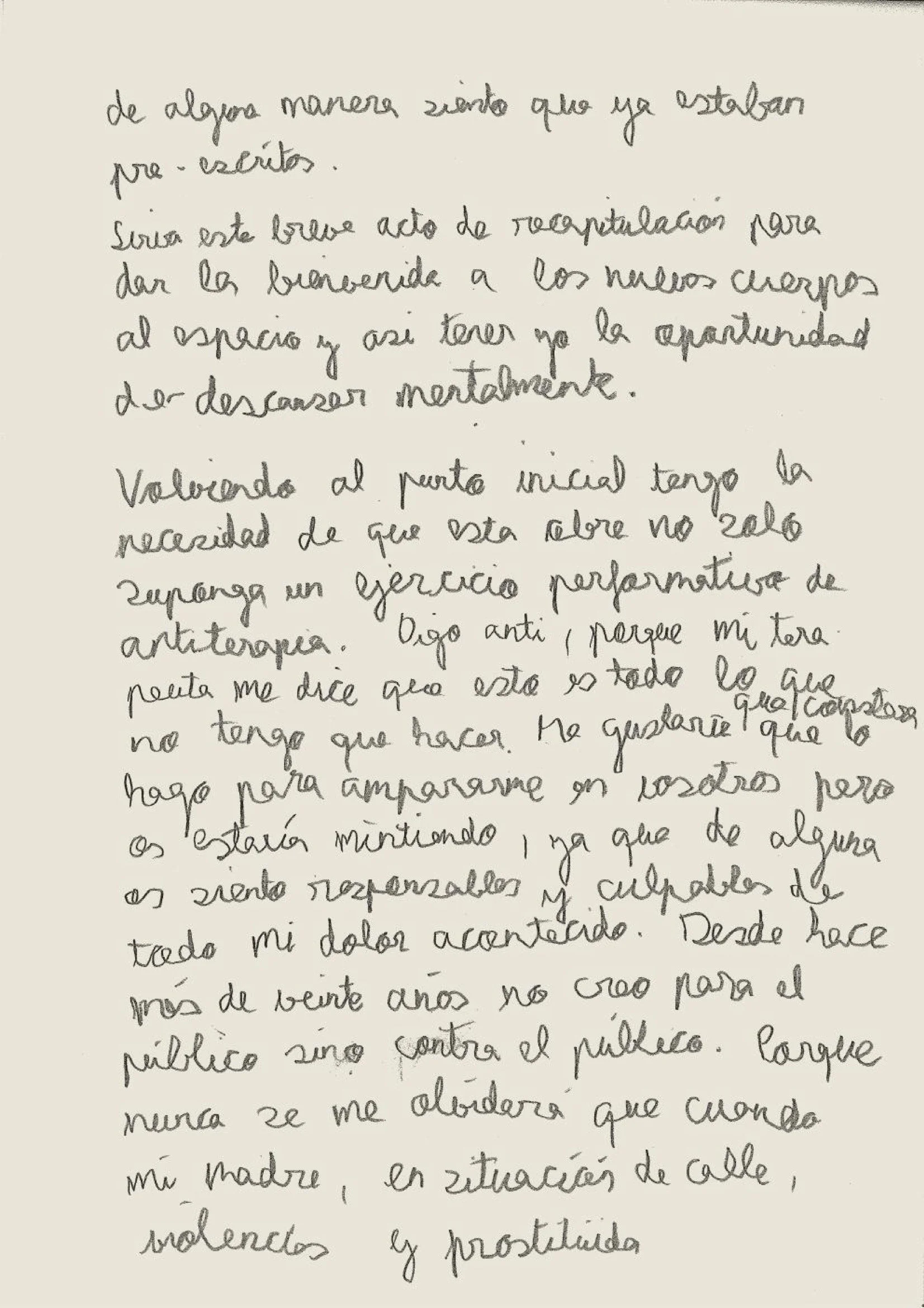
The greatest act of love anyone has ever performed for me were the three attempts at abortion made by my biological mother. I repeatedly include the word biological because life punished me with other mothers. Sadly, I insist on the verb to punish. To punish, to punish. On the verb to punish. Imagine, in the Catholic city of Pamplona, a woman who is a prostitute, or has been prostituted, living on the streets and consuming drugs, forced not to terminate her pregnancy because of the moral and collective belief in a possible nonexistent god. We could enter into a barren debate, like a field in which nothing could grow, but the reality is that I was growing violently inside my mother’s womb.
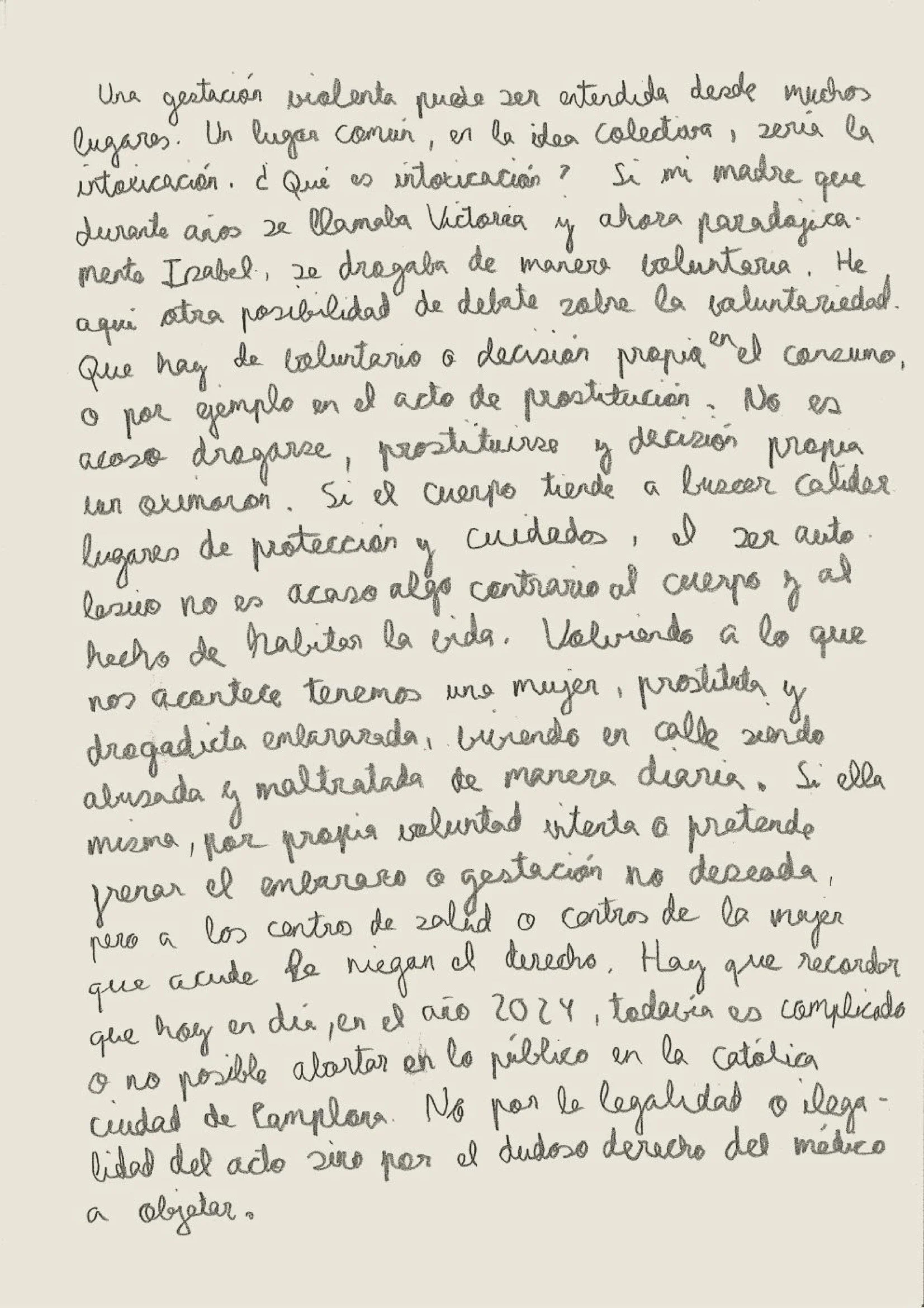
A violent pregnancy can be understood from many perspectives. A common one, in the collective imagination, would be intoxication. What is intoxication? If my mother, who for years was called Victoria and is now, paradoxically, Isabel, took drugs voluntarily. Here lies another possibility for debate concerning voluntariness. What is voluntary or a personal decision about drug use, or, for example, prostitution? Is taking drugs, prostituting yourself and considering it a personal decision not an oxymoron? If the body tends to seek warmth, places of protection and care, is self-harm not something contrary to the body and to the act of inhabiting life? Returning to what concerns us, we have a woman, a prostitute and drug addict, pregnant, living on the streets, being abused and mistreated on a daily basis. If she herself, of her own free will, attempts or intends to stop an unwanted pregnancy or gestation, but is denied that right by the health centres or women’s centres she attends. We must remember that even today, in 2024, it is still difficult, or impossible, to obtain an abortion through the public health system in the Catholic city of Pamplona. Not because of the legality or illegality of the act, but because of the questionable right of doctors to object.
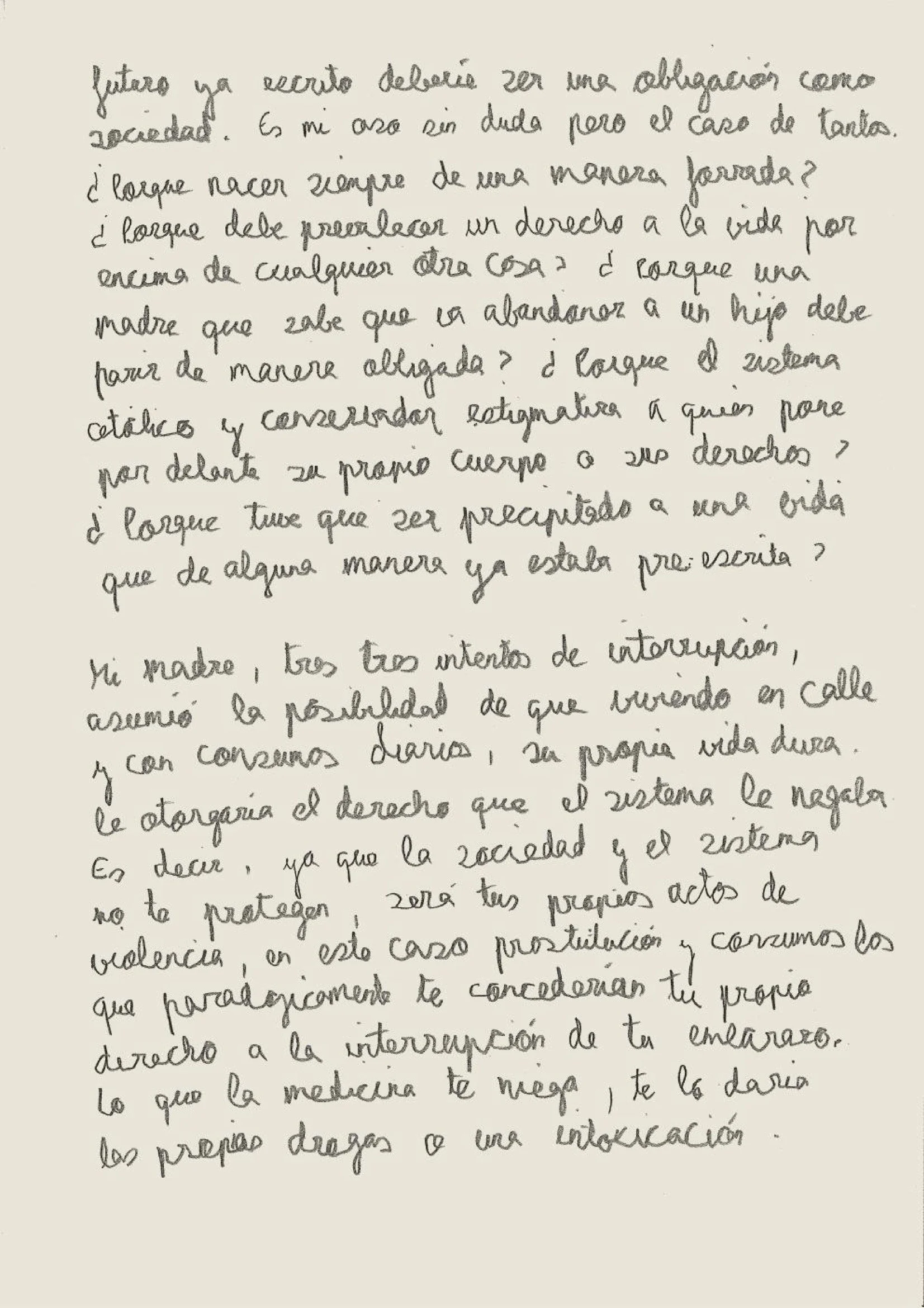
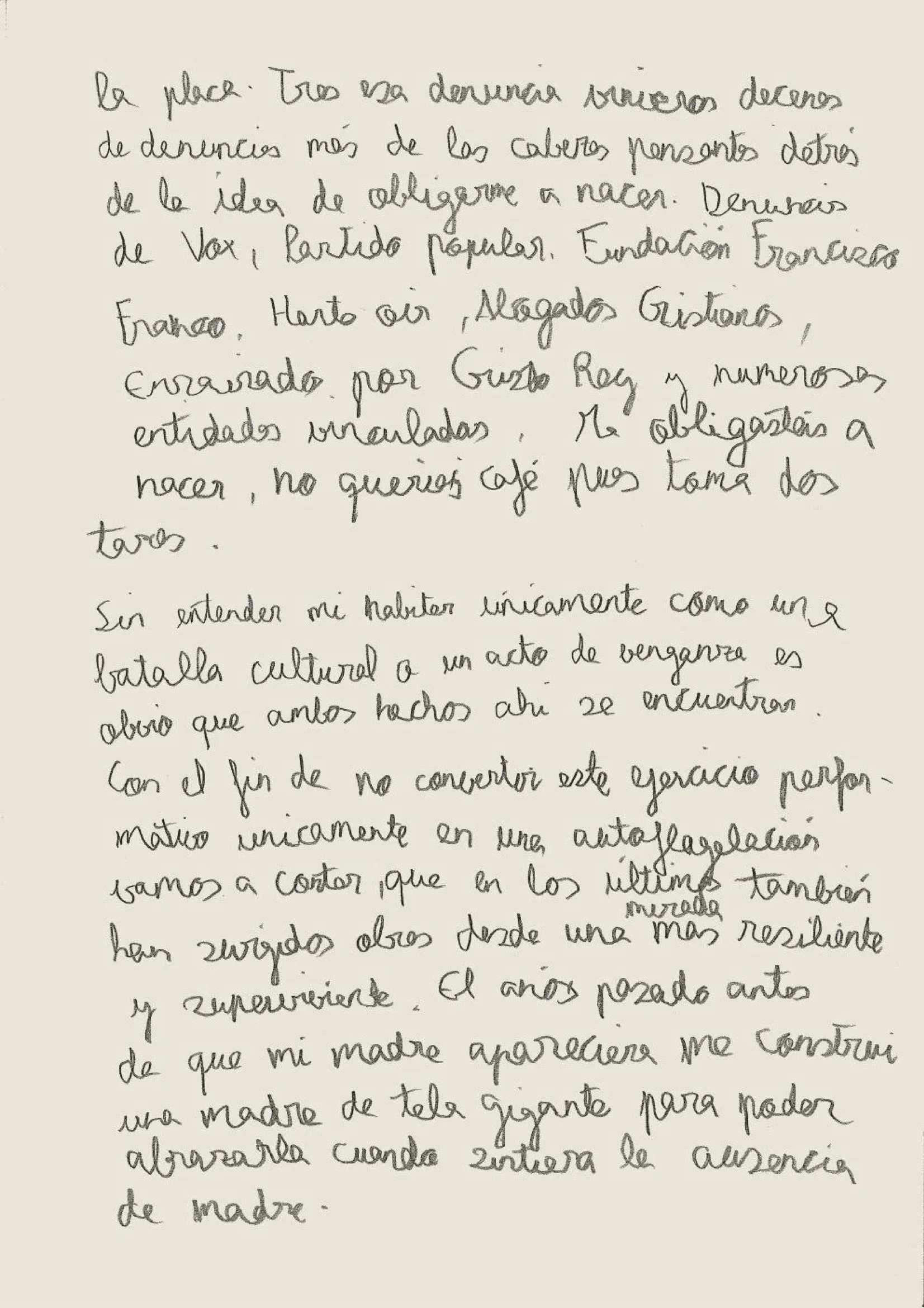
Conscientious objection is a questionable right that doctors, most of them trained at the Opus Dei University of Pamplona, use as an excuse to undermine women’s rights, such as choosing when and how to proceed with a pregnancy or even with its voluntary termination. At the ultra-Catholic university that trains doctors who are distributed throughout Spain, abortion or the right to abortion is not included at any point during the six years of the degree. Instead, there is a subject called Ethics, or Medical Ethics, created to help future doctors convince—I would say coerce—women not to terminate their pregnancies, not even in cases of sexual abuse or rape. That is the main reason why Pamplona, under the power of Opus Dei, does not allow women to exercise their unquestionable right to do whatever they want with their bodies. A clear example of how the Catholic religion seeks to assert its authority over our bodies. Because we must not forget that abortion is and will always be a woman’s right, but without a doubt it is also a measure for the protection of children. Since being born into a context of extreme precarity and violence, when it is possible to save the unborn child from an already-written future, should be a social obligation. It is my case, without a doubt, but also the case of many others. It is my case, without a doubt, but also the case of many others. Why must one always be born in a forced manner? Why should the right to life prevail above everything else? Why should a mother who knows she is going to abandon a child be forced to give birth? Why does the Catholic and conservative system stigmatise anyone who places their own body or rights first? Why was I thrust into a life that, in some way, had already been prescribed?
After three attempts to terminate the pregnancy, my mother accepted the possibility that, by living on the streets and using drugs every day, her own harsh life would grant her the right that the system denied her. In other words, since society and the system do not protect you, your own acts of violence—in this case prostitution and drug use—will paradoxically grant you your own right to terminate your pregnancy. What medicine denies you, the drugs or an intoxication would give you.
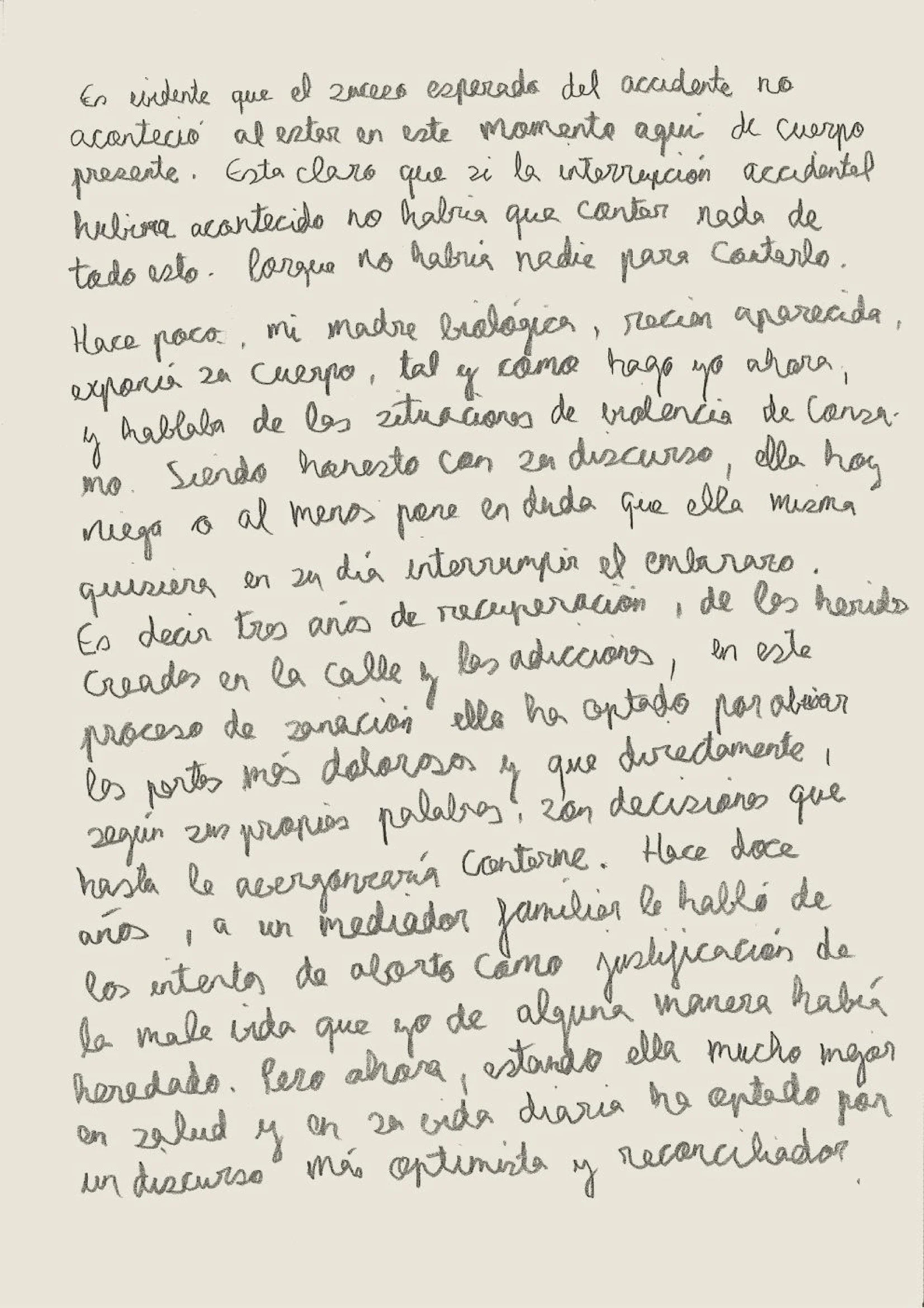
It is evident that the expected accident did not occur, since I am here at this moment, present in body. It is clear that if the accidental termination had occurred, there would be nothing to tell about any of this. Because there would have been no one to tell it.
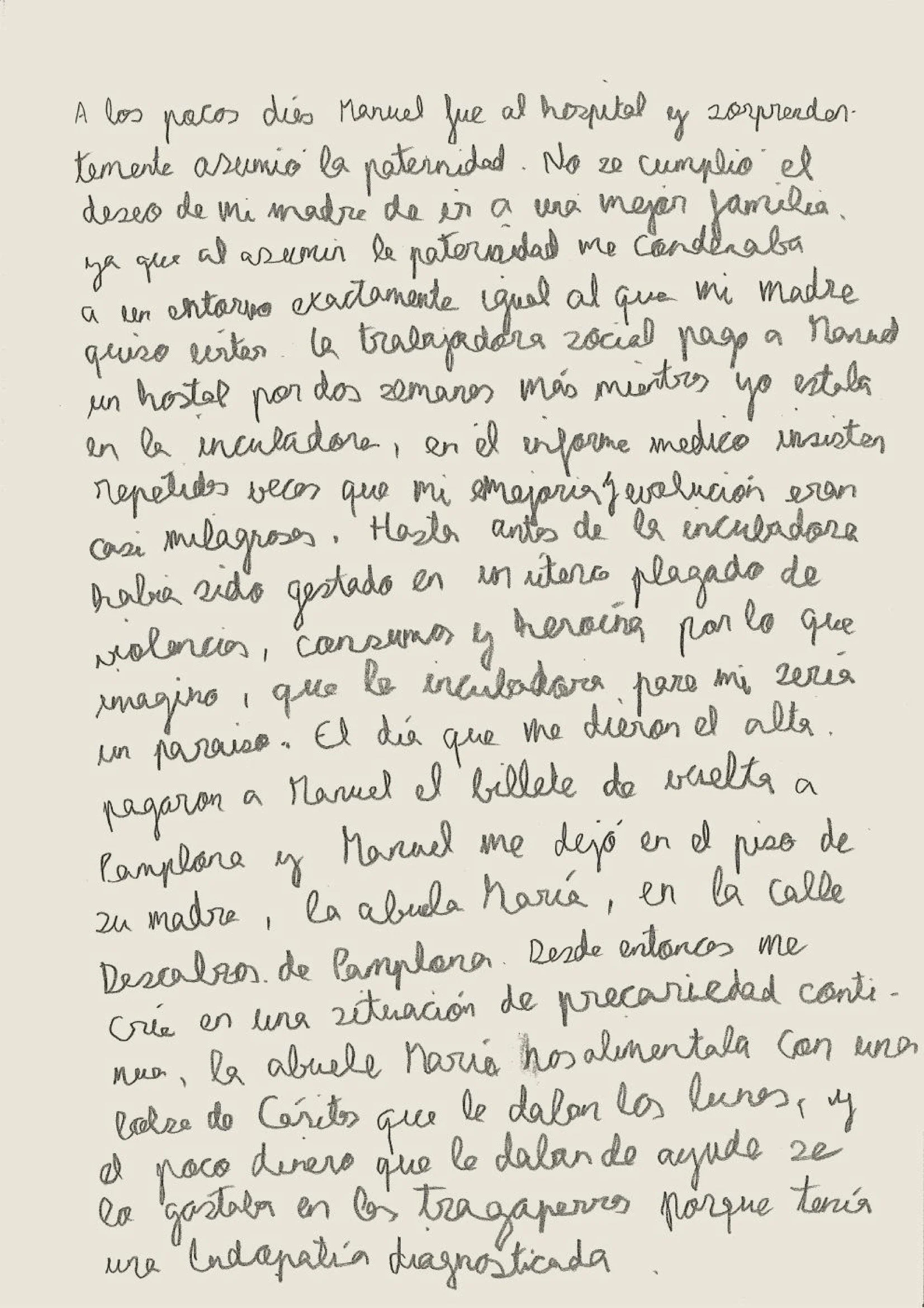
Some time ago, my biological mother, newly reappeared, exposed her body, just as I am doing now, and spoke about the violent circumstances surrounding drug use. Being honest with her account, she now denies, or at least questions, whether she herself wanted to terminate the pregnancy at the time. In other words, after years of recovering from the wounds created on the streets and by addiction, during this process of healing she has chosen to leave out the most painful parts and those that, directly, according to her own words, she would be ashamed to tell me. Twelve years ago, she spoke to a family mediator about the attempts to terminate the pregnancy as a justification for the difficult life that I had, in some way, inherited. But now, being much better in terms of her health and daily life, she has chosen a more optimistic and reconciliatory narrative.
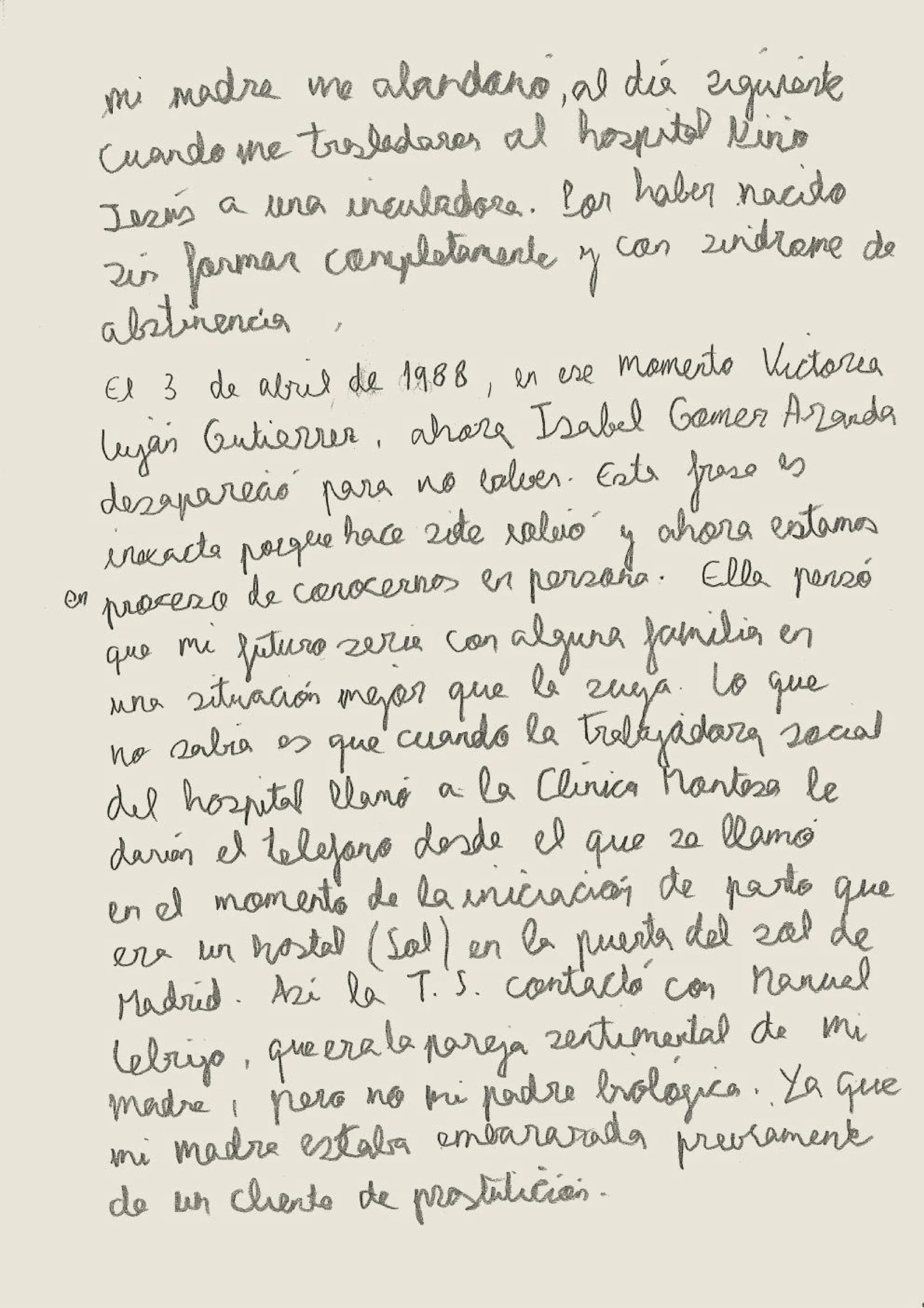
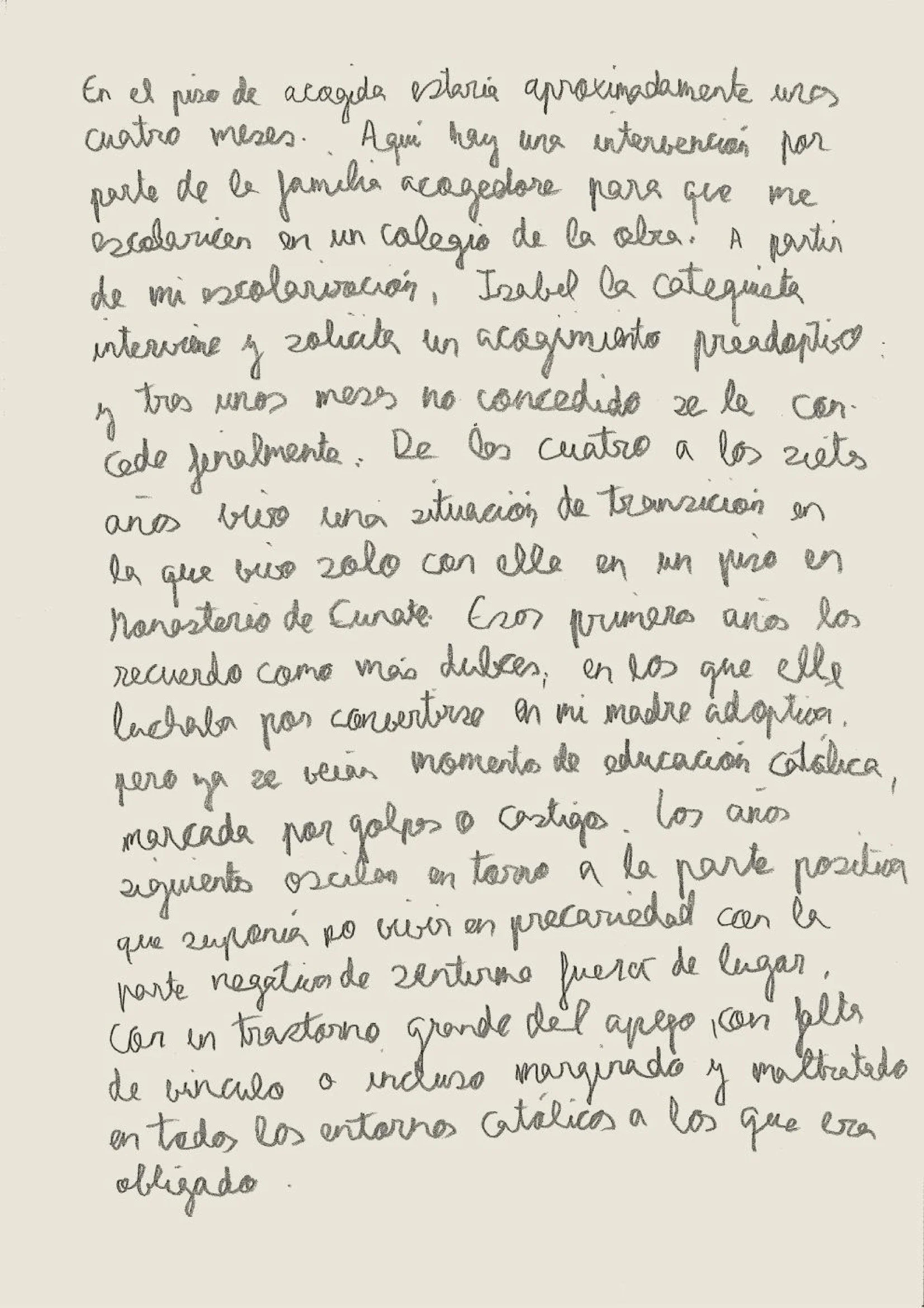
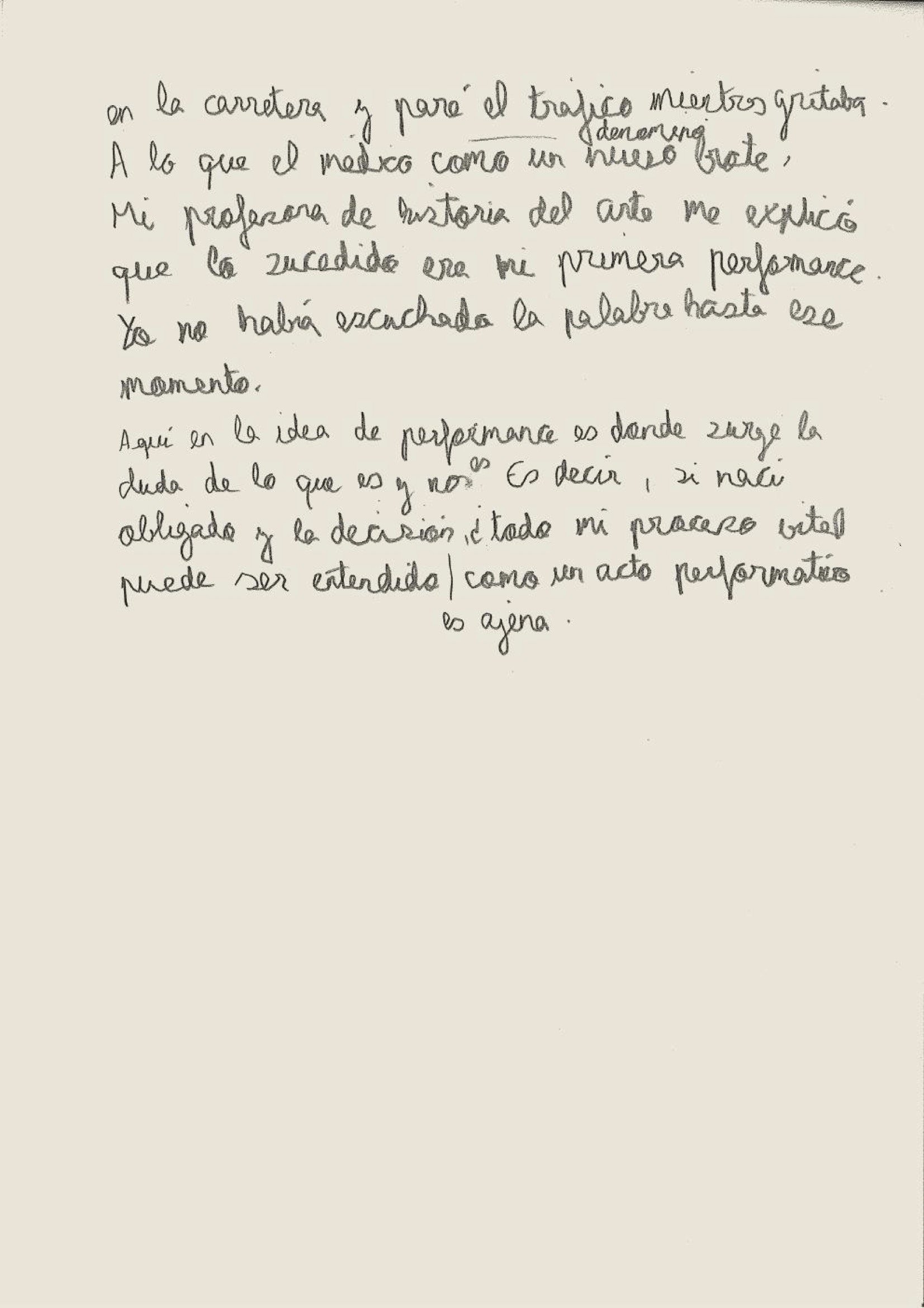
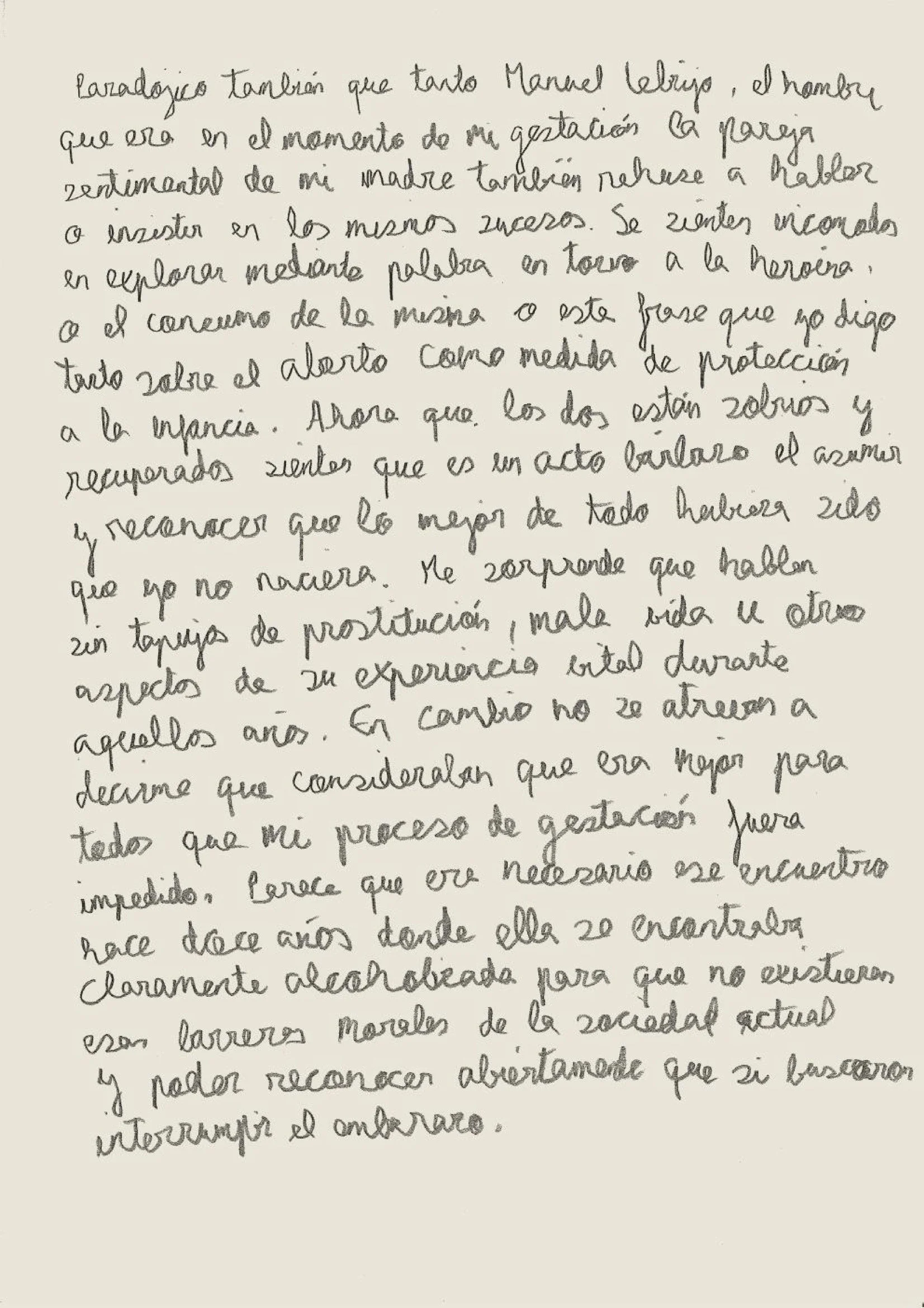
It is also paradoxical that Manuel Lebrijo, the man who was my mother’s partner at the time of my conception, also refuses to speak about or insist on the same events. They feel uncomfortable exploring, through words, the subject of heroin, or its use, or this statement that I repeat about abortion as a measure for the protection of children. Now that they are both sober and recovered, they feel that acknowledging and recognising that it would have been best for everyone if I had not been born is a barbaric act. It surprises me that they speak openly about prostitution, a difficult life and other aspects of their experience during those years. Yet they do not dare tell me that they believed it would have been better for everyone if my gestation had been prevented. It seems that it was necessary for that meeting twelve years ago, when she was clearly intoxicated with alcohol, for the moral barriers of present-day society not to exist and for her to be able to openly acknowledge that they had indeed sought to terminate the pregnancy.
Santiago de Compostela, 16 de mayo de 2024. 9:50 de la mañana.
Empieza el largo ensayo a cuerpo presente en torno al derecho a no haber nacido y lo que derive de este ensayo. En este último año va siendo habitual las acciones que además del cuerpo incorporan la palabra. La palabra como acto de autorreflexión y pensamiento. Se puede contar una historia desde la narrativa visual, no obstante considero que en la política de incorporar la palabra como posicionamiento está la base conceptual y discursiva. El artista muestra y narra y cura o sana al mismo tiempo. Curioso acto el de crear a cuerpo presente cuando el objetivo es denunciar justamente o precisamente la propia presencia del cuerpo. Lo que nos cuenta paradójicamente que el cuerpo habita la vida aunque desee estar muerto. O más allá de la idea del morir, simplemente como reivindicación de la posibilidad del no existir.
Siendo consciente de lo que es idea o anhelo y lo que es la realidad, en este momento el cuerpo presente nos revela que se encuentra aquí y ahora por lo tanto existe, vive o sobrevive de buena o mala manera. En el día de hoy al estar expuesto con más de doce horas por delante nos va a posibilitar un acto de reflexión o conclusión del porqué el cuerpo no debería haber sido gestado y menos parido de manera obligada o violenta.
Ahora es el momento de liberar el pensamiento y hacer un ejercicio de reflexión personal e intimidad compartida con el espectador que entre en la sala. En este momento sigo en soledad que será interrumpida a lo largo del día. Al contrario que el proceso de embarazo que contra el deseo de madre y embrión no fue interrumpido. No fue interrumpido. No fue interrumpido. No fue interrumpido. No fue interrumpido. No fue interrumpido. No fue interrumpido. No fue interrumpido. No fue interrumpido. No fue interrumpido. No fue interrumpido. No fue interrumpido. No fue interrumpido. No fue interrumpido. No fue interrumpido.
El mayor acto de amor que alguien ha hecho jamás por mí han sido los tres intentos de aborto de mi madre biológica. Incluyo el biológica de manera recurrente al haberme castigado la vida con otras madres. Tristemente, insisto en el verbo castigar. Castigar, castigar. En el verbo castigar. Imagina en la católica ciudad de Pamplona, una mujer prostituta o prostituida en situación de calle y consumo de tóxicos obligada a no interrumpir su embarazo por la idea moral y colectiva de un posible dios inexistente. Podríamos entrar en un debate yermo como un campo donde nada podría crecer pero la realidad es que yo sí crecía de manera violenta en el vientre de mi madre.
Una gestación violenta puede ser entendida desde muchos lugares. Un lugar común, en la idea colectiva, sería la intoxicación. ¿Qué es intoxicación? Si mi madre que durante años se llamaba Victoria y ahora paradójicamente Isabel, se drogaba de manera voluntaria. He aquí otra posibilidad de debate sobre la voluntariedad. ¿Qué hay de voluntario o decisión propia en el consumo, o por ejemplo en el acto de prostitución? ¿No es acaso drogarse, prostituirte y considerarlo una decisión propia un oxímoron? Si el cuerpo tiende a buscar calidez, lugares de protección y cuidados, el ser autolesivo no es acaso algo contrario al cuerpo y al hecho de habitar la vida. Volviendo a lo que nos acontece tenemos una mujer, prostituta y drogadicta embarazada, viviendo en calle siendo abusada y maltratada de manera diaria. Si ella misma, por propia voluntad intenta o pretende frenar el embarazo o gestación no deseada, pero a los centros de salud o centros de la mujer a los que acude le niegan el derecho. Hay que recordar que hoy en día, en el año 2024, todavía es complicado o no posible abortar en la sanidad pública en la católica ciudad de Pamplona. No por la legalidad o ilegalidad del acto sino por el dudoso derecho del médico a objetar.
La objeción de conciencia es un cuestionable derecho que médicos, en su mayor parte formados en la Universidad del Opus Dei de Pamplona, utilizan como excusa para dilapidar derechos de la mujer como elegir cuándo y cómo proceder en un proceso de gestación o incluso en la interrupción voluntaria del mismo. En la universidad ultracatólica que forma a médicos repartidos por todo el territorio español no se incluye el aborto o el derecho al mismo en ningún momento en los seis años de carrera y en cambio sí una asignatura bajo el nombre de Ética o ética médica creada para ayudar a los futuros doctores a convencer, yo diría coaccionar, a las mujeres a no interrumpir el embarazo, ni siquiera bajo abuso sexual o violación. Ese es el motivo principal, que Pamplona bajo el poder del Opus no posibilita a la mujer ejercer su derecho incuestionable de hacer con su cuerpo lo que quiera. Un claro ejemplo de cómo la religión católica pretende imperar sobre nuestros cuerpos. Porque no olvidamos que el aborto es y será siempre un derecho de la mujer pero sin duda, también una medida de protección a la infancia. Ya que nacer en contexto de extrema precariedad y violencia, en el caso de ser posible salvar al no nacido de un futuro ya escrito debería ser una obligación como sociedad. Es mi caso sin duda pero el caso de tantos. Es mi caso sin duda pero el caso de tantos. ¿Por qué nacer siempre de una manera forzada? ¿Por qué debe prevalecer un derecho a la vida por encima de cualquier cosa? ¿Por qué una madre que sabe que va a abandonar a un hijo debe parir de manera obligada? ¿Por qué el sistema católico y conservador estigmatiza a quien pone por delante a su propio cuerpo o sus derechos? ¿Por qué tuve que ser precipitado a una vida que de alguna manera ya estaba prescrita?
Mi madre, tras tres intentos de interrupción, asumió la posibilidad de que viviendo en calle y con consumos diarios, su propia vida dura le otorgaría el derecho que el sistema le negaba. Es decir, ya que la sociedad y el sistema no te protegen, serán tus propios actos de violencia, en este caso prostitución y consumos los que paradójicamente te concederían tu propio derecho a la interrupción de tu embarazo. Lo que la medicina te niega, te lo darían las propias drogas o una intoxicación.
Es evidente que el suceso esperado del accidente no aconteció al estar en este momento aquí de cuerpo presente. Está claro que si la interrupción accidental hubiera acontecido no habría que contar nada de todo esto. Porque no habría nadie para contarlo.
Hace poco, mi madre biológica, recién aparecida, exponía su cuerpo, tal y como hago yo ahora, y hablaba de las situaciones de violencia del consumo. Siendo honesto con su discurso, ella hoy niega o al menos pone en duda que ella misma quisiera en su día interrumpir el embarazo. Es decir tras años de recuperación, de las heridas creadas en la calle y las adicciones, en este proceso de sanación ella ha optado por obviar las partes más dolorosas y que directamente, según sus propias palabras, son decisiones que hasta avergonzaría contarme. Hace doce años a un mediador familiar le habló de los intentos de aborto como justificación de la mala vida que yo de alguna manera había heredado. Pero ahora, estando ella mucho mejor en salud y en su vida diaria ha optado por un discurso más optimista y reconciliador.
Paradójico también que tanto Manuel Lebrijo, el hombre que era en el momento de mi gestación la pareja sentimental de mi madre también rehúsa a hablar o insistir en los mismos sucesos. Se sienten incómodos en explorar mediante palabra en torno a la heroína, o el consumo de la misma o esta frase que yo digo tanto sobre el aborto como medida de protección a la infancia. Ahora que los dos están sobrios y recuperados sienten que es un acto bárbaro el asumir y reconocer que lo mejor de todo hubiera sido que yo no naciera. Me sorprende que hablan sin tapujos de prostitución, mala vida u otros aspectos de su experiencia vital durante aquellos años. En cambio no se atreven a decirme que consideraban que era mejor para todos que mi proceso de gestación fuera impedido. Parece que era necesario ese encuentro hace doce años donde ella se encontraba claramente alcoholizada para que no existieran esas barreras morales de la sociedad actual y poder reconocer abiertamente que sí buscaron interrumpir el embarazo.
Hasta la 8 no incluida.






News following the inauguration and performance of the artist Abel Azcona in Santiago de Compostela. / Noticias a raiz de la inauguración y performance del artista Abel Azcona en Santiago de Compostela.